Longevity & Science · Explainer
Crepey Arm Skin After Weight Loss: What’s Actually Happening Beneath the Surface
Weight loss is supposed to improve how skin looks and feels. For many women in their forties and fifties, the arms are a frustrating exception — and the reason is structural, not superficial.

The expectation is reasonable: lose weight, look better. And for most of the body, that expectation holds. Belly, hips, face — the reduced volume tends to translate into a leaner, tighter appearance. The arms, for many women who lose significant weight in middle age, are a different story. The fat goes. The skin doesn't recover the way it should. Instead, it settles into a papery, crinkled texture that wasn't there — or wasn't as visible — before the weight loss.
This isn't a paradox. It's the predictable result of two separate processes converging: the mechanical role that subcutaneous fat was playing in the arm, and the slower background shift in dermal structure that was happening independently. When fat loss removes the first, it makes the second suddenly visible. Understanding the distinction matters, because it determines what interventions have any realistic chance of helping.
What subcutaneous fat was doing for the arm
Subcutaneous adipose tissue — the fat layer that sits between skin and muscle — is not purely an energy reservoir. It plays a direct mechanical role in how skin behaves on the surface. Specifically, it provides a volumetric substrate: a surface for the dermis to rest on that distributes load, provides buoyancy, and allows the overlying skin to maintain tension without relying entirely on its own structural properties.
The upper and inner arm contains a particularly variable amount of this subcutaneous fat, which is why it's often one of the first places to show volume changes with weight gain or loss. In a heavier state, the fat fills the space beneath the skin, and even a dermis with diminished structural density can look smooth and taut — because it has volume underneath it providing that effect.
When significant weight loss reduces the subcutaneous layer, the dermis is required to maintain its surface appearance entirely through its own structural properties. Collagen fibre density, elastin cross-linking, and overall dermal thickness all become the primary determinants of what the arm looks like — instead of being secondary contributors supported by the fat layer below.
The crepey texture that appears after weight loss is not new skin damage. It is the dermal condition that was already developing — now revealed without the volumetric buffer that was partially concealing it.
The dermal changes that were already underway
Collagen and elastin production in the dermis begins declining gradually after the mid-twenties. The decline is slow enough that it typically goes unnoticed for years — the body's repair mechanisms keep pace, and the fat layer beneath provides its compensating volume. The visible inflection point for most women arrives in the forties, when two things converge: the cumulative collagen loss becomes significant enough to affect skin behavior, and estrogen — which actively supports dermal collagen density — begins its perimenopausal decline.
Collagen fibres in the dermis provide structural thickness and rigidity. Elastin fibres determine the skin's snap-back behavior after stretching or compression. Both decline with age, and both are affected by chronic UV exposure — which accumulates disproportionately on the outer arm surface over decades of outdoor activity where facial sunscreen habits weren't extended to the arm.
Weight loss doesn't cause this dermal decline. But the volume reduction it produces in the subcutaneous layer removes the compensating support that was masking it. The arms that had adequate subcutaneous fat to fill the dermis smoothly may not have adequate dermal structure to support themselves once the fat is gone.
Why the arm is particularly vulnerable
Several anatomical factors make the upper and inner arm more susceptible to this change than most other areas:
- Thinner dermis. The skin of the upper arm is structurally thinner than skin on the thigh, back, or face. It has less intrinsic dermal density to draw on when subcutaneous support is reduced.
- Less structural backing from below. Unlike the thigh or calf — where skin sits over organized, active muscle — the inner arm overlies loosely organized connective tissue. There is less structural support from below to compensate for what's happening above.
- Chronic UV accumulation. The outer surface of the upper arm accumulates decades of UV exposure that most people don't consciously protect. UV radiation causes direct degradation of dermal collagen and elastin fibres, independent of the age-related decline occurring simultaneously.
- Gravitational loading. Skin on the inner arm hangs dependent — it's subject to consistent gravitational pull in a way that upper-body areas with more muscular support are not. As dermal tension decreases, gravitational effects become more visible.
Why topical approaches have limited reach here
Moisturizers and firming creams are formulated to act on the epidermis — the outermost surface layer of the skin. They improve surface hydration, reduce the appearance of dryness, and may temporarily affect how fine lines look at the surface. They do not penetrate the dermis in any meaningful way.
This is not a failure of formulation — it's a boundary the skin's own barrier function maintains by design. The structural changes determining arm skin texture occur in the dermis, which is separated from the epidermis by the dermo-epidermal junction. Topical products applied to the surface cannot cross that boundary to affect collagen density or elastin organization in the structural layer.
This is why women who are diligent about topical skin care — daily moisturizing, broad-spectrum UV protection, retinoids — still find this texture developing on their arms after weight loss. The surface is maintained. The structural layer is a separate system.
The cofactor question in collagen production
A common response to crepey skin is to add collagen peptides — oral supplementation with the building blocks of the protein itself. The logic is intuitive: if the dermis needs more collagen, supply more collagen. The evidence for collagen peptide supplementation shows modest, real effects in controlled trials. But for many women, the result is underwhelming relative to expectation.
The reason may not be material supply. The fibroblasts that manufacture collagen continue functioning into middle age and beyond. The limitation, increasingly well-documented, is cofactor availability — the specific nutrients the collagen assembly process depends on to produce structurally sound output.
Two are particularly critical:
- Vitamin C. The collagen molecule achieves its characteristic triple-helix structure through a process dependent on two enzymes — prolyl hydroxylase and lysyl hydroxylase — both of which require vitamin C as a cofactor. Without adequate vitamin C, these enzymes cannot complete the hydroxylation reactions that stabilize the helix. The resulting collagen fibres are structurally inferior — produced at normal rates but not properly assembled. This is established biochemistry, not a supplement marketing claim; it underpins the connective tissue pathology of vitamin C deficiency.
- Copper. Once collagen and elastin fibres are produced, they must be cross-linked into a stable, organized network to provide dermal tensile strength. That cross-linking is performed by lysyl oxidase, an enzyme that requires copper to function. Without adequate copper for lysyl oxidase activity, the fibres are synthesized but cannot be properly organized — the dermis contains the raw components of structure without the bonds that make structure functional.
Zinc completes the picture: it supports normal skin cell turnover and the continuous dermal maintenance processes that run throughout life. Its effects are less dramatic than vitamin C or copper, but inadequate zinc levels reduce the pace of normal dermal renewal.
The practical implication: if collagen peptide supplementation has produced limited results, the bottleneck is more likely the assembly process than the raw material. Addressing the cofactors that determine assembly quality may be the more productive intervention.
Referenced in this article
VitaRenew
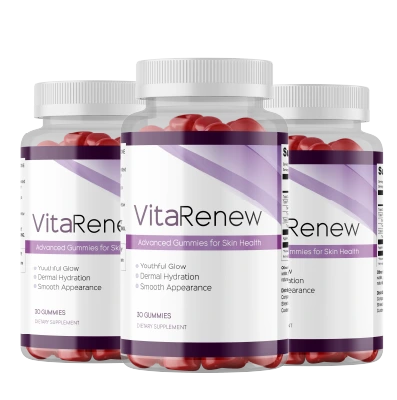
A daily gummy formulated around the cofactors dermal collagen synthesis depends on — vitamin C, copper, and zinc — plus antioxidant support. Made in an FDA-registered, GMP-certified facility. The 2-bottle kit is a practical starting point.
Built around the process, not just the material.
60-day money-back guarantee · One-time purchase, no subscriptionWhat a realistic response timeline looks like
The dermis does not remodel quickly. The epidermis turns over every four to six weeks — which is why surface texture and hydration respond relatively fast to topical changes. The dermis operates on a longer cycle: most controlled intervention studies of skin-directed supplementation measure outcomes at eight to twelve weeks minimum, with structural changes continuing to accumulate beyond that window.
The arm is also slower to respond than the face: it has lower vascularity, less frequent mechanical stimulation, and greater historical UV damage to contend with. Realistic markers — if an approach is working — tend to appear at six to eight weeks as a subtle change in how the skin feels when compressed, and become more clearly visible by twelve to sixteen weeks.
Photography under consistent conditions is useful here: the eye adapts to gradual change more efficiently than a comparison image does. Starting the 2-bottle kit gives sixty days of consistent use within the guarantee window — enough to form a reasonable initial assessment before extending the protocol.
"I'd expected the weight loss to help my arms. Instead they looked worse — loose and papery in a way I hadn't anticipated. I started looking at this from the inside rather than the outside, focused on the structural side. The difference at three months was noticeable — not complete, but real enough that I stopped feeling self-conscious in short sleeves."
"I'd been using collagen powder for over a year with minimal results. The switch to a formulation that addresses the cofactors — what the assembly process actually needs — made a difference that the raw material alone hadn't. Texture on my inner arms is still there but noticeably less pronounced."
These statements reflect individual experiences. Results are not typical and will vary from person to person.
A note on what VitaRenew is and isn’t
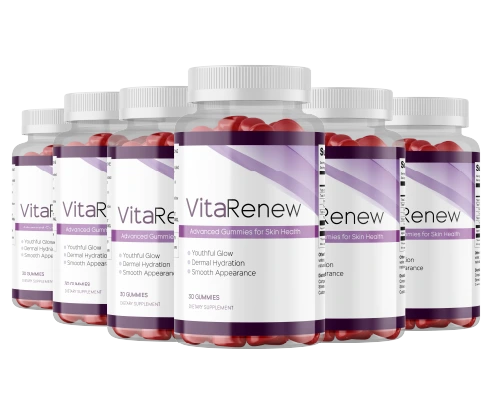
VitaRenew is a daily gummy supplement containing vitamin C, zinc, and copper, with additional antioxidant support from vitamin E, selenium, and beta-carotene. It is made in an FDA-registered, GMP-certified facility in the United States. It supports skin, hair, and nail health — it makes no claims about treating, curing, or reversing any condition, because it is a supplement, not a pharmaceutical, and should not be described as one.
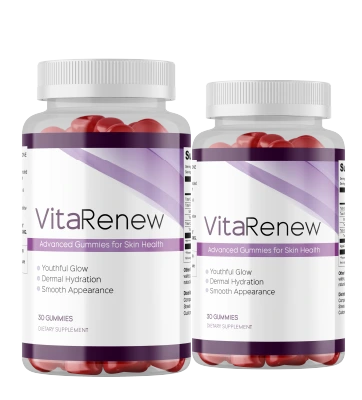
The 2-bottle option is the practical entry point: two months of consistent use under a 60-day money-back guarantee, sufficient time to observe whether the approach is producing any meaningful effect before extending the protocol. Collagen remodelling is slow. Patience is required. But the direction of the intervention — addressing the structural layer from the inside rather than the surface — is the one aligned with where the problem actually starts.
Product referenced above
VitaRenew
Vitamin C, copper, and zinc in a daily gummy. Supports the internal scaffolding skin structure depends on. No autoship.
For the layer the cream was never designed to reach.
60-day money-back guarantee · Supports skin, hair and nails