Skin Health · Explainer
Why Skin Gets Crepey After Weight Loss — And What the Dermal Matrix Needs
You did everything right. The number moved. But the skin on your arms, belly and inner thighs is loose and crinkled — and a richer cream was never going to change it.

You celebrated the milestone. The pants from a couple of years ago finally buttoned. The photographs started to look the way you remembered feeling. And then you lifted your arm in a dressing room under fluorescent light and saw something you hadn't expected — a loose, crinkled fold where the volume used to be.
It looks like what people call crepey skin, but with an added element: it arrived as the weight came off. And it feels, somehow, like the wrong reward for all that work.
Before we get into the biology — and we will — two things are worth saying clearly.
The first is that this is not your fault, and it is not a verdict on how you lost the weight. It happens to people who lost slowly, to people who lost quickly, to people who exercised throughout and to people who didn't. It is not a consequence of something you did wrong.
The second is that the standard explanation — "you lost too fast" or "you just have to accept it" — is incomplete. The more useful question is what's actually happening in the skin right now, and what, if anything, the skin's structural layer needs to recover.
The crepey texture after weight loss isn't the skin losing something during the diet. It's the skin being exposed — to a structural deficit that was quietly accumulating long before the first pound came off.
What the fat underneath was actually doing
Under the visible surface of skin sits a layer of subcutaneous fat. Its most visible function — the one that matters here — is to plump the skin from within. Fat fills the space between the dermis and the structures beneath it, keeping skin inflated and smooth against the surface.
Think of a fitted sheet on a bed. With the mattress in place, the sheet lies smooth and taut. Remove part of the mattress and the same sheet, completely unchanged, gathers and crinkles. Nothing happened to the sheet. The internal support changed.
When you lose a meaningful amount of weight, the subcutaneous fat layer thins. If the dermis above it — the deeper structural layer of skin — still had its full architecture of collagen and elastin, it would often retract and redrape reasonably well. But if that architecture had already thinned with age, there isn't enough recoil left to take up the slack.
What you see on your upper arms and abdomen isn't skin that was damaged during the diet. It's skin whose internal scaffold had been gradually thinning for years — with fat compensating for the deficit by keeping it plumped — and now, with the compensation removed, the deficit is visible for the first time.
The deficit that was already building
Collagen production begins declining from the mid-twenties — slowly, roughly one percent per year by commonly cited estimates. For a long time, that rate is imperceptible. Nobody notices it year by year.
What changes the equation is perimenopause. Estrogen supports collagen density and skin thickness, and as estrogen levels fall through the perimenopausal years, dermal collagen loss accelerates. Research on skin changes around this transition has found that a meaningful share of skin collagen can be lost within a short window of years surrounding it.
So by the time a woman in her forties or early fifties reaches a significant weight-loss milestone, the dermis has often already lost substantial thickness and elasticity. The fat has been papering over this by keeping the skin inflated. When the fat thins, the paper comes down.
The places this shows most acutely — upper arms, abdomen, inner thighs — tend to be places where the skin was most distended by fat and is thinnest to begin with.
Why creams have a ceiling
The two most common responses to this kind of skin are moisturizer and body lotion, applied more diligently. Both genuinely help — temporarily — in the same way that dampening a crinkled cloth smooths it briefly. The outer skin barrier hydrates, light reflects more evenly, and the texture looks finer for a few hours.
By evening, it's back. Nothing structural changed, because nothing structural was ever reached.
Creams and lotions act on the stratum corneum, the outermost skin layer — a barrier of already-dead cells roughly as thin as kitchen film. They cannot penetrate to the dermis, which is where the structural work happens: the collagen mesh, the elastin fibres, the hyaluronic acid that holds them apart. That layer sits too deep, and its conditions are set by what happens inside the body, not what's applied to the surface above it.
What's actually happening inside the dermis
The dermis isn't passive tissue that simply degrades. It contains fibroblasts — cells whose job is to continuously produce and maintain the collagen and elastin that give skin its density and recoil. Those cells are present and active in midlife. The body has not lost the capacity to maintain its collagen network. What changes is the rate, and the efficiency of that maintenance depends on something specific.
Collagen synthesis is a chemical assembly line. And like any assembly line, it's only as functional as the machinery running it. Two parts of that machinery are worth understanding by name.
Vitamin C: the machine that makes collagen stable
A collagen molecule only works because of its shape — three protein chains wound together in a tight triple helix. That configuration is what gives it tensile strength and the ability to form a resilient mesh.
Two enzymes — prolyl hydroxylase and lysyl hydroxylase — perform the winding. Both are strictly dependent on vitamin C to function. This is not a wellness-industry talking point. It is the reason scurvy, which is a vitamin C deficiency, causes connective tissue to fall apart: without vitamin C, collagen is produced but in an unstable form that can't hold its shape. The molecule exists; it just can't do its job.
You don't need a deficiency for this to matter. These enzymes work along a gradient. Adequate vitamin C isn't just useful — it's the rate-limiting factor in producing stable collagen.
Copper: the machine that ties the fibres together
Newly synthesized collagen and elastin fibres start as loose, unconnected threads. On their own they give skin almost nothing. What converts them into a functional, resilient network is cross-linking — chemical bonds that bind fibre to fibre, transforming a collection of loose strands into woven architecture.
Cross-linking is performed by an enzyme called lysyl oxidase, which requires copper to function. Without copper, fibres get produced and never properly joined. The threads exist but the network doesn't form.
This is the most commonly missing piece in skin-support formulas, and the one that explains why many women who take collagen supplements see little change: raw material isn't usually the bottleneck. The machinery is.
Zinc belongs in the same list — it supports normal skin integrity and the continuous repair that happens in the dermis every day, largely invisibly.
You can have all the building material you want. If the machinery to assemble it is running short on what it needs, the output doesn't improve. This is why six months of collagen powder often produces results indistinguishable from doing nothing.
What to look for if you decide to try something
Whatever you decide — and doing nothing is a completely legitimate choice — these are the criteria worth applying to anything marketed for skin support:
A short, practical checklist
- Vitamin C in a meaningful amount — not a trace presence added for the label.
- Copper — the most commonly omitted element, and the one that determines whether new collagen and elastin actually get cross-linked into a network.
- Zinc, for ordinary dermal repair and skin integrity.
- Antioxidant support (vitamin E and selenium are the standard pair) to protect existing fibres from the oxidative degradation that outpaces rebuilding.
- A realistic timeline in the marketing. Dermal collagen remodelling operates on months, not days. Any formula promising visible results in a week is telling you something about the seller.
- A guarantee long enough to actually evaluate it — sixty days at minimum, ninety is better.
No. 1: VitaRenew
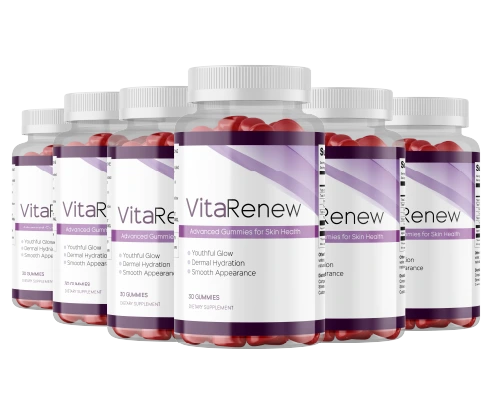
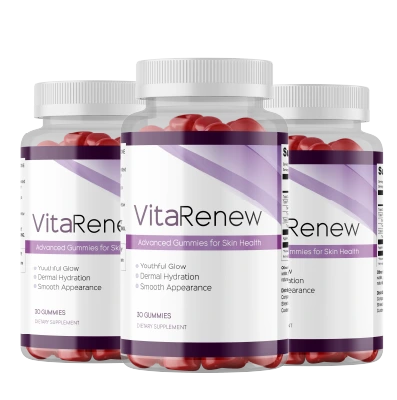
Of the formulas we reviewed while researching this, VitaRenew is the one built most directly around the cofactor side of the equation rather than the raw-material side. It's a daily gummy with vitamin C, zinc and copper, plus vitamin E, selenium and beta-carotene for antioxidant support. Made in an FDA-registered, GMP-certified facility. Sixty-day money-back guarantee.
It is a supplement. It supports skin, hair and nails. It is not a treatment for any condition, and any company that says otherwise is one to avoid.
Referenced in this article
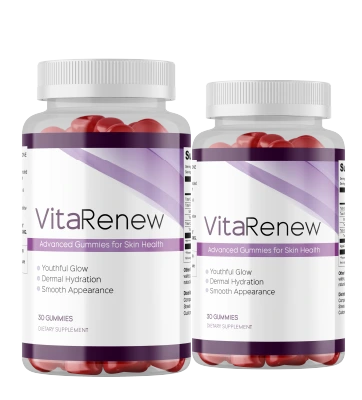
VitaRenew
Vitamin C, zinc and copper in a daily gummy — the cofactors your skin's repair process actually depends on.
For the arms you've stopped avoiding in photographs.
60-day money-back guarantee · One-time purchase, no subscriptionWhat people notice, and when to expect it
The outer skin layer turns over roughly every four to six weeks — surface texture is usually the first thing that shifts. The dermis is slower. Collagen remodelling is a matter of months. Most controlled studies of skin-support supplements use eight to twelve weeks as the standard evaluation window, and that's a reasonable benchmark to borrow.
Give anything you try at least three months. Take an honest photograph on day one, in consistent light, without a filter. Expect gradual change, not transformation. Individual results vary significantly with genetics, sun history, sleep quality, stress levels and what your diet already provides.
"I lost 28 pounds over about a year and was proud of it — until I saw my arms in a photograph at my daughter's graduation. The skin looked like tissue paper. I'd been using collagen powder for months with nothing to show for it. Once I switched to something that included vitamin C and copper as cofactors, the texture started to feel different around month two. Not a transformation, but genuinely better."
"The loose skin on my belly was the part I didn't expect. I was prepared for my body to look different — I wasn't prepared for the texture. I've been using a daily gummy with the collagen cofactors for about four months now and I feel more comfortable in my own skin. My nails are also stronger, which surprised me as a bonus."
These statements reflect individual experiences. Results are not typical and vary significantly between people.
The short version
Crepey skin after weight loss isn't the result of losing weight incorrectly. It's the result of subcutaneous fat — which was compensating for years of gradual dermal thinning — being reduced, leaving the skin's structural deficit visible for the first time. The dermis still has the cells and the mechanisms to support its collagen architecture. What's often missing is what those mechanisms run on: vitamin C to stabilize the collagen produced, and copper to cross-link the fibres into a network that actually holds.
That's a less dramatic story than the ones most articles on the subject are telling. It also points at something concrete you can check on a label.
Product referenced above
VitaRenew
Vitamin C, zinc and copper in a daily gummy. FDA-registered, GMP-certified facility. 60-day guarantee.
Give your skin's repair process what it actually runs on.
60-day money-back guarantee · Supports skin, hair and nailsWorth saying clearly: if a patch of skin changes suddenly, thickens, discolours, or a spot changes shape or bleeds, that is a question for a dermatologist, not a supplement. The crepey skin that follows weight loss in midlife is gradual and generally symmetrical. Anything that doesn't match that description should be looked at by someone qualified to do so.
Background reading
- Pullar JM, Carr AC, Vissers MCM. "The Roles of Vitamin C in Skin Health." Nutrients, 2017.
- Rucker RB et al. "Copper, lysyl oxidase, and extracellular matrix protein cross-linking." American Journal of Clinical Nutrition, 1998.
- Thornton MJ. "Estrogens and aging skin." Dermato-Endocrinology, 2013.
- Ogawa Y et al. "Zinc and skin disorders." Nutrients, 2018.
- Shuster S, Black MM, McVitie E. "The influence of age and sex on skin thickness, skin collagen and density." British Journal of Dermatology, 1975.