Skin Health · Science Explained
Why The Skin Around Your Mouth Goes Crepey After 40
The perioral zone — the area encircling the mouth — is the most mechanically active surface on the face. It moves every time you speak, chew, smile, or purse your lips. Combined with the structural changes that arrive in midlife, that constant activity creates ideal conditions for crepey texture to develop earlier here than almost anywhere else.

Apply a lipstick you've worn for years and something is different. Not the color — the texture. The product collects in the fine vertical lines above the upper lip rather than lying flat. The skin around the mouth looks slightly gathered, the way tissue paper looks when it's been folded and smoothed back out. The word most women reach for is the right one: crepey.
This change concerns a lot of women in their forties and fifties — it shows in search data, in dermatology consultations, and in the questions that appear in health forums — yet there is relatively little straightforward information about why this area changes the way it does. The answer is structural, and understanding it changes what interventions make sense and which ones don't.
Why the mouth area specifically
Three features of the perioral zone interact to produce the pattern of aging that becomes visible as crepey texture around the mouth:
The orbicularis oris — the most active muscle on the face. This circular muscle encircles the mouth and is involved in virtually every voluntary and involuntary facial action: speaking, chewing, smiling, expressing concentration, forming words, swallowing. Unlike the muscles of the cheeks or forehead, which contract episodically, the orbicularis oris is in near-continuous use throughout every waking hour. The skin stretched over it folds and releases thousands of times per day. Elastin fibers — which allow skin to deform and return to shape — experience cumulative mechanical stress that exceeds any other zone on the face.
Little to no subcutaneous fat beneath the surface. The cheeks are supported by a layered system of fat compartments that sit between the muscle and the skin, providing cushion, volume, and a buffer against the effects of structural decline. Directly above and around the lips, this cushion is largely absent. When the dermis loses density, there is no fat layer to compensate — the surface reflects the change more immediately.
Thin skin with relatively high UV exposure. Unlike the eyelids, which are partially shaded by the brow, the upper lip is a naturally sun-exposed surface. UV radiation accelerates collagen breakdown through a process called photoaging, compounding the chronological loss. The combination produces a zone where intrinsic aging and extrinsic damage converge in a location that already had limited structural reserve.
The perioral zone has three structural disadvantages working simultaneously: continuous mechanical load, no fat buffer, and compounding UV exposure. Any one of them alone would be significant. Together, they explain why this area signals structural change in midlife before almost anywhere else.
What is happening in the dermis
Crepey skin is not a surface problem. The fine, gathered texture that becomes visible is caused by changes in the dermis — the deeper structural layer beneath the epidermis — not in the uppermost skin itself. Moisturizers and topical products can temporarily smooth the epidermal surface, but the underlying change is one layer deeper.
Two protein networks give the dermis its structural properties, and both decline progressively from the mid-twenties:
- Collagen provides the dermis with its physical thickness, density, and the resistance that lets skin hold its contours. Dermal collagen concentration declines at a commonly cited rate of approximately one percent per year after early adulthood. As it falls, skin thins. In the perioral area, which had no fat buffer to begin with, this thinning is expressed directly at the surface as fine creasing and reduced resilience.
- Elastin governs return-to-shape — the property that allows skin to fold during expression and recover to its baseline position without leaving a crease. Elastin synthesis largely stops after early adulthood, and existing fibers accumulate damage from both mechanical stress and UV exposure. In a zone that folds thousands of times daily, degraded elastin means the creases formed during movement hold longer after the muscle releases. Over years, what were transient expression lines become structural ones.
The perioral zone is where this dual decline produces its most visible expression, for all the reasons above. It is not a sign that aging is happening faster there — it is a sign that the structural reserve in that zone was always thinner, and the load on it was always higher.
Why the forties accelerate the process
Collagen decline has been a slow background process for fifteen or more years by the time most women enter their forties. But the rate at which the cumulative effect becomes visible accelerates sharply around perimenopause. The reason is endocrine.
Estrogen supports dermal collagen through two mechanisms: it upregulates fibroblast activity — the cells that synthesize collagen — and it inhibits the matrix metalloproteinase enzymes that break collagen down. As estrogen levels fall in the perimenopausal transition, both of those effects diminish simultaneously. Studies published in Dermato-Endocrinology document measurable decreases in skin collagen content and thickness in the years surrounding menopause that exceed what chronological aging alone would predict.
The vertical lines above the lip that appear to arrive suddenly in the mid-forties have usually been accumulating slowly for a decade. What changes in the forties is the rate. The structural threshold that makes them visible is crossed in a shorter window than it was traversed.
UV exposure compounds this: decades of sun on the upper lip — no brow shading it, no hat typically extending that low — mean that photoaging-related breakdown is layered on top of the endocrine acceleration. The result is a zone where multiple processes converge.
What the dermis requires for its own maintenance
The dermis maintains itself through continuous synthesis and controlled breakdown of collagen. Fibroblast cells — present throughout life — drive that synthesis process. What changes with age is not the absence of fibroblasts but the efficiency of the enzymatic cascade that converts the materials they produce into functional collagen structure.
Three micronutrients are directly load-bearing in that process:
- Vitamin C is the required cofactor for prolyl hydroxylase and lysyl hydroxylase — the enzymes that stabilize newly synthesized collagen chains into their functional triple-helix structure. Without adequate vitamin C, newly assembled collagen cannot complete its cross-linking and is structurally compromised. The documented biochemistry here is well-established: it is the mechanism behind scurvy's disruption of connective tissue. Adequate vitamin C is what allows synthesis to complete correctly rather than producing fragile, short-lived fibers.
- Copper activates lysyl oxidase, the enzyme responsible for the final cross-linking step that weaves individual collagen and elastin fibers into the dense network that gives skin its physical firmness. Individual fibers can be synthesized, but without functioning lysyl oxidase, they remain unassembled. Copper governs the step that converts raw material into load-bearing structure — and it is among the most consistently under-represented micronutrients in skin supplement formulations.
- Zinc supports fibroblast function and modulates matrix metalloproteinase activity — helping maintain the balance between collagen synthesis and breakdown in favor of preservation. Zinc deficiency measurably accelerates collagen breakdown; adequate zinc tilts the balance toward net maintenance.
These nutrients do not add collagen from the outside. They support the biochemical machinery the dermis already uses to produce and maintain collagen from within. When evaluating supplements for structural skin support, this distinction matters: the question is not whether a product contains collagen, but whether it contains the cofactors the body needs to drive its own synthesis process.
Referenced in this article
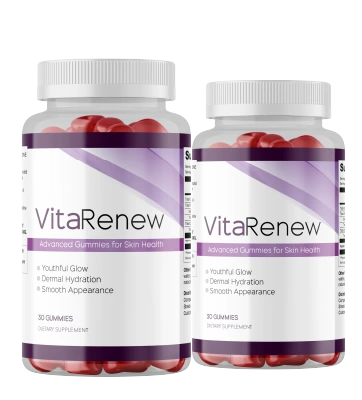
VitaRenew
Vitamin C, zinc and copper in a once-daily gummy formulated for women 40+. Supports the cofactor availability the dermis uses for its own structural maintenance.
Give the perioral zone what the dermis actually needs to work with.
60-day money-back guarantee · One-time purchase, no subscriptionWhat to look for when evaluating a supplement
A practical evaluation checklist
- All three cofactors present: vitamin C, copper, and zinc. Each addresses a different enzymatic step. A product that provides two of the three is leaving part of the process unsupported. The most commonly omitted is copper — yet lysyl oxidase activation is the step that converts fiber into network.
- Meaningful vitamin C dose. The biochemical requirement for cofactor-level support differs from a trace amount added for label purposes. Look for a dose that could plausibly serve an enzymatic function, not a cosmetic one.
- A 60-day return guarantee, minimum. Dermal remodeling operates on a timescale of months — meaningful changes in the dermis take eight to twelve weeks. A 30-day guarantee signals the manufacturer does not expect results within any window where the biology can reasonably respond.
- GMP certification and an FDA-registered manufacturing facility. These are the minimum standard for quality assurance of any supplement intended to influence a biological process.
- Compliant language. No supplement supports or reverses photoaging that has accumulated over decades. Claims that a product will eliminate vertical lip lines, reverse crepey texture, or restore the skin of your twenties are inconsistent with dermal biology. The language to look for is "supports," "may help maintain," "in conjunction with" — language that reflects how the biology actually operates.
Setting a realistic timeline
The epidermal layer turns over approximately every four to six weeks, and early changes in surface texture and tone can sometimes be noticed within that window. Dermal collagen synthesis is slower: clinical studies of nutritional interventions on skin typically use evaluation periods of eight to twelve weeks as a minimum meaningful window.
Photograph the perioral area in consistent natural light on day one. Review at week four and week twelve. Do not adjust variables during the evaluation window. Genetics, prior UV history, sleep quality, diet, and stress all influence the process — but providing the enzymatic process with the cofactors it requires, consistently over months, is the foundational intervention that all other approaches build on.
What women report noticing
"The lines above my lip were the thing I was most self-conscious about. I'd tried every topical product that promised to smooth them — none touched them because they were structural, not surface. I started focusing on what my skin needed internally and gave it a proper twelve weeks. The texture didn't disappear, but it became meaningfully less prominent, and my foundation stopped gathering there the way it had been."
"My dermatologist told me the perioral area is the hardest part of the face to address topically because of all the movement. She suggested looking at internal support rather than more surface products. I did my research, settled on a cofactor-focused gummy, and stuck with it for four months. The improvement wasn't dramatic but it was real — and it stayed, which was the part that surprised me."
These are individual accounts. Results are not typical and vary based on individual factors including age, sun history, diet, genetics, and consistency of use. No supplement is intended to diagnose, treat, cure, or prevent any disease.
Product referenced above
VitaRenew
Vitamin C, zinc and copper in one daily gummy. Made in an FDA-registered, GMP-certified facility. 60-day money-back guarantee. One-time purchase — no subscription.
For the zone that works hardest and shows it first.
60-day money-back guarantee · Supports skin, hair and nailsBackground reading
- Thornton MJ. "Estrogens and aging skin." Dermato-Endocrinology, 2013.
- Pullar JM, Carr AC, Vissers MCM. "The Roles of Vitamin C in Skin Health." Nutrients, 2017.
- Rucker RB et al. "Copper, lysyl oxidase, and extracellular matrix protein cross-linking." American Journal of Clinical Nutrition, 1998.
- Krutmann J et al. "The skin aging exposome." Journal of Dermatological Science, 2017.
- Ogawa Y et al. "Zinc and skin disorders." Nutrients, 2018.
- Varani J et al. "Decreased collagen production in chronologically aged skin." American Journal of Pathology, 2006.
- Wlaschek M et al. "Solar UV irradiation and dermal photoaging." Journal of Photochemistry and Photobiology B, 2001.