Crepey Skin at 60: Why the Change Accelerates Beyond the Fifties


The question arrives at dermatology offices more often after 60 than before it: "My skin was already crepey in my fifties — why does it look so much worse now?" It's a reasonable observation, and it reflects something real. The biology of skin aging at 60 is not simply "more of the same" as at 50. Several distinct mechanisms converge at this stage in ways that accelerate the visible change.
Understanding what those mechanisms are — and why they matter — is the first step toward addressing the problem at the right level rather than managing its surface appearance.
What makes 60 different from 50
During the perimenopause years — typically spanning the late forties and early fifties — estrogen levels fluctuate and decline. This period is when most women first notice significant skin changes. Estrogen receptors are present throughout the dermis; the hormone supports collagen synthesis, water retention in skin tissue, and the activity of the fibroblast cells that maintain the dermal matrix.
By 60, most women have been fully postmenopausal for several years. The distinction matters because the skin response to estrogen loss is not linear. The period of accelerated collagen decline tied to the estrogen transition tends to plateau — but the deficit it has left is cumulative and largely structural.
Research has documented that women can lose a meaningful proportion of their total skin collagen in the years immediately surrounding menopause. By the early sixties, that structural shortfall has been compounding for a decade — not accelerating, but also not recovering.
Two additional factors converge at 60 to compound what estrogen loss started.
Growth hormone and fibroblast activity
Growth hormone (GH) supports the activity of fibroblasts — the cells responsible for synthesizing collagen and elastin in the dermis. GH levels decline progressively with age, but the decline is steepest between the mid-fifties and mid-sixties. By 60, circulating GH is typically at its lowest point in adult life.
This matters because fibroblasts depend on GH signaling to remain active at meaningful levels. When GH is low, fibroblasts become less responsive — even when the other cofactors necessary for collagen production are present. The result is a dermis that is not only depleted from the estrogen-driven losses of the fifties but is now less actively being replenished.
It is important to note that this does not mean synthesis stops. Fibroblasts remain capable of producing collagen throughout life. What the research shows is that their baseline activity declines, and that supporting the biochemical environment they depend on becomes proportionally more important — not less — as the hormonal signals that once drove them weaken.
Four decades of accumulated sun damage
Ultraviolet radiation is the single largest environmental contributor to dermal collagen degradation. UV exposure — even at levels far below sunburn threshold — activates matrix metalloproteinases (MMPs), enzymes that break down existing collagen fibers. It also generates reactive oxygen species that disrupt the structural organization of the dermis over time.
By 60, four decades of daily UV exposure have accumulated. The cumulative effect on the dermal matrix is substantial: existing collagen fibers are cross-linked in abnormal patterns, some are fragmented, and the organized lattice that gives young skin its mechanical properties is progressively disorganized. This photo-aging compounds the hormonal losses of the fifties in a way that is visible as skin that wrinkles at the lightest touch and loses its snap.
Areas with the highest cumulative UV exposure — the backs of the hands, the forearms, the chest — tend to show the most pronounced crepey texture at 60, precisely because the UV-driven MMP activation in those areas has had the longest time to run.
Why nutrition becomes more important, not less
The common instinct when skin changes accelerate is to reach for more topical products. The limitation of this approach is structural: most active ingredients in creams and serums cannot penetrate through the outer layers of skin into the dermis, where the changes are happening. The stratum corneum evolved precisely to keep the environment out.
What the dermis depends on — and what the research on skin aging consistently identifies — is the availability of specific micronutrients that drive the enzymatic processes behind collagen synthesis. The key ones:
- Vitamin C is a non-negotiable cofactor for two critical enzymes — prolyl and lysyl hydroxylase — that give each collagen molecule the stable triple-helix configuration it needs to function as structural protein. Insufficient vitamin C means collagen is assembled incorrectly. This is established biochemistry, not a supplement claim.
- Copper activates lysyl oxidase, the enzyme that cross-links newly formed collagen and elastin fibers into a dense, organized network. Without adequate copper, individual fibers are produced but never assembled into the matrix that gives skin its firmness.
- Zinc supports the ongoing integrity of existing collagen structures and plays a role in regulating the MMP activity that degrades the dermal matrix — a particularly relevant function given the accumulated UV burden at 60.
At 60, when hormonal signaling is diminished and the dermal deficit is more substantial than at 50, ensuring that these cofactors are reliably available is one of the few modifiable variables available for supporting skin structure from within.
What we suggest looking into
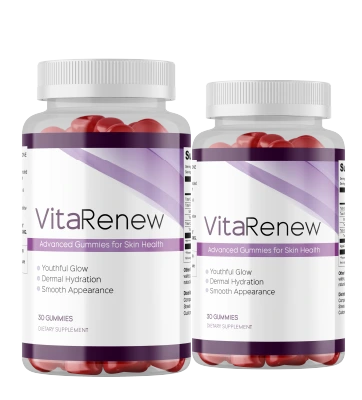
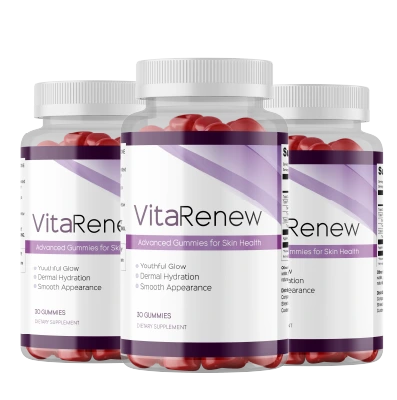
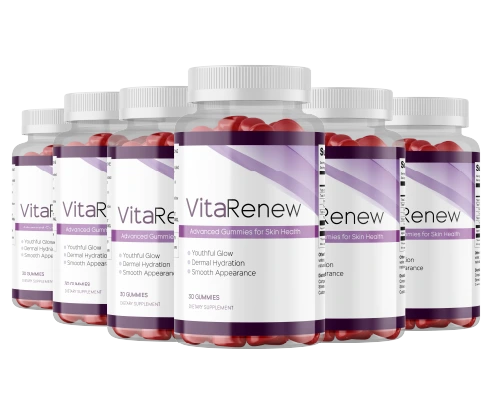
VitaRenew is a daily collagen-support gummy formulated for women 40 and over. It provides the micronutrients that the body's own collagen-synthesis pathways depend on — rather than attempting to deliver collagen topically or through ingestion of collagen peptides, which faces different bioavailability limits.
- Vitamin C & copper — the two cofactors most directly tied to collagen production and cross-linking in the dermis
- Zinc & antioxidant support — for ongoing skin integrity and MMP regulation
- Gummy format — easy daily compliance without adding a new step to a supplement routine
This is a supplement, not a medical treatment. It won't undo structural changes already in place, and it isn't a substitute for sun protection going forward. But for women at 60 who want to support the nutritional environment that the remaining collagen-synthesis activity depends on, it's a rational starting point.
What women report
"I'd been using a retinol for years — it helped in my fifties but seemed to stop making a difference around 60. My dermatologist mentioned the nutritional side. I started VitaRenew about four months ago and I genuinely notice more firmness in my neck and the backs of my hands."
"I was skeptical because I'd tried a lot of things. But my skin at 63 is noticeably less thin-looking than it was a year ago. The crepe texture on my upper arms has improved. I don't know exactly what changed but this is the only thing I added."
These statements reflect individual experiences. Results are not typical and will vary from person to person.
The practical conclusion
Crepey skin at 60 reflects the compounded effect of completed estrogen loss, declining fibroblast activity tied to lower growth hormone, and four decades of accumulated UV-driven collagen degradation. No single intervention reverses these processes. But supporting the biochemical environment that the body's own collagen synthesis still depends on — specifically by ensuring the enzymatic cofactors are reliably present — represents the most structurally coherent approach available. VitaRenew is built around exactly that logic.