The Elastin Problem: Why Skin Gets Crepey in Your 50s


Here is the test: press two fingers gently against the inner surface of your upper arm, then release. Pay attention not to whether the skin looks different — but to how long it takes to come back. That delay, that slow return, is not dehydration. It is not a failure of your moisturizer. It is the signature of elastin that has become less functional over decades, and it becomes unmistakable in the fifties.
Elastin is the structural protein in skin responsible for recoil — the snap-back quality that lets a young face bounce back immediately after being pressed or folded. Collagen provides thickness and tensile strength; elastin provides elasticity. Crepey skin is what happens when both are compromised, but the characteristic papery texture and the slow-return phenomenon point specifically to the elastin problem.
What makes elastin different from collagen
Collagen is constantly being produced and turned over throughout life, though at a declining rate. Elastin is different in a critical way: the body synthesizes virtually all of its elastin during development and the early years of life. After the late teens and early twenties, meaningful new elastin production largely stops. From that point on, the body's strategy is maintenance and protection — not replacement.
This has a significant implication. While collagen loss is a story of declining production, elastin loss is primarily a story of cumulative degradation. What you have in your fifties is, largely, the elastin you built decades ago — weathered by time, UV exposure, and a changing hormonal environment.
Enzymes called elastases break down elastin over time. UV radiation activates these enzymes. And a changing hormonal environment — specifically, declining estrogen — removes a key natural brake on the elastin degradation process. The fifties is when these forces converge most visibly.
Why the 50s specifically — not the 40s, not the 60s
Elastin degradation is a gradual process across decades, which raises a reasonable question: why does the texture change seem to arrive so specifically in the fifties for many women, rather than progressively from the thirties onward?
The answer involves a threshold effect. Elastin has a functional reserve — a buffer of structural capacity that can absorb gradual degradation without the deficit showing clearly at the surface. Cumulative UV exposure erodes that reserve slowly. By the time the perimenopausal hormonal shift arrives and removes the protective influence of estrogen on the dermal matrix, many women are close enough to the threshold that the accelerated degradation pushes them visibly past it. The change feels sudden because the reserve, not the ongoing rate, is what finally runs out.
Research on skin changes during the perimenopausal transition has documented measurable acceleration in the loss of dermal structural proteins — both collagen and elastin — during this window. The convergence is the story of why the 50s feel different.
Why surface products can't reach elastin
The skin's outermost layer — the stratum corneum — is a highly effective barrier. It evolved to keep the external world out, and it does that job whether the external world is a pathogen, a chemical irritant, or an ingredient in a bottle. Large molecules, including most topically applied proteins and antioxidants, cannot cross the barrier to reach the dermis where elastin lives.
A moisturizer can make skin look temporarily plumper and smoother by hydrating the epidermis and blurring the surface texture. Within hours, absent the moisture, the appearance reverts. This is not a failure of any specific product — it is the basic physics of what topical application can and cannot achieve. Crepey skin caused by dermal elastin degradation is a structural problem, and structure lives below the reach of anything applied to the surface.
The nutritional support angle
This is where the research becomes more actionable. While new elastin synthesis is largely not possible in adults, the environment in which existing elastin functions — and in which the body maintains the surrounding structural matrix — is influenced by nutrition.
Several pathways are relevant:
- Oxidative protection: Free radical damage is a primary driver of elastin degradation. Antioxidant micronutrients — including vitamin C, vitamin E, and zinc — support the body's natural defenses against the oxidative processes that degrade structural proteins in the dermis.
- Collagen synthesis support: While elastin is not meaningfully replaced, collagen continues to be produced. Vitamin C and copper are required cofactors for the enzymes that build and cross-link collagen fibers. Supporting ongoing collagen production may help maintain the broader structural environment of the dermis.
- Matrix integrity: The extracellular matrix surrounding collagen and elastin fibers depends on adequate micronutrient availability to maintain its organization and hydration.
None of this represents a claim that supplements can reverse elastin loss. They cannot. What the evidence does suggest is that the nutritional environment in which the dermis operates is something that can be supported — and that doing so from the inside, where the structural proteins actually live, is a more mechanistically coherent approach than surface application.
What we suggest looking into
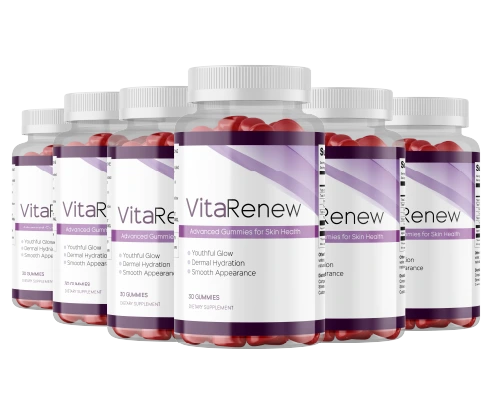
VitaRenew is a daily collagen-support gummy designed for women 40 and over, formulated around the micronutrients most directly linked to dermal matrix health:
- Vitamin C — required cofactor for collagen-building enzymes; also a key antioxidant protecting structural proteins from oxidative damage
- Copper — essential for lysyl oxidase, the enzyme that cross-links collagen and elastin fibers into a resilient network
- Zinc & supporting nutrients — for ongoing matrix integrity and the skin's natural repair processes
- Daily gummy format — no additional steps, no capsules
VitaRenew is a supplement, not a medical treatment. It supports the nutritional environment that the dermis depends on — it does not add new elastin or override years of structural change. But for women who want to do more than moisturize, it represents a structurally sound approach to dermal support.
What women in their 50s report
"I'd read so much about collagen that I'd forgotten elastin was even a thing. Once I understood that the snap-back problem was about a different protein, I stopped expecting any lotion to fix it. I started focusing on nutritional support instead. About six weeks in I started noticing a real difference in how the skin on my arms looked and felt."
"My dermatologist explained the elastin piece to me and it made everything click. She said the most useful thing I could do was support my skin from the inside nutritionally. I've been taking a collagen-support supplement for about two months and the texture on my chest is noticeably smoother."
These statements reflect individual experiences. Results are not typical and will vary from person to person.
The bottom line
Crepey skin in your 50s reflects a structural shift involving two proteins — collagen, which declines in production, and elastin, which cannot be meaningfully replaced and is degraded by decades of UV exposure and the hormonal transition of perimenopause. Surface products cannot reach these structures. Supporting the nutritional environment that the dermis depends on — particularly the micronutrients that protect existing structural proteins and support ongoing collagen synthesis — is the most mechanistically coherent approach available to women who want to address the issue at the source. VitaRenew was formulated around that principle.