Skin Health · Science Explained
Why the Skin on Your Ankles Gets Crepey After 40
The ankle carries naturally thinner dermis and sits at the end of the body's longest circulatory loop. It is one of the first zones where structural skin changes become visible — and one of the last most women think to watch.

You cross your legs — sitting at a table, on a plane, at a dinner — and the light catches the ankle. The texture there is different from what you remember. A faint crepe-paper quality has settled into the skin between the bone and the heel: fine horizontal lines in a mesh pattern, the surface slightly loose when pinched, veins more visible than they were a few years ago. If you were watching your face, you might have noticed the change starting. Here, you probably weren't.
The ankle is not the obvious place to look. It receives far less conscious monitoring than the face, neck, or even the forearms. But the biology of why it changes early — before many areas with more visible real estate — is worth understanding, because the mechanism there is somewhat different from what drives change on the face, and understanding it changes what actually helps.
Why ankle skin is structurally distinctive
The dermis is not uniform thickness across the body. It is thickest on the back and palms, and measurably thinner on the lower legs and ankles — an area where the skin must be close to the bone and where the structure has never had the same depth of supporting tissue that the torso or upper arms carry. Thinner dermis means that any age-related loss of structural proteins shows earlier, because there is less to lose before changes become visually apparent.
The ankle is also the most distal point in the body's circulatory circuit. Blood that travels down from the heart to the lower extremity must return against gravity, and venous return from the ankle depends on both functional vein valves and regular muscular movement to pump it back up. As both tend to become less efficient with age, microcirculation in the capillary beds of the ankle skin can be correspondingly slower. The practical consequence: the enzymatic maintenance that takes place in the dermis — synthesis of structural proteins, clearance of degraded matrix — runs on nutrient and oxygen supply delivered through those capillary beds. Slower flow means slower maintenance.
Two other factors compound in this zone. Sebaceous glands — which produce the natural lipids that help the skin surface retain moisture — are relatively sparse on the lower legs and ankles compared with the face or scalp. The ankle skin therefore loses surface moisture faster and is more susceptible to the fine-line texture that dryness produces in thin dermis. And the ankle is in almost constant motion: the friction of socks, the compression of shoes, and the repeated flexion of the joint all stress a surface that lacks the depth of padding found elsewhere.
The systemic process that runs in the background
Alongside the site-specific characteristics of ankle skin, the structural changes there are also shaped by the same systemic process that affects all skin in the forties: the accelerated decline in dermal collagen that accompanies the perimenopausal hormonal transition.
Collagen production declines from the mid-twenties at roughly one percent per year — a slow background slope that crosses no visible threshold for most of the thirties. The forties introduce a second, faster decline. Estrogen plays a direct role in maintaining dermal collagen density throughout the reproductive years: it promotes fibroblast activity and inhibits the enzymes that degrade collagen. Research published in Dermato-Endocrinology in 2013 documented that skin collagen content and thickness decrease significantly in the years surrounding menopause — changes that exceed the gradual age-related baseline and that occur throughout the body, including the extremities.
On the ankle, that systemic decline stacks directly on top of the structural disadvantages already present: thinner baseline dermis, slower microcirculation, lower lipid production, and daily mechanical stress. The combination means that visible changes can arrive earlier here than in more protected or better-supplied tissue.
The ankle has thinner baseline dermis than almost anywhere else on the body. When systemic collagen decline accelerates in the 40s, it shows earlier here — not because the ankle is aging faster, but because it had less structural depth to begin with.
What supports the dermis in this zone
The common assumption is that the bottleneck in dermal maintenance is collagen supply — that the body has simply stopped making enough, and the solution is to add more raw material in the form of collagen peptide supplements. The research tells a more specific story.
Fibroblast cells in the dermis continue to synthesize collagen throughout adult life, including in the 40s and 50s. What changes is the balance between synthesis and degradation: the rate of breakdown accelerates while the rate of assembly slows at specific enzymatic steps. Those steps are not bottlenecked by amino acid availability — they are bottlenecked by micronutrient cofactors.
Three cofactors are rate-limiting in the collagen assembly process:
- Vitamin C is required by the enzymes prolyl hydroxylase and lysyl hydroxylase to stabilize newly synthesized collagen chains into their functional triple-helix structure. Without adequate vitamin C, newly made collagen is structurally weak and degrades rapidly. This mechanism is well-established: it is the documented cause of the tissue breakdown in scurvy, and it remains relevant at the lower circulating vitamin C levels common in adults who are not actively deficient but not optimally supplied.
- Copper activates lysyl oxidase, the enzyme responsible for cross-linking individual collagen and elastin fibers into the load-bearing network of the dermis. Individual fibers can be present — and synthesis can be occurring — while the cross-linking step remains incomplete without adequate copper. It is the most consistently underrepresented cofactor in skin supplement formulations despite being the rate-limiting step for structural matrix assembly.
- Zinc supports fibroblast function and modulates matrix metalloproteinases — the enzymes that degrade structural proteins. Adequate zinc supports the balance between synthesis and breakdown at the tissue level.
In typical adults, the rate-limiting factors in dermal maintenance are these enzymatic cofactors, not the amino acid building blocks of collagen itself. That distinction matters practically: a supplement that addresses amino acid supply but not cofactor availability is solving the wrong bottleneck.
Referenced in this article
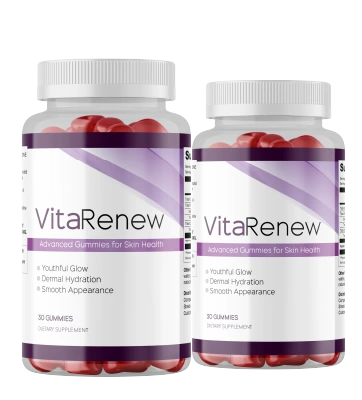
VitaRenew
Vitamin C, copper, and zinc — the three cofactors the dermis depends on for structural maintenance — in a once-daily gummy formulated for women 40+.
Supporting what the tissue actually needs, from the ground up.
60-day money-back guarantee · One-time purchase, no subscriptionWhat to look for when evaluating a supplement
If you have used collagen peptide powders consistently without being able to point to a visible change in the lower legs or ankles, the most common explanation is that the product addressed the amino acid supply side — which is not typically the limiting factor — rather than the enzymatic cofactors that actually govern assembly and cross-linking.
A practical evaluation checklist
- All three cofactors present: vitamin C, copper, and zinc. Each operates at a distinct step in the process. Missing one leaves a gap that the others cannot cover.
- Copper at a functional dose. It is the most frequently missing piece in skin supplement formulations — often present in trace amounts that fall short of the enzymatic activity threshold for lysyl oxidase.
- A 60-day guarantee, minimum. Dermal remodeling operates on a timescale of months. A 30-day return window does not allow an honest evaluation and suggests the manufacturer knows this.
- Verified manufacturing. FDA-registered facility and GMP certification set the baseline. Third-party testing adds confidence in label accuracy.
- Measured language about results. Any product making specific claims about visible effects in two weeks is communicating something about the seller, not the science. Realistic timelines are themselves a quality signal.
A realistic timeline for evaluating results
The epidermis — the outermost layer — turns over every four to six weeks, so surface texture and tone can begin to shift within that window as cellular renewal reflects improved cofactor support. The dermis is slower. The studies that have measured meaningful changes in dermal structure use evaluation periods of eight to twelve weeks, and dermal remodeling continues to accumulate past that point when support is consistent.
A practical approach: photograph the ankle in consistent light at the start, give any consistent protocol three months before forming a conclusion, and focus on texture and how the skin looks in side-light rather than color changes, which vary with hydration and are less indicative of structural improvement.
What women report after focusing on the cofactors
"I noticed the ankle thing first, honestly — that crepe-paper texture right on the lower leg and around the bone. I'd been on collagen powder for months with no real change. A friend pointed me toward the cofactor research. Three months in, the texture is noticeably different — smoother, less loose-looking. My ankles don't bother me in sandals the way they used to."
"It started with a photo from a summer trip — I could see the skin on my ankles looked thin and crinkled in a way that wasn't obvious until the light caught it. I got serious about getting vitamin C, copper, and zinc consistently. By the end of the third month the difference in texture was something my daughter noticed without me saying anything."
These are individual accounts. Results are not typical and vary based on individual factors including age, baseline dermal thickness, diet, and consistency of use. No supplement is intended to diagnose, treat, cure, or prevent any disease.
Product referenced above
VitaRenew
Vitamin C, zinc, and copper in one daily gummy. Formulated for women 40+. Made in an FDA-registered, GMP-certified facility. 60-day money-back guarantee. One-time purchase — no subscription.
For the skin that rarely gets attention — until the light catches it.
60-day money-back guarantee · Supports skin, hair and nailsBackground reading
- Thornton MJ. "Estrogens and aging skin." Dermato-Endocrinology, 2013.
- Pullar JM, Carr AC, Vissers MCM. "The Roles of Vitamin C in Skin Health." Nutrients, 2017.
- Rucker RB et al. "Copper, lysyl oxidase, and extracellular matrix protein cross-linking." American Journal of Clinical Nutrition, 1998.
- Chung JH et al. "Molecular mechanisms of intrinsic skin aging." International Journal of Dermatology, 2003.
- Ogawa Y et al. "Zinc and skin disorders." Nutrients, 2018.
- Gniadecka M et al. "Dermal water distribution in normal and aging skin." British Journal of Dermatology, 1998.