Skin Health · Explainer
What Causes Crepey Skin on Arms After 40 — And Why It Hits There First
The skin above your elbows changed before the rest of you did. The reason has less to do with the surface and more to do with a slow structural shift most people never hear explained.

It usually happens in a specific moment. You catch a mirror at an angle, or a photograph taken without warning, and you see the skin on your upper arms — thin, slightly crumpled, crosshatched with fine lines that weren't there five years ago. You look at the rest of yourself and nothing has changed. But the arms have.
This kind of skin change has a name: crepey skin. The word is exact. The texture looks like crinkled tissue paper or the delicate, wrinkled surface of crepe fabric. And of all the places it can appear — the neck, chest, under the eyes — the upper and inner arms tend to be among the first and most noticeable.
Understanding why requires going one layer beneath what you can see.
What makes arm skin different — and more vulnerable
The skin on your upper arms is thinner than the skin on your face or legs. It also sits over loose connective tissue rather than dense muscle, which means it has less structural support from below. When the underlying architecture starts to shift, the arms often show it before anywhere else.
That architecture lives in the dermis — the layer beneath the surface you can touch. It's a mesh of collagen fibres giving skin its thickness, elastin fibres giving it snap-back, and hyaluronic acid holding moisture between them. What shows up as crepey texture is what a loosening, thinning dermis looks like from the outside.
Crepey skin is a structural change — it begins in a layer that moisturizers were never designed to reach.
Why the forties accelerate this
Collagen production declines gradually from the mid-twenties onward — slowly enough that nobody notices for a long time. What changes around the forties is that a second curve arrives on top of the first. Estrogen actively supports collagen density and skin thickness. As estrogen levels fall through the perimenopausal years, dermal collagen loss accelerates noticeably.
The result is the "overnight" feeling that many women describe — two gradual slopes that suddenly converge. On the thinner skin of the upper arm, this intersection is visible earlier than almost anywhere else on the body.
The part most articles skip
Here is where it gets more interesting, and more actionable. Your body has not lost the ability to produce collagen. The cells that make it — fibroblasts — are still there. Collagen synthesis is a chemical assembly line, and that line depends not just on raw material but on the cofactors that run the machinery.
Two are worth knowing by name:
- Vitamin C. Two enzymes — prolyl hydroxylase and lysyl hydroxylase — give each collagen molecule its stable triple-helix shape. Both are entirely dependent on vitamin C. Without adequate levels, the body produces collagen in a structurally weaker form. This is well-established biochemistry, not a marketing claim.
- Copper. Newly produced collagen and elastin fibres are loose threads until they are cross-linked into a strong, springy network. That cross-linking is performed by an enzyme called lysyl oxidase — and lysyl oxidase depends on copper. Without it, the fibres are made but not properly bound.
Zinc belongs in the same list. It plays a role in normal skin cell turnover and the continuous repair processes happening in the dermis.
The practical implication is worth stating plainly: if you've tried collagen powders and seen limited results, the limiting step may not have been raw material. It may have been the cofactors the manufacturing process actually runs on.
Referenced in this article
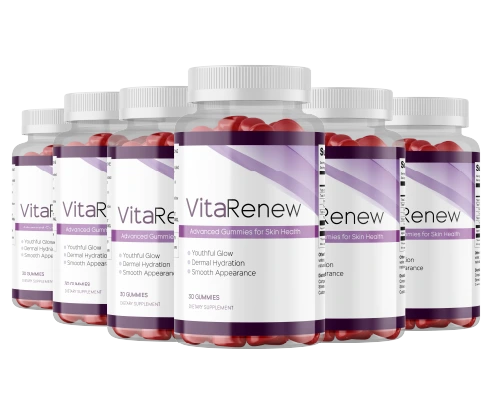
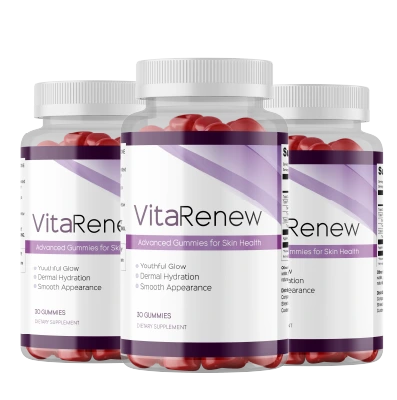
VitaRenew
Built around the cofactors skin structure depends on — vitamin C, copper, and zinc — in a daily gummy. Made in an FDA-registered, GMP-certified facility.
For the moment you raise your arm and feel like yourself again.
60-day money-back guarantee · One-time purchase, no subscriptionWhat people report
"I started noticing a change in how the skin on my arms felt — less papery, slightly more bounce — around the eight-week mark. I wasn't expecting that fast."
"I liked that it wasn't a cream or a serum. A gummy in the morning, and I stopped obsessing over long sleeves."
These statements reflect individual experiences. Results are not typical and will vary from person to person.
What a realistic timeline looks like
The surface layer of skin turns over every four to six weeks, so texture and tone can shift relatively quickly. The dermis is slower — collagen remodelling happens over months, not days. Most controlled studies on skin-directed supplements measure outcomes at eight to twelve weeks for exactly that reason.
Give any approach a full three months before drawing conclusions, photograph your arms in the same light on day one, and expect gradual rather than dramatic. Genetics, sun history, diet, and sleep all influence the outcome.
Product referenced above
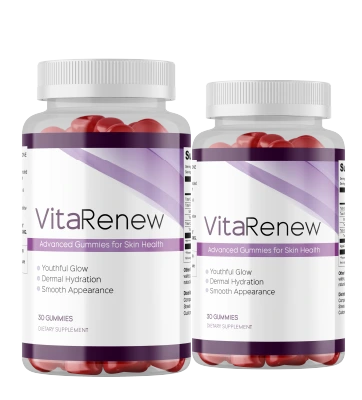
VitaRenew
Vitamin C, zinc, and copper in a daily gummy. Supports skin, hair, and nails.
For the photograph you don't feel like cropping.
60-day money-back guarantee · Supports skin, hair and nails