Eye Area Health · Explainer
What Causes Crepey Skin on Eyelids — The Structural Reason It Appears Here First
Of all the places on the face where skin can thin and crinkle with age, the eyelids tend to show it earliest. That isn’t coincidence. The skin covering your eyelids is the thinnest on the entire human body — and what happens there tells you something precise about what’s changing underneath.


Scroll back through photographs from a decade ago and compare the area around your eyes. For many women past forty, the most visible change isn’t new lines radiating from the corners — it’s the texture of the eyelid itself. The upper lid, which once appeared smooth and taut, now carries a faint papery crosshatch. The skin looks delicate in a way it didn’t before. When you blink, you can see it fold.
That shift has a specific structural explanation. Understanding it changes how you think about what, if anything, can support the area from within.
The anatomy of the thinnest skin on the body
The skin covering your eyelids averages roughly 0.5 millimeters in depth. For comparison, skin on the back or thigh typically measures three to four times that. This thinness is functional — it allows the eyelid to move rapidly and with precision. But structural thinness means one thing in the context of aging: there is less reserve.
The dermis is the layer directly beneath what you can touch, and it is where the structural proteins that give skin its firmness and resilience are manufactured. In the eyelid, that dermal layer is exceptionally narrow to begin with. When collagen and elastin naturally decline with age, a thin dermis has proportionally less structural material to lose before the change becomes visible at the surface. The margin was smaller from the start.
Beyond the dermis, a small orbital fat pad sits beneath the upper eyelid, providing subtle volume and fill. With age, this fat redistributes and in some areas reduces. When it does, the skin above it loses the internal padding that once kept the surface smooth and slightly lifted. The skin begins to drape rather than sit taut, and folds that were once invisible at rest become noticeable even when the face is relaxed.
The eyelid has the least dermal reserve of any skin on the body. A loss that takes decades to become visible on the cheek or neck appears here years earlier.
Fifteen thousand blinks a day
The average person blinks approximately fifteen thousand times per day. That’s fifteen thousand repetitions of mechanical stress applied to eyelid skin — compression, stretch, release — every single day. Over decades, this continuous cycle of movement places cumulative strain on elastin fibres that are already losing their recoil properties through normal aging.
Healthy elastin allows skin to spring back after being stretched or compressed. As elastin fibres age, they fragment and crosslink in abnormal patterns, reducing that recoil. In the eyelid, where the same motion repeats more than five million times each year, the cumulative effect of reduced elastin recoil becomes visible as skin that folds and does not fully recover.
The manufacturing process — and what it runs on
Here is where the explanation becomes relevant beyond describing what has already changed. Collagen production does not stop with age. The fibroblast cells responsible for synthesizing collagen and elastin remain active in eyelid skin and throughout the body. Production slows and efficiency declines — but the process continues. What it increasingly depends on are the cofactors that enable it.
Three are worth understanding in this context:
- Vitamin C is a required cofactor for the enzymes that stabilize each collagen molecule into its triple-helix structure. Without adequate vitamin C, collagen is produced but structurally weaker than it should be. Older adults tend to have lower circulating vitamin C levels, in part due to changes in gastrointestinal absorption over time.
- Copper is essential for lysyl oxidase, the enzyme that cross-links newly synthesized collagen and elastin fibres into a resilient, load-bearing mesh. Without copper, individual fibres form but fail to assemble correctly into a functional matrix.
- Zinc participates in the ongoing turnover and repair of skin cells and supports normal cell signalling within the dermis. Zinc absorption declines measurably with age, and borderline zinc status is common in older adults even in otherwise well-nourished populations.
When these cofactors are in shorter supply, the machinery that maintains the dermis runs at reduced capacity. The synthesis process continues — but the quality and rate of output are constrained by missing tools rather than missing raw materials.
Why topicals have limited reach here
Eye creams occupy a large and well-marketed category. Many products in it are genuinely well-formulated and can provide meaningful improvements in surface hydration, reduce the temporary appearance of fine lines under certain lighting conditions, and improve how well makeup applies to the area. None of that is trivial.
The structural changes driving crepey eyelid skin, however, originate in the dermis — a layer that topical products are not designed to reach in any meaningful way. A cream that addresses the surface can make crepey eyelid skin look better day to day. It cannot support the cofactor-dependent synthesis happening two layers down. Both approaches address real things; the limitation is expecting one to do the job of the other.
Referenced in this article
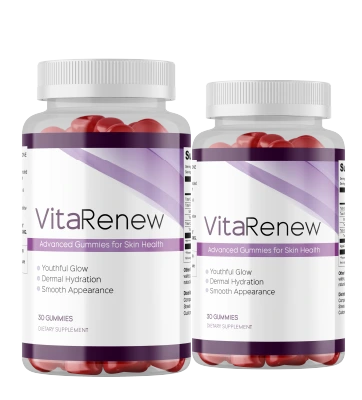
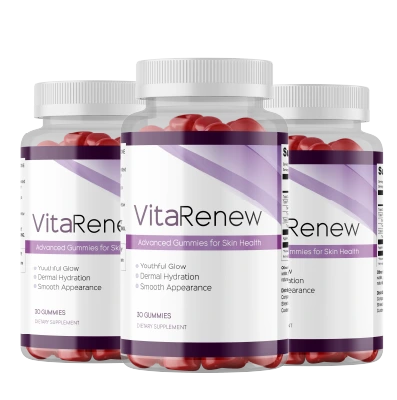
VitaRenew
A daily gummy built around vitamin C, copper, zinc, vitamin E, and selenium — the cofactors the collagen synthesis process depends on. Made in an FDA-registered, GMP-certified facility. Supports skin firmness, elasticity, and overall skin health. Available to try starting with a 60-day supply.
The eye area is where thin skin shows what’s changing inside. This supports what’s still working there.
60-day money-back guarantee · One-time purchase, no subscriptionWhat people report
“I noticed the skin on my upper eyelids started looking different around 47 — finer, more papery when I blinked. After about three months, my husband mentioned I looked less tired. I hadn’t told him I’d changed anything.”
“The eyelid area feels more substantial now — less like crepe paper when I press gently. It’s quiet, hard to photograph, but my concealer doesn’t settle into the folds the way it used to. That was the change I noticed first.”
These statements reflect individual experiences. Results are not typical and will vary from person to person.
Setting realistic expectations
Dermal remodelling is a slow process. Skin studies measuring collagen-related outcomes typically run for twelve to sixteen weeks before assessing results, because that is how long the process takes to accumulate visible change. If you decide to support the collagen synthesis process nutritionally, photograph the eye area in consistent lighting on day one and plan to evaluate at eight to twelve weeks — not in the first few days.
The goal is supporting what is still running, not reversing what has already changed over decades. The fibroblast cells in eyelid skin are still producing collagen. Ensuring they have the cofactors that production depends on is a low-risk, coherent place to begin.
Product referenced above
VitaRenew
Vitamin C, copper, zinc, vitamin E, and selenium. Supports skin, hair, and nails. One-time purchase — no subscription. A 60-day supply is a practical place to start.
Collagen synthesis needs the right tools. This is what we suggest starting with.
60-day money-back guarantee · Supports skin, hair and nails