Skin Health · Science Explained
Why the Skin on Your Forearms Turns Crepey After 40
It's not the face that gives it away first. For most women, the inner forearm — that unguarded strip of skin that rests against every table, every lap, every armrest — is where the change quietly announces itself.

You notice it at the table, not at the mirror. Your elbow is on the edge of the desk, sleeve pushed back, and there it is — a soft, papery rumple along the inside of the forearm that wasn't there three summers ago. Not a wrinkle exactly. More like tissue paper that lost its spring.
It's a quieter kind of change than what shows on the face. Visible in certain light angles. Apparent when you cross your arms in conversation, or glance down at your arm resting in your lap. And unlike the face, where you've been watching closely for years, the forearm catches you off guard.
Understanding why it shows there first — and what's driving it — changes what you can actually do about it.
Why the forearm, specifically
The inner forearm has some properties that make it a reliable early indicator of structural skin changes. The skin there is inherently thinner than on the face, and unlike the back of the hand — which also ages visibly — the inner arm hasn't spent decades in direct sun. That means what you're seeing isn't primarily UV damage. It's something more systemic.
This distinction matters. Sun damage is accelerated, external, cumulative. What shows on the inner forearm is primarily the result of changes in the skin's support architecture — the deep scaffolding of protein that gives skin its thickness, its resistance to pressure, and its ability to return to shape after being moved.
The inner forearm also moves in ways that reveal structural change more clearly than other areas. When you press your forearm flat on a surface and lift it, watch what happens: the skin either snaps back cleanly, or it settles slowly. That settling — that reluctance to return — is a measurable sign of reduced elastin activity. On the inner arm, it's more visible than almost anywhere else.
Two proteins and what happens to them
The structural layer responsible for these properties isn't the outer surface you can touch or moisturize. It sits beneath — in the dermis, a dense, complex layer where two proteins do the work:
- Collagen provides volume, thickness, and the firm resistance you feel when you press on skin. Think of it as the mattress springs underneath. When collagen density is high, skin has cushion and structure. As density falls, skin thins and the underlying geometry changes — contours flatten, surfaces crinkle.
- Elastin is responsible for the snap-back property. It forms a network of fibers that allow skin to deform and return to its original shape. Reduced elastin activity is what you're observing when skin creases into a shape and stays there longer than it should.
Crepey texture — that dry, paper-thin, slightly crumpled quality — is the surface appearance of changes happening in this deeper layer. Moisturizing the surface can temporarily plump the outermost barrier and improve the immediate feel of skin, but it cannot address what's happening in the dermis. The address is different.
The texture on your forearm isn't coming from the outer layer. It's the dermis showing through a surface that's grown too thin to fully conceal it.
Why the forties feel like a turning point
Collagen production declines gradually from the mid-twenties — a slow background slope, commonly estimated at roughly one percent per year. For most of the thirties, there's enough reserve that nothing obvious happens. The skin thins imperceptibly. The scaffolding loses density slowly. Nothing crosses the visual threshold yet.
What changes in the forties is that a second, faster decline arrives on top of the first. Estrogen plays a direct role in maintaining dermal collagen density throughout the reproductive years — it upregulates the gene expression of collagen-producing cells called fibroblasts and inhibits the enzymes that break collagen down. As estrogen levels fall through the perimenopausal transition, both of those protections weaken.
Research published in Dermato-Endocrinology in 2013 found that skin collagen content and thickness decrease significantly in the years surrounding menopause — changes that exceed the gradual background rate of loss. The result is two declining curves meeting: the slow age-related slope that's been building for fifteen years, and a sharper hormonal-driven drop. That intersection is why the change can feel sudden even though it wasn't.
Sun exposure, smoking, and some medications accelerate the process. But they are accelerants. Women who avoided every risk factor still develop crepey skin on their forearms after 40. It is not a consequence of anything you failed to do.
Referenced in this article
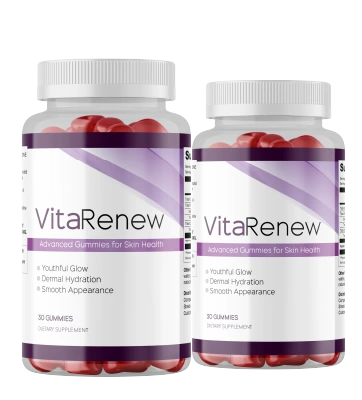
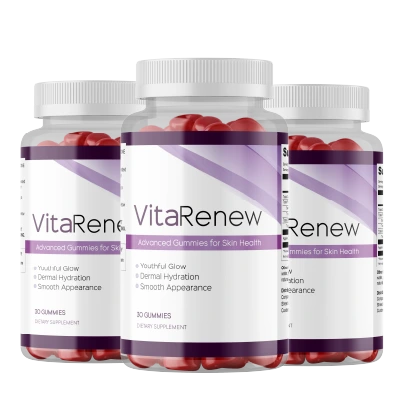
VitaRenew
Vitamin C, zinc and copper — the cofactors your skin's structural maintenance depends on — in a once-daily gummy formulated for women 40+.
Support what the dermis actually needs, not just the surface above it.
60-day money-back guarantee · One-time purchase, no subscriptionWhat the dermis actually needs to run its maintenance
Here is the part that gets left out of most conversations about skin supplementation: the body does not stop making collagen in your mid-forties. Fibroblast cells are still present in the dermis. Synthesis is still running. What changes is how efficiently the assembly process completes — and that depends heavily on whether certain inputs are available.
Three nutrients are particularly load-bearing in this process:
- Vitamin C is not optional for collagen synthesis. Two enzymes — prolyl hydroxylase and lysyl hydroxylase — are responsible for stabilizing newly formed collagen chains into their final triple-helix structure. Both require vitamin C to function. Without adequate vitamin C, newly synthesized collagen is structurally weak and degrades quickly. This is not supplement marketing — it's the documented biochemistry behind scurvy's destruction of connective tissue.
- Copper activates lysyl oxidase, the enzyme that cross-links collagen and elastin fibers into the dense, load-bearing network that gives skin its firmness and elasticity. Individual fibers are present; copper is what assembles them into structure. It's consistently underrepresented in skin supplements, despite being the difference between a pile of threads and a woven fabric.
- Zinc supports keratinocyte function and the maintenance processes that run continuously in the epidermis and dermis. It also modulates collagen-degrading enzymes, helping tip the balance toward preservation.
These aren't raw materials. Amino acid supply is rarely the bottleneck for well-nourished adults. The limiting factor tends to be the enzymatic steps — and those depend on the micronutrients above.
What to look for when evaluating a supplement
If you've tried collagen supplements without meaningful results, the most common explanation is that the product focused on raw peptide supply rather than the cofactors the synthesis process needs. Controlled trials of oral collagen peptides show real but modest effects on skin elasticity and hydration. The mechanism is plausible. But in a well-nourished adult, amino acid availability isn't typically what limits the process.
A practical checklist
- Adequate vitamin C — not a trace amount added for the label, but a meaningful dose that could support enzymatic activity.
- Both zinc and copper, together. They act at different steps. Copper is the piece most often omitted — without it, the structural cross-linking step is compromised.
- A 60-day guarantee, minimum. Dermal remodelling is measured in months. A 30-day return window signals the manufacturer doesn't expect results in a useful evaluation window.
- Verified manufacturing. FDA-registered facility and GMP certification are the minimum. Third-party testing adds confidence.
- Realistic marketing. If the copy promises visible results in under two weeks, that sentence is telling you something about the seller — not the science.
How long to actually evaluate
The outermost skin layer turns over every four to six weeks — so tone and surface texture can begin to shift in that window. The dermis is slower. Collagen remodelling operates on a timescale of months, which is why well-designed clinical studies of skin supplements use eight- to twelve-week evaluation periods.
Take a photograph of your inner forearm on day one, in consistent natural light. Give any intervention three full months before drawing a conclusion. Expect gradual change, not a transformation. Variables like sun history, sleep, diet, and genetics all influence the process in ways no supplement overrides — but supporting the machinery consistently, over time, is how results accumulate.
What people report after making the switch
"I'd been using a collagen powder for almost a year — no change I could point to on the forearms. A friend suggested trying something built around the cofactors instead. About eight or nine weeks in, I noticed the texture on my inner arms looked different in morning light. Less papery. My husband noticed before I said anything."
"My dermatologist had told me there wasn't much I could do about the crepey texture short of in-office treatments. I wasn't ready for that. I started a cofactor supplement and stayed consistent for three months. I won't say it's gone — but my arms don't look the age they did. The change has been real enough that I've kept going."
These are individual accounts. Results are not typical and vary based on individual factors including age, sun history, diet, and consistency. No supplement is intended to diagnose, treat, cure, or prevent any disease.
Product referenced above
VitaRenew
Vitamin C, zinc and copper in one daily gummy. Made in an FDA-registered, GMP-certified facility. 60-day money-back guarantee. One-time purchase — no subscription.
For the arms that tell the story before your face does.
60-day money-back guarantee · Supports skin, hair and nailsBackground reading
- Pullar JM, Carr AC, Vissers MCM. "The Roles of Vitamin C in Skin Health." Nutrients, 2017.
- Rucker RB et al. "Copper, lysyl oxidase, and extracellular matrix protein cross-linking." American Journal of Clinical Nutrition, 1998.
- Thornton MJ. "Estrogens and aging skin." Dermato-Endocrinology, 2013.
- Shuster S, Black MM, McVitie E. "The influence of age and sex on skin thickness, skin collagen and density." British Journal of Dermatology, 1975.
- Ogawa Y et al. "Zinc and skin disorders." Nutrients, 2018.
- Chung JH et al. "Molecular mechanisms of intrinsic skin aging." International Journal of Dermatology, 2003.