Perimenopause & Skin · Explainer
Crepey Skin in Perimenopause — Why It Starts Before Menopause
Most skin-aging conversations point to menopause as the turning point. But for a large proportion of women, the visible texture change arrives earlier — in the early-to-mid forties, during the perimenopausal transition. Understanding the hormonal mechanism explains why.

She's 42, still getting her period, and the skin on her upper arms has changed. Not dramatically — but undeniably. There's a fine crosshatch of lines when she pinches it. It doesn't snap back the way it used to. On the backs of her hands and across her chest, the same texture: thinner, slightly papery, the look dermatologists call crepey.
She searches the question and finds articles about menopause. But she hasn't reached menopause. The category doesn't seem to fit. And so she attributes it to sun exposure, or stress, or simply bad luck — and moves on without an explanation that actually accounts for the timing.
The explanation exists. It's not about menopause as a destination. It's about what happens in the years before it.
Perimenopause begins much earlier than most women expect
Menopause is a single point in time: twelve consecutive months without a period, typically occurring between ages 45 and 55. Perimenopause is the transition that leads to it, and it is considerably longer — ranging from four to ten years depending on the individual. For many women, this transition begins in the early forties. For some, in their late thirties.
During perimenopause, ovarian function changes gradually. Estrogen levels do not decline in a straight line. They oscillate: sometimes sharply elevated, sometimes dropping below what was typical. This irregularity — rather than a simple, gradual decrease — defines the perimenopausal hormonal environment. Cycles become less predictable. But the hormonal flux begins well before the last period.
That flux is relevant to skin because the dermis responds directly to estrogen.
What estrogen actually does in the dermal layer
Beneath the surface of the skin — beneath the epidermis that creams and serums are designed to reach — is the dermis. This is the structural layer: dense, fibrous, containing the collagen and elastin networks that give skin its thickness, its firmness, and its recoil. The dermis is not passive. It is maintained by fibroblasts, cells that continuously lay down new structural proteins and remodel the existing matrix.
Fibroblasts contain estrogen receptors. This is established in dermatological research: estrogen acts as a maintenance signal for the dermal layer, keeping fibroblast activity elevated and sustaining the ongoing process of collagen production and fiber remodeling.
When estrogen is consistent — as it tends to be during the reproductive years — this maintenance signal is relatively stable. The dermis turns over slowly, loses collagen gradually (about one percent per year from the mid-twenties onward), and remains within the range that appears normal at the surface.
When estrogen begins to oscillate — as it does during perimenopause — the maintenance signal becomes intermittent. Fibroblasts receive irregular input. New collagen production slows and becomes inconsistent. Existing fibers continue breaking down at their baseline rate. The balance tilts toward net loss.
The skin doesn't need menopause to arrive before it responds to the hormonal shift. It responds to the oscillation — which begins in perimenopause, years earlier.
Why the change appears where it does — and when
Crepey texture tends to manifest first on the upper arms, the inner elbows, the chest, and the backs of the hands. Understanding why requires a brief look at what makes these areas structurally different.
Facial skin is thicker. It has more underlying subcutaneous fat, which provides a cushion against structural changes in the dermis. It tends to receive more deliberate topical care. The skin on the arms, chest, and hands is, by comparison, thinner from the outset. It sits over less fat. It has often accumulated more cumulative UV exposure, which accelerates collagen breakdown through a separate mechanism: UV-induced metalloproteinase activity that degrades existing fibers.
These areas carry less structural reserve. When the dermis begins to lose density — whether from hormonal change, aging, or both — they are the first to show it at the surface. The skin loosens fractionally. The surface develops the fine wrinkling that crepey skin is named for. The characteristic snap-back on pinching slows or disappears.
And because this process begins during perimenopause rather than at menopause, it can arrive on a timeline that surprises women who are still cycling, still years away from what they've been told to expect.
Referenced in this article
VitaRenew
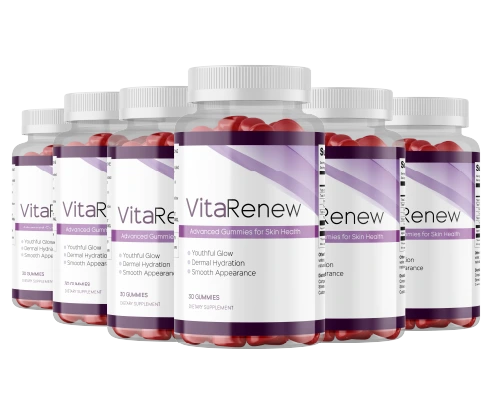
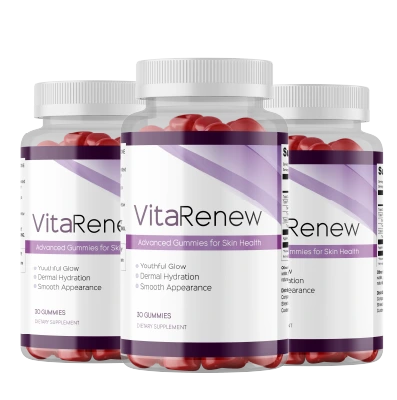
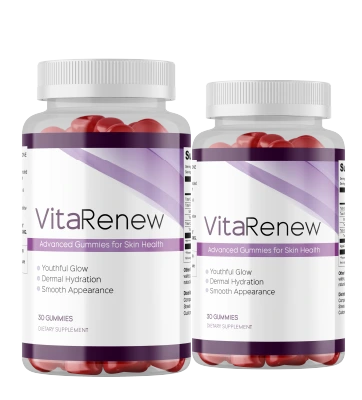
A daily gummy formulated around the cofactors collagen synthesis depends on — vitamin C, copper, and zinc. Made in an FDA-registered, GMP-certified facility. 60-day money-back guarantee.
For the skin you want to feel comfortable in again.
60-day money-back guarantee · One-time purchase, no subscriptionWhat the dermis loses — and why it matters for texture
Crepey skin is a structural event. To understand it fully means understanding what the dermis is made of and what it progressively contains less of during the perimenopausal transition:
- Collagen fibers — specifically Types I and III — form the primary load-bearing scaffold of the dermis. They give skin its thickness and its resistance to mechanical deformation. Their loss is the dominant driver of the thinner, less resilient quality that crepey skin produces. Collagen synthesis depends on fibroblast activity; fibroblast activity depends on estrogen signaling.
- Elastin fibers run alongside the collagen network and provide the skin's recoil — the ability to stretch and return. Elastin is remarkably long-lived tissue, but its degradation accelerates with age and hormonal change, and its replacement slows. When elastin is diminished, the skin stretches but recovers slowly or incompletely. The crepey effect is partly this: a loss of elastic memory in the dermal matrix.
- Glycosaminoglycans — including hyaluronic acid — occupy the space between structural fibers and bind large amounts of water within the tissue. Their decline contributes to the flat, slightly deflated quality that crepey areas develop even when the surface has adequate topical hydration. The dermis holds less water from within, and this affects both the visual appearance and the feel of the skin.
All three components are maintained by fibroblasts. All three are sensitive to the hormonal environment. And none of them are accessible to surface-level interventions designed for the epidermis.
The cofactor dimension: what collagen synthesis requires to run
The often-overlooked aspect of the crepey-skin-in-perimenopause picture is this: the body's capacity to produce collagen does not disappear with hormonal change. It slows. And slowing can be partially offset by ensuring the biological machinery has the raw materials it requires.
Collagen synthesis is an enzymatic process, and it depends on specific micronutrients as cofactors at each stage:
- Vitamin C is required for two enzymes — prolyl hydroxylase and lysyl hydroxylase — that modify procollagen chains into their stable triple-helix configuration. Without sufficient vitamin C, the collagen produced is structurally compromised. This is established biochemistry with extensive documentation in the research literature, not a supplement claim.
- Copper activates lysyl oxidase, the enzyme responsible for cross-linking newly formed collagen and elastin fibers into the interconnected load-bearing network the dermis requires. Without copper, fibers are synthesized but remain weakly bound — functional individually, but insufficient as a matrix.
- Zinc plays multiple roles in skin maintenance, including support for ongoing epidermal cell renewal and a role in the metalloproteinase activity that governs collagen remodeling and repair.
The practical consequence is direct: if collagen synthesis is already under hormonal pressure during perimenopause, running the process without its required cofactors compounds the limitation. Addressing the cofactor supply alongside — not instead of — other aspects of skin support may help the machinery run closer to its remaining capacity.
What "supporting skin during perimenopause" actually means
A clarification that matters: nothing here is a claim that any supplement reverses the structural changes perimenopause produces in the dermis. The hormonal transition is real. Its dermal effects are real. The body's biology during this period cannot be simply undone by a cofactor supply.
What the research on skin-directed nutritional support explores is narrower and more honest: whether ensuring adequate cofactor availability during a period when collagen synthesis is already under pressure may help the process run more efficiently. Whether the machinery, asked to produce collagen with less hormonal signal, functions better when it also has the raw materials it requires.
Studies examining vitamin C and skin outcomes typically report measurable changes at eight to twelve weeks — not because they are designed around a marketing timeline, but because collagen remodeling is inherently a slow process. Skin cell turnover is visible in three to six weeks; deeper structural changes take longer to accumulate. A realistic assessment means committing to a consistent approach for three months before drawing conclusions.
Individual outcomes vary based on genetics, sun history, diet, and the stage and severity of the hormonal transition. No consistent result across all individuals can be guaranteed.
What women going through perimenopause report
"I'm 44 and I started noticing the change on my arms and chest about a year ago. I wasn't in menopause — I'm still having periods. But the texture shift was unmistakable. I've been using VitaRenew for about three months and the skin on my arms feels different. More substantial somehow. I'm not reading too much into it, but I notice it."
"My OB told me I was in perimenopause at 41. The skin changes came about a year after that — my chest and arms first. I started looking at cofactor supplements after reading about vitamin C and collagen synthesis. Two and a half months in, there's a visible difference in my upper arms. Not back to what they were, but noticeably better texture."
These statements reflect individual experiences. Results are not typical and will vary significantly from person to person.
Product referenced above
VitaRenew
Vitamin C, zinc, and copper in a daily gummy. Supports skin, hair, and nails from within. 60-day money-back guarantee.
For the skin that still has time to feel different.
60-day money-back guarantee · Supports skin, hair and nails