Periorbital Skin · Research Explainer
Why the Skin Under Your Eyes Turns Crepey After 40
The under-eye area has the thinnest skin on the face, no subcutaneous fat, and constant mechanical stress from blinking. Understanding the structural biology explains why it changes first — and why no cream can reach the layer where the real change happens.

For most women, the change under the eyes arrives before they are looking for it. One morning you smile at something and notice, in the bathroom light, that the skin below your eyes has crinkled into a fine pattern of lines — a texture that was not there six months ago, or that you can no longer explain away with tiredness or dehydration. When you stop smiling, the lines soften but do not disappear. They have become the resting state.
This is one of the most commonly searched skin concerns among women in their forties and the reason is structural, not cosmetic. The under-eye area reveals age-related change earlier and more visibly than almost any other part of the face. Understanding why changes what you look for — and what you can realistically expect from anything you try.
What makes periorbital skin structurally different
The skin around and below the eyes — the periorbital zone — is anatomically distinct from the skin on your cheeks, forehead, or jaw in several important ways.
It is the thinnest skin on the human face. Periorbital skin averages approximately 0.5 millimetres in depth, compared to two to three millimetres in the cheek and forehead. A thinner dermis means a thinner scaffold: less collagen matrix, less elastin, and less of the hyaluronic acid that fills the space between fibres and gives skin its physical bulk. The same amount of age-related structural loss that is barely visible in thicker areas becomes clearly visible in tissue that was thinner to begin with.
There are almost no sebaceous glands here. Sebaceous glands produce the oily secretion that lubricates the skin's surface and maintains its moisture barrier. The periorbital area has dramatically fewer of these than the cheeks or forehead. Without regular sebaceous secretion, under-eye skin is drier at baseline — and dryness amplifies the appearance of fine texture and creasing significantly.
There is no subcutaneous fat directly underneath. In most areas of the face, a cushioning fat layer sits between the dermis and the underlying muscle and bone. Under the eye, that cushion is minimal or absent. The dermis sits close to the orbicularis oculi — the circular muscle responsible for blinking and squinting. When dermal volume decreases, the skin settles directly against underlying tissue rather than against a fat cushion, which changes how it folds and whether it recovers.
The orbicularis oculi creates constant mechanical stress. The average adult blinks 15,000 to 20,000 times a day. Each blink involves a subtle compression and stretching of the skin just below the eye. Over decades, this repetitive mechanical cycling — combined with squinting in bright light and the constant micro-movements of normal expression — accumulates as fatigue in the dermal matrix at that specific zone. The under-eye area is not just structurally thinner; it is also one of the most mechanically stressed areas of the face.
Thinner scaffold, no oil glands, no fat cushion, and 15,000 mechanical repetitions daily. Before any age-related change even begins, the periorbital zone is working with narrower structural margins than anywhere else on the face. That is why it shows change first — not because something unusual is happening, but because the margin was lower from the start.
What is happening at the cellular level after 40
The dermis is built around a mesh of collagen fibres, which provide tensile strength and volume, and elastin fibres, which allow skin to recoil after deformation. Between the fibres, a water-binding matrix of hyaluronic acid and proteoglycans keeps the mesh hydrated and gives skin its physical plumpness.
Collagen synthesis begins declining from the mid-twenties, at roughly one percent per year. By 40, that cumulative loss is already meaningful. The fibres that remain undergo cross-linking changes: they become less well-organised and less capable of distributing mechanical load evenly. Older collagen does not spring back from deformation the way younger collagen does.
The more significant accelerator after 40 is estrogen. Estrogen receptors are distributed throughout the dermis, and estrogen actively supports fibroblast activity — the cells that produce collagen and elastin. It also regulates hyaluronic acid synthesis and helps maintain dermal thickness. When estrogen declines during the perimenopausal transition, which typically begins in the early-to-mid forties, dermal collagen loss accelerates substantially. Research published in the dermatological literature indicates that a significant proportion of total dermal collagen can be lost in the years immediately surrounding menopause, followed by a slower but continuing decline.
In thicker skin areas, this loss takes longer to become visible. In the periorbital zone — where the structural margin was already narrower — the change appears sooner and more clearly. Skin that used to spring back when you smiled now holds the impression a moment longer. Then longer. Eventually it holds it continuously.
Why topical eye products reach only so far
The eye-area skincare market is large and well-developed. Products marketed for under-eye concerns include retinoids, peptide serums, hyaluronic acid gels, caffeine preparations, and vitamin C formulations. Some of these have genuine evidence for surface-level effects.
The relevant limit is penetration depth. The stratum corneum — the outer barrier layer of the skin — restricts penetration of molecules above roughly 500 daltons in molecular weight. Collagen, the structural protein of the dermis, is many times above that threshold. Applied collagen remains at the surface. Topical hyaluronic acid primarily affects surface hydration rather than the deeper dermal matrix. Retinoids — the best-studied topicals with sub-surface evidence — work primarily at the dermal-epidermal junction, not deep in the dermis where the structural scaffold lives.
Topicals can meaningfully improve how the surface of under-eye skin looks and feels. That is a real, measurable effect. They cannot reach the collagen scaffold beneath the surface — and the crepey skin under eyes when smiling is primarily a scaffolding problem, not a surface problem.
This is not an argument against topical care. It is a description of where topical care ends, which is the same as describing where an internal approach begins.
Referenced in this article
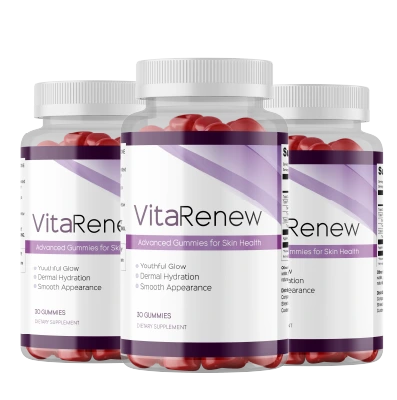
VitaRenew
Vitamin C, copper, zinc, vitamin E, selenium and beta-carotene — the cofactor combination the body's collagen synthesis process depends on, in one daily gummy.
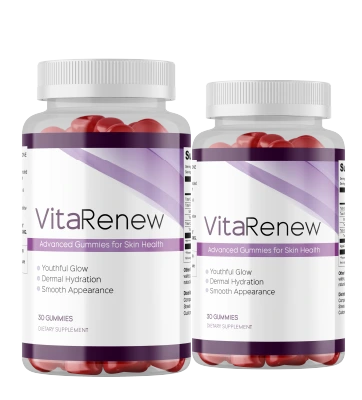
Most readers start with the 2-bottle supply — 60 days is the minimum window for a fair assessment of any internal skin support.
60-day money-back guarantee · One-time purchase, no subscriptionWhat the skin's own production process depends on
The body does not lose the ability to synthesise collagen at 40. Fibroblasts continue to function. What changes is the efficiency of the process — and that efficiency depends on specific cofactors: molecules the enzymatic machinery requires in order to complete the work.
Three have clear roles in the published biochemistry and dermatology literature:
- Vitamin C is required by prolyl hydroxylase and lysyl hydroxylase — the enzymes that add the hydroxyl groups that stabilise the collagen triple helix. Without adequate vitamin C, the collagen produced is structurally incomplete. This is not a marketing claim; it is the same mechanism responsible for the skin effects of scurvy, documented in clinical nutrition literature for over a century.
- Copper is the obligate cofactor for lysyl oxidase, the enzyme that cross-links collagen and elastin fibres into a load-bearing network. Cross-linking converts loose protein strands into a functional scaffold. Without copper, fibres are synthesised but the final bonding step does not complete. Copper is consistently underrepresented in commercial skin supplements despite its direct role at this critical step.
- Zinc participates in regulating the matrix metalloproteinases that govern collagen turnover, and in wound-repair signalling. Its role is supportive throughout the process, and it is consistently present in the dermal biology literature.
A second mechanism runs in parallel: oxidative degradation of existing fibres. The dermis is metabolically active tissue, and reactive oxygen species accelerate the fragmentation of collagen and elastin at the same time the body is attempting to maintain them. Vitamin E and selenium — an antioxidant pair with consistent representation in the dermal oxidative-stress research — address this second mechanism.
What to look for in a supplement
A working checklist before you spend
- Vitamin C at a meaningful dose. Not a trace amount included for label positioning. The prolyl and lysyl hydroxylase enzymes need adequate supply to function at useful rates.
- Copper included alongside zinc. They act at different enzymatic steps. A formula with zinc but no copper addresses collagen regulation while missing the cross-linking stage — where scaffold formation actually completes. Many skin supplements omit copper entirely.
- Both vitamin E and selenium. The two antioxidant cofactors most consistently cited together in the dermal oxidative-stress literature. A single antioxidant addresses one mechanism; the pair is a more complete approach.
- Verified manufacturing standards. FDA-registered facility, cGMP certification. These are documentable facts — a credible manufacturer can provide the paperwork on request.
- A guarantee that reflects the biology. The dermis remodels slowly. A 60-day guarantee is the minimum that allows an honest evaluation. Shorter guarantees ask you to assess an internal supplement on a timeline the biology cannot support.
VitaRenew
Of the formulations we reviewed against this checklist, VitaRenew maps most directly to the cofactor model the dermal synthesis literature points to. It is a daily gummy supplying vitamin C, zinc, copper, vitamin E, selenium, and beta-carotene — addressing both the enzymatic requirements of collagen synthesis and the antioxidant requirements of fibre protection, in a single product rather than a multi-supplement stack.
It is manufactured in an FDA-registered, GMP-certified facility and sold as a one-time purchase with no subscription, backed by a 60-day money-back guarantee. The 2-bottle option — at $79 per bottle — provides the 60-day minimum window needed for a meaningful assessment.
VitaRenew is a supplement. It supports healthy skin, hair, and nails. It is not intended to diagnose, treat, or cure any condition, and these statements have not been evaluated by the FDA.
On timelines and realistic expectations
The skin under the eyes responds to internal support on the same biological timeline as skin elsewhere — which is slow. Surface texture and hydration changes can sometimes shift within four to six weeks. Structural changes in the deeper dermis are standardly measured at eight to twelve weeks in clinical research, not four.
Individual variation is significant and real. Starting point — how much structural change has already occurred, current hormonal status, genetics, cumulative UV history — affects both the baseline and the rate of response. Two women using the same supplement for the same duration can have measurably different experiences, and both can fall within the normal range of variation for that product.
"The texture under my eyes when smiling was my specific concern — it's such a targeted thing because it shows up with expression first and then eventually stays. After about twelve weeks on VitaRenew the texture is noticeably smoother in that area. My under-eye concealer doesn't settle into the lines the way it was."
— Diane L., 48, verified purchaser
"I've been using eye creams for years. They help with dryness but never addressed the actual crinkled texture — I finally understood why after reading about penetration depth. Eight weeks on VitaRenew and the skin below my eyes feels more supple when I press it. Subtle but consistent, and my husband noticed before I told him."
— Rebecca F., 52, verified purchaser
Individual results vary. These testimonials represent personal experiences and may not reflect typical outcomes.
A clinical note: age-related changes to periorbital skin are gradual and occur on both sides. If you notice changes that are asymmetric, rapidly worsening, accompanied by swelling or changes in colour, those warrant evaluation by a dermatologist — not a supplement response. Any change that falls outside the pattern of gradual bilateral skin thinning should be assessed professionally first.
The short version
Crepey skin under the eyes appears first for structural reasons specific to that site: the periorbital zone starts with thinner skin, fewer oil glands, no subcutaneous fat, and absorbs decades of mechanical stress from blinking and expression. Over that foundation, age-related collagen loss and the estrogen-associated acceleration of perimenopause work on tissue that had less structural reserve to begin with.
Topical products address the surface and do so effectively within that boundary. The dermal scaffold beneath depends on enzymatic processes that require specific cofactors — vitamin C, copper, and zinc most directly — to function. Those cofactors are separate from dietary protein and are commonly absent or underdosed in skin supplements.
That is what the research supports. What you choose to do with it is your decision.
Product referenced above
VitaRenew
The cofactor-first formula for skin, hair and nails. FDA-registered, GMP-certified facility. No subscription. Ships from the US.
Start with the 2-bottle supply — 60 days gives the biology time to show a real response.
60-day money-back guarantee · No subscription · Ships from the USBackground Reading
- Pullar JM, Carr AC, Vissers MCM. "The Roles of Vitamin C in Skin Health." Nutrients, 2017.
- Rucker RB et al. "Copper, lysyl oxidase, and extracellular matrix protein cross-linking." American Journal of Clinical Nutrition, 1998.
- Uitto J. "The role of elastin and collagen in cutaneous aging." Journal of Drugs in Dermatology, 2008.
- Thornton MJ. "Estrogens and aging skin." Dermato-Endocrinology, 2013.
- Varani J et al. "Decreased collagen production in chronologically aged skin." American Journal of Pathology, 2006.
- Peyrefitte G et al. "Sebaceous gland density and skin thickness of the human face." Skin Research and Technology, 2000.
- Ogawa Y et al. "Zinc and skin disorders." Nutrients, 2018.