Skin Health · Explainer
What Causes Crepey Skin on Upper Arms — And Why That Area Changes First
The papery, loose texture on your upper arms has a specific structural explanation. It's not weight, it's not entirely sun damage, and no moisturizer was designed to reach the layer where it starts.

Most women can pinpoint the exact moment they noticed it. A candid photograph at a summer event. Reaching for something on a high shelf and catching a glimpse in a mirror. The skin on the upper arm — the inner part, just below the shoulder — has changed. It's thinner, slightly crinkled, and when the arm moves, it moves differently. Not like fat. Like a fabric that's lost its tension.
The term crepey skin is clinically accurate. The texture does look like crepe paper — delicate, papery, and layered with fine lines that appear even at rest. And of all the places it can develop — the neck, the décolletage, behind the knees — the upper arms are among the earliest and most consistent sites.
This isn't coincidence. The upper arm has a specific anatomy that makes it more vulnerable to this change than most other areas of the body. Understanding why starts one layer beneath the surface you can touch.
Why the upper arm is uniquely vulnerable
The skin covering your upper arm is thinner than the skin on your thighs, your back, or even your face. It sits over loose connective tissue and a layer of subcutaneous fat rather than dense, active muscle. That matters because the dermis — the structural layer just beneath the surface — relies partly on what's beneath it for support. Where there's little structural scaffolding below, a weakening dermis shows itself sooner.
The upper arm is also subject to consistent gravitational pull. Hanging tissue, loosened by loss of dermal density, tends to droop in ways that muscle-supported areas don't. This is the real explanation for what women sometimes call "bat wings" — not excess fat, but skin that has lost the internal architecture to hold its position against gravity.
And then there's UV history. The outer surface of the upper arm is chronically exposed — gardening, driving, outdoor exercise, summers over a lifetime. Most women applied sunscreen to their face long before they thought to protect their arms. That historical UV accumulation causes a specific kind of damage to dermal fibres, independent of the age-related decline happening beneath the surface at the same time.
The upper arm shows dermal change earlier than almost anywhere else — not because of what you've done to the surface, but because of what's been slowly changing underneath.
The structure that's actually changing
The dermis is made of three main components working together: collagen fibres, which provide thickness and structure; elastin fibres, which allow skin to spring back after stretching; and hyaluronic acid, which fills the spaces between them with moisture. Together, they give skin its firmness, bounce, and plumpness.
After the mid-twenties, collagen production begins to decline gradually — too slowly to notice at first. What changes in the forties is that a second force accelerates that decline. Estrogen actively supports collagen density in skin. As estrogen levels fall through the perimenopausal years, the rate of collagen loss increases noticeably, and the structural shift that was a gradual background process becomes visible on the surface.
On the upper arm — with its thinner skin, less structural support from below, and accumulated UV history — this shift tends to show up earlier and more dramatically than elsewhere.
Why topical products can't fully address this
A moisturizer reaches the epidermis — the outermost layer of skin. It can improve the appearance of surface dryness and reduce the look of fine lines temporarily. But crepey texture originates in the dermis, a layer that topical creams and lotions were not designed to penetrate in a meaningful way.
This is why women who are diligent about skincare — daily moisturizing, sun protection, retinoids — still find crepey texture developing on their upper arms. The surface is well-maintained. The dermis is a different conversation.
What the dermis actually needs to function
The critical insight that most coverage of this topic misses is about cofactors. The body doesn't stop producing collagen in the forties. Fibroblasts — the cells that manufacture collagen — continue their work. What changes is the efficiency and quality of that production. And that efficiency depends on specific nutrients that are necessary for the assembly process itself.
Two are particularly well-documented:
- Vitamin C. Two enzymes in the collagen assembly process — prolyl hydroxylase and lysyl hydroxylase — are entirely dependent on vitamin C. Without adequate levels, collagen molecules are produced in a structurally weaker form that cannot properly build the tight fibrous network the dermis needs. This is established biochemistry, not a supplement marketing claim.
- Copper. Once collagen and elastin fibres are produced, they need to be cross-linked into a strong, organized network. That process is performed by an enzyme called lysyl oxidase — and lysyl oxidase requires copper to function. Fibres produced without adequate copper for cross-linking are structurally weaker and less resilient.
Zinc rounds out the picture. It's involved in normal skin cell turnover and the continuous dermal repair processes that happen beneath the surface throughout life. Inadequate zinc doesn't announce itself loudly, but it shows up in skin that isn't renewing itself at its normal pace.
The practical implication: if you've tried collagen powders and felt the difference was minimal, the bottleneck may not have been raw material. It may have been the cofactors the manufacturing process depends on.
Referenced in this article
VitaRenew
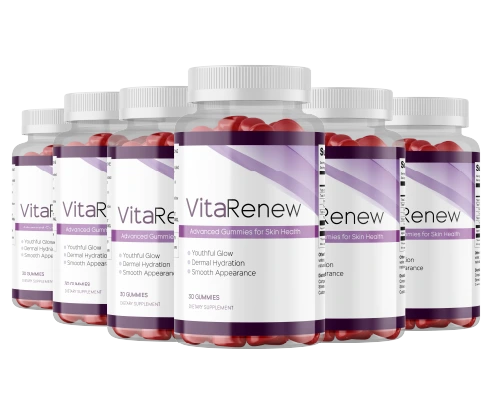
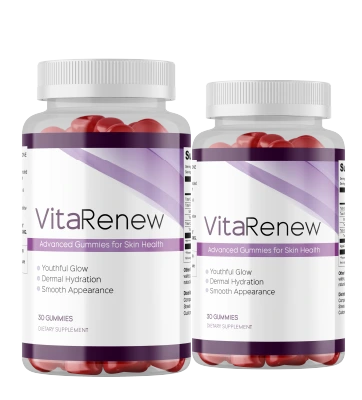
A daily gummy built around the cofactors skin structure depends on — vitamin C, copper, and zinc. Made in an FDA-registered, GMP-certified facility. The 2-bottle kit is a reasonable place to start.
For the photograph where you don't choose the angle first.
60-day money-back guarantee · One-time purchase, no subscriptionWhat people in their forties and fifties report
"After about six weeks I noticed the skin on my inner arms felt different — not the dramatic change I was half-hoping for, but the texture was less papery when I pinched it. By month three I'd stopped reaching for the cardigans by default."
"I'd tried creams for years. The difference with something systemic is that it feels like it's working from a different angle entirely. I can't point to a single day it changed, but I look at photos from a year ago and the difference is there."
These statements reflect individual experiences. Results are not typical and will vary from person to person.
How long does it actually take
The surface layer of skin — the epidermis — renews itself every four to six weeks, which is why some texture changes can happen relatively quickly. The dermis operates on a longer cycle. Collagen remodelling studies typically measure outcomes at eight to twelve weeks for exactly that reason.
The upper arm is also slower to respond than the face, partly because it has less blood circulation and less daily movement to drive cellular turnover. Realistic expectations: notice something at six to eight weeks, judge the full result at twelve weeks or beyond. Photograph your arms in consistent lighting from the start — your eyes adapt to gradual change faster than a comparison photo does.
If you're starting out, the 2-bottle kit gives you a full 60 days with the guarantee in place — enough time to observe whether the approach is working before committing further.
Product referenced above
VitaRenew
Vitamin C, copper, and zinc in a daily gummy. Supports skin, hair, and nails. Manufactured in the USA.
Because good skin starts somewhere you can't put a cream.
60-day money-back guarantee · Supports skin, hair and nails