Skin & Hormonal Health
Does Estrogen Loss Cause Crepey Skin? What the Research Shows About Hormones and Skin Structure
The short answer is yes — and the pathway is specific. Estrogen receptors in dermal fibroblasts directly regulate collagen and elastin synthesis. Here’s what happens structurally when that hormonal signal weakens, and what the evidence suggests may help support firmness from within.

Women searching this question are usually in their mid-forties to mid-fifties, noticing skin texture changes that don’t respond to topical products, and wondering whether their hormonal transition is involved. The answer, based on what is understood about skin biology, is that the connection is real and mechanistically specific — not vague or associative.
The skin changes that accompany declining estrogen are not cosmetic noise. They reflect measurable structural shifts in the dermis that begin during perimenopause, often years before the final menstrual period, and accelerate across the menopausal transition. Understanding the mechanism matters because it clarifies both why topical interventions have limited reach and what alternatives may actually address the underlying process.
Estrogen receptors in the skin: the direct link to collagen production
The dermis — the structural layer of skin beneath the epidermis — is actively maintained by a population of cells called fibroblasts. These cells produce and regulate the three main structural components of dermal tissue:
- Type I and Type III collagen fibers, which form the primary load-bearing scaffold. They give skin its thickness, its resistance to compression and stretching, and its density. Their gradual loss is the main structural basis of crepey, papery-looking skin.
- Elastin fibers, which provide elastic recoil — the snap-back quality of skin when pinched or stretched. Elastin degradation without adequate replacement reduces this recoil and contributes to the loss of “bounce” that women often notice in aging skin.
- Glycosaminoglycans (including hyaluronic acid), which occupy the interstitial space between fibers and bind water within the tissue. Their loss produces a flatter, less-plump quality to the dermis that is distinct from surface dehydration and is not addressed by topical hydration.
Fibroblasts express estrogen receptors, primarily estrogen receptor beta (ERβ). When estrogen binds to these receptors, it upregulates genes involved in collagen synthesis — particularly those encoding procollagen types I and III — and modulates the activity of matrix metalloproteinases (MMPs), the enzymes responsible for collagen degradation.
The net effect of a functional estrogenic signal is a balance that favors collagen maintenance: synthesis is actively stimulated while degradation is partially suppressed. When estrogen levels decline or become erratic during perimenopause and menopause, this balance tips. Synthesis slows; degradation continues at its baseline rate. The dermis progressively loses density.
The structural loss visible as crepey skin is not a surface phenomenon. It originates in the dermis, where estrogen-responsive fibroblasts have been running on a weakening hormonal signal for months or years.
Why perimenopause, not just menopause, matters here
A common misconception is that significant skin changes accompany the definitive hormonal shift of menopause. In practice, the estrogen fluctuation that affects dermal fibroblasts begins during perimenopause — a transition that can span four to ten years and typically begins in the early to mid-forties.
During perimenopause, estrogen does not decline in a smooth downward curve. It oscillates: high in some cycles, substantially lower in others. This variability produces a signal environment in which fibroblasts receive an intermittent and increasingly unreliable estrogenic stimulus. Research suggests that it may be the variability itself, not just the eventual lower mean level, that begins to reduce collagen synthesis output during this period.
The practical implication: skin structural changes may be underway in women who still have regular or near-regular menstrual cycles, well before any diagnostic threshold for menopause is met. The upper arms, inner elbows, chest, and backs of hands tend to show these changes earliest, because the skin in these locations is structurally thinner and carries more cumulative UV-mediated collagen damage than facial skin.
Mentioned in this article
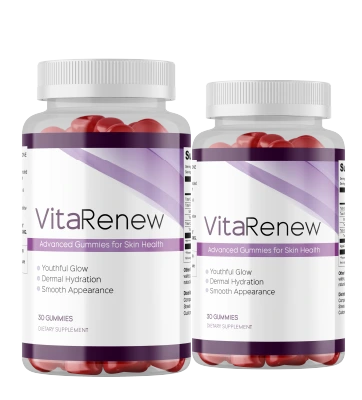
VitaRenew
A daily gummy supplying vitamin C, copper, and zinc — the enzymatic cofactors collagen synthesis requires at key steps. Made in an FDA-registered, GMP-certified facility.
A two-bottle supply is a practical starting point for assessing whether this approach works for you.
60-day money-back guarantee · One-time purchase, no subscriptionThe cofactor gap: why the hormonal signal alone does not determine collagen output
Collagen biosynthesis is a multi-step enzymatic process. The hormonal signal from estrogen functions as a regulatory upstream input, but the actual assembly of each collagen molecule requires specific micronutrients as enzymatic cofactors. If these cofactors are suboptimal, collagen synthesis is constrained independently of the hormonal environment — and the two deficits compound each other.
Three micronutrients are particularly well characterized in this context:
- Vitamin C (ascorbic acid) is an essential cofactor for prolyl hydroxylase and lysyl hydroxylase, the enzymes that hydroxylate proline and lysine residues within procollagen chains. This hydroxylation step is required for the chains to fold correctly into the stable triple-helix structure that defines a functional collagen molecule. Collagen produced in the absence of adequate ascorbic acid is structurally unstable. This relationship is established biochemistry with a long research record.
- Copper is required for lysyl oxidase activity. Lysyl oxidase catalyzes the cross-linking of collagen and elastin fibers after they are secreted into the extracellular matrix — the step that converts individual fibers into the tensile, interconnected network the dermis depends on for structural integrity. Without adequate copper, fibers may be synthesized but remain poorly cross-linked, reducing the mechanical properties of the resulting matrix.
- Zinc functions as a cofactor in multiple metalloproteinases and participates in keratinocyte proliferation, wound-repair processes, and the ongoing maintenance of dermal cell populations. Its roles in skin biology are broad, and suboptimal zinc status is associated with impaired skin barrier function and delayed tissue repair.
Most women are not clinically deficient in any of these. But many are not consuming them at levels that specifically support an enzymatic process that is already under hormonal pressure. During a period when collagen synthesis is dealing with a reduced estrogenic stimulus, ensuring adequate cofactor availability represents a lever that is mechanistically grounded and practically accessible.
What topical approaches can and cannot address
Topical skincare acts on the epidermis and the very outermost layers of the dermis. Humectants can transiently increase surface hydration. Retinoids may modestly stimulate fibroblast activity through non-estrogenic receptor pathways and slow surface-level MMP activity. Peptides and growth factors in topical formulations face significant penetration barriers and have limited reach into deeper dermal layers.
The collagen matrix, elastin network, and glycosaminoglycan content of the mid-to-deep dermis are maintained by fibroblasts that are not meaningfully influenced by anything applied to the skin surface. This is not a criticism of topical skincare — it is an accurate account of the anatomical constraints. Surface hydration and epidermal support have value. They do not address the structural mechanisms described above.
What the evidence suggests for supporting firmness from within
Supplementation with the three cofactors described above — vitamin C, copper, and zinc — is not a novel idea. Their roles in collagen biosynthesis are well-established, and formulations specifically designed to provide them in combination are available.
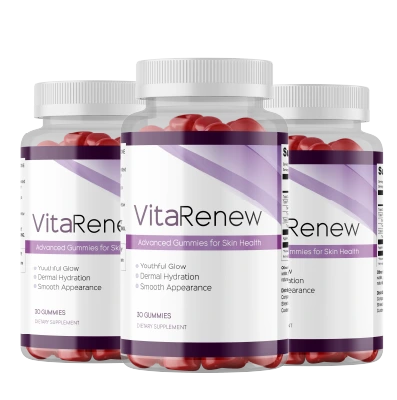
VitaRenew is one such formulation: a daily gummy supplying vitamin C, copper, and zinc in a form designed for consistent daily use. The gummy delivery format has a meaningful compliance advantage over capsules and powders for supplementation that requires consistency over weeks to months to show effect.
The timeline for perceiving changes in skin texture from within is not rapid. Collagen turnover in the dermis is slow. Most reports of perceptible change appear at eight to twelve weeks of consistent use — and gradual changes require careful, consistent observation to distinguish from normal variation. Photographing the same area under consistent lighting conditions at regular intervals is a more reliable assessment method than day-to-day tactile or visual impression.
Claims about this category of supplement are appropriately bounded: these formulations may support the processes involved in collagen synthesis, and individual responses vary. They do not reverse hormonal change or substitute for it. What they may do is ensure that an enzymatic process already under hormonal pressure is not additionally constrained by suboptimal cofactor availability.
“I’m a 50-year-old who reads the research before I try anything. The cofactor argument for vitamin C, copper, and zinc made biological sense to me, and the mechanism was documented rather than speculative. Three months into VitaRenew the texture on my upper arms is measurably better — I use the same photo setup every month. Not a transformation. A real, consistent improvement.”
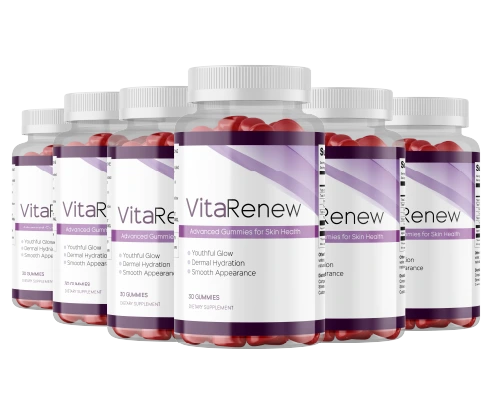
“I was skeptical of skin supplements in general because of the amount of marketing noise in this category. What made VitaRenew different for me was understanding specifically what the cofactors do at the enzymatic level. Two months in, I can feel a difference in the texture of the skin on my hands and chest. I’m continuing with the three-bottle supply.”
These statements reflect individual experiences. Results are not typical and will vary. Individual skin response depends on numerous factors including baseline nutritional status, hormonal profile, and degree of dermal structural change.
Summary
Does estrogen loss cause crepey skin? Yes, through a direct mechanism: estrogen receptors in dermal fibroblasts regulate collagen and elastin production, and when the estrogenic signal weakens during perimenopause and menopause, collagen synthesis slows while degradation continues, resulting in progressive dermal thinning.
The structural changes this produces — reduced skin density, diminished elasticity, the fine papery texture associated with crepey skin — are not addressable from the skin surface. They originate in the dermis and are maintained by processes that depend on internal biochemical inputs.
Among the inputs that matter most for those processes are vitamin C, copper, and zinc — the enzymatic cofactors collagen synthesis requires at critical assembly steps. Ensuring adequate, consistent intake of these three nutrients during a period when collagen synthesis is already under hormonal pressure is a mechanistically grounded approach to supporting skin structure from within.
Product referenced above
VitaRenew
Vitamin C, copper, and zinc in a daily gummy. Supports the enzymatic processes collagen synthesis depends on. 60-day money-back guarantee.
A two-bottle supply gives a realistic window for observing whether this approach makes a difference for you.
60-day money-back guarantee · One-time purchase, no subscription