Skin Health · Explainer
Does Smoking Cause Crepey Skin? The Biology Is More Direct Than Most People Expect
Tobacco smoke activates specific enzymes in the dermis that break down the proteins responsible for firmness. Understanding the mechanism helps explain why the effects can persist long after the habit ends — and what the skin support process actually needs.

The connection between smoking and skin appearance is one of the more well-documented relationships in dermatological research — and one of the more specific ones. It is not simply that smoking ages the face; the mechanisms are identifiable, they act on distinct parts of the skin's structure, and they are somewhat independent of the normal aging process. Which means they add to it.
The question most people bring to this subject is whether stopping smoking will reverse the skin changes. That's a reasonable question, but it may not be the most useful starting point. The more instructive question is: what, exactly, is happening in the dermis when someone smokes — and why does it show up the way it does in skin texture and firmness after forty?
The two layers that matter
Skin has at least two structural layers that explain most of what people see and feel when skin starts looking older or losing its quality.
The epidermis — the outer surface — is primarily a barrier. Its job is to hold moisture in and keep environmental irritants out. It turns over continuously and is visible in what we'd call texture: the roughness, the dryness, the fine lines that appear when the barrier is compromised.
Underneath it sits the dermis, which is where the structural architecture lives. Collagen fibers give skin its thickness and resistance to deformation. Elastin fibers give it the ability to spring back. Hyaluronic acid and other glycosaminoglycans hold water between the fibers and maintain the plumpness that makes skin look supported. When this layer loses mass and organization, skin looks thinner, looser, and creased in ways that don't resolve with moisturizer — because the change is below the surface that moisturizers reach.
Smoking's effects are concentrated in this second layer.
What cigarette smoke actually does in the dermis
Tobacco smoke contains thousands of compounds, but from a dermal-biology perspective, a handful of mechanisms are particularly relevant.
MMP activation. Matrix metalloproteinases — MMPs — are a family of enzymes whose ordinary job is tissue remodeling. In healthy skin they are tightly regulated: activated for specific repair tasks, then switched off. Cigarette smoke has been shown to trigger upregulation of several MMPs, particularly MMP-1 (collagenase) and MMP-3, in skin fibroblasts. These enzymes digest collagen and elastin. When they are chronically overactivated, the dermal scaffolding breaks down faster than it is replaced. The net effect is structural loss — less collagen, more disorganized fibers, and the flattened appearance that defines crepey texture.
Vasoconstriction and the nutrient delivery problem. Nicotine is a powerful vasoconstrictor. It causes blood vessels to narrow — including the small capillaries that supply the dermis with oxygen, amino acids, and the micronutrients that the collagen synthesis process depends on. Reduced blood flow to the skin is not a theoretical concern; it has been measured in smokers and is part of why wound healing is slower in people who smoke. From the collagen-synthesis standpoint, this matters because the enzymes that build and cross-link collagen fibers depend on specific cofactors — vitamin C, copper, zinc — that arrive through the blood. Chronically lower delivery of those cofactors means chronically lower output from the assembly process.
Oxidative degradation of elastin. Tobacco smoke generates an exceptionally high free-radical load. Elastin — the protein responsible for the snap-back quality of young skin — is particularly vulnerable to oxidative damage. Oxidized elastin loses its elasticity. It no longer contracts properly after being stretched. The visible result is skin that settles and folds, rather than springing back, which is the defining quality of crepey texture.
All three mechanisms are active simultaneously and compound the normal age-related decline in collagen production — which begins in the mid-twenties for everyone, at roughly one percent per year, independent of smoking. In a smoker, that underlying decline has an accelerant added to it.
Why the effects can outlast the habit
This is the part that tends to surprise people. Quitting smoking does remove the ongoing stimulus for MMP overactivation and ongoing oxidative stress. Blood flow begins to normalize. The acute insults to the dermis ease.
But dermal collagen loss that has already occurred is structural. Collagen that has been digested by MMPs is not simply waiting to regenerate; regeneration is a slow biological process, and a dermis that has been thinned over years does not recover its previous thickness in weeks. Elastin that has been oxidatively degraded does not spontaneously re-cross-link.
The implication is not that quitting smoking is without benefit for skin — it clearly is beneficial, and the research supports that ongoing insults are removed. The implication is that the skin changes a former smoker sees in the mirror represent an actual structural state of the dermis, and what matters going forward is whether the repair process is adequately supported.
The cofactor gap — where most approaches miss the point
Fibroblasts — the cells in the dermis responsible for producing collagen and elastin — remain active throughout adult life. The capacity to produce collagen does not simply switch off with age or with smoking history. What the process depends on is a set of nutrients that function as cofactors in the enzymatic reactions that actually build the proteins.
Two are especially critical and are worth understanding by name:
- Vitamin C and collagen hydroxylation. The enzymes prolyl hydroxylase and lysyl hydroxylase are required to give each collagen molecule the stable triple-helix structure that makes it functional. Both enzymes are vitamin C-dependent — without sufficient vitamin C, collagen is produced in an unstable form that cannot properly assemble into load-bearing fibers. This is not speculative; it is the biochemistry underlying scurvy, documented for over a century. What is less often appreciated is how significantly the vasoconstriction from smoking may reduce vitamin C availability to skin fibroblasts even when dietary intake appears adequate.
- Copper and fiber cross-linking. Once collagen and elastin fibers are produced, they must be cross-linked into an organized, mechanically stable network. This cross-linking is performed by the enzyme lysyl oxidase, which is copper-dependent. Without sufficient copper, fibers are synthesized but never properly bound together. Skin that produces collagen but cannot cross-link it effectively has the same functional outcome as skin that is not producing enough — loose, disorganized structure.
Zinc supports ongoing dermal integrity and is involved in the continuous repair and turnover of skin tissue. It is not a minor addition to this picture.
The practical implication: if you are thinking about what to do for skin support — whether you are a current smoker, a former smoker, or someone who has simply been exposed to secondhand smoke for years — the cofactor side of the equation is more often the limiting factor than additional collagen substrate. Collagen peptide supplements provide amino acids; they do not provide the enzymatic machinery that determines how well those amino acids are assembled.
Referenced in this article
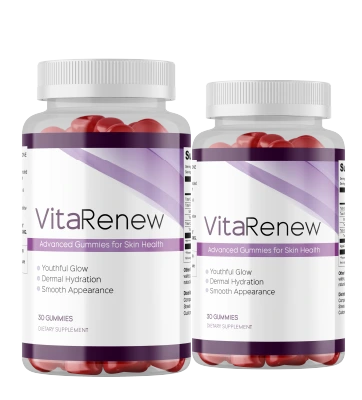
VitaRenew
A daily gummy built around vitamin C, zinc, and copper — the three cofactors the collagen assembly process most consistently depends on — with vitamin E, beta-carotene, and selenium for antioxidant support.
For the dermal support process that runs on nutrients, not creams.
60-day money-back guarantee · One-time purchase, no subscriptionWhat to look for when evaluating your options
A plain checklist
- Vitamin C in a meaningful dose — not a token amount for the label; enough to actually support the hydroxylase enzymes that depend on it.
- Copper explicitly on the label. Copper is the most commonly omitted ingredient in skin-support formulas, even though it is required for the cross-linking step. Check for it by name.
- Zinc alongside copper. They work on different steps of the same dermal repair process. Both matter; both are frequently underdosed.
- Antioxidant support — vitamin E and selenium — to address the ongoing oxidative environment that damages existing fibers while synthesis works to build new ones.
- Third-party testing and a GMP-certified facility. Both are verifiable claims, not marketing language.
- A guarantee long enough to actually evaluate the product. Dermal collagen remodeling is measured in months. Sixty days is a reasonable minimum; anything shorter does not give you time to see real change.
The formula we reviewed against this list
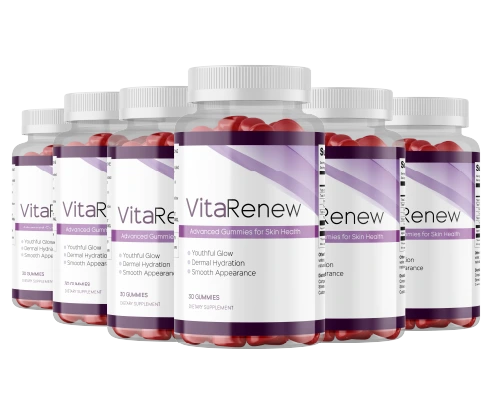
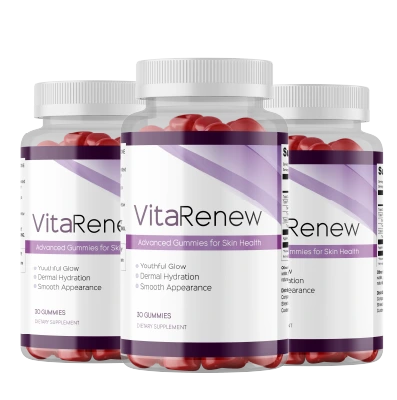
Of the daily supplements we evaluated against these criteria, the one that most completely addresses the cofactor side of the collagen assembly process is VitaRenew. It is a daily gummy formulated around vitamin C, zinc, and copper, with vitamin E, beta-carotene, and selenium as antioxidant support.
It is made in an FDA-registered, GMP-certified facility and carries a sixty-day money-back guarantee. It is a supplement — designed to support skin, hair, and nails — not a treatment, and not intended to diagnose, treat, or cure any condition.
A two-bottle supply gives you a genuine sixty-day window to evaluate the effect. At the same sixty-day guarantee, it carries the lowest upfront commitment of any option and pays the same commission as larger supplies — a straightforward starting point if you want to assess the process before committing to a longer supply.
What the timeline realistically looks like
It is worth being explicit about this, because the gap between marketing timelines and biological timelines is where most supplement disappointment comes from.
The outer layer of skin turns over every four to six weeks. Surface texture improvements — some increase in surface hydration, minor smoothing — can begin to show relatively quickly in some people. The dermis is slower. Dermal collagen remodeling is a process measured in months, and clinical studies of skin-support supplements typically run eight to twelve weeks to give the process time to register in measurable outcomes.
Individual results vary considerably based on genetics, cumulative sun exposure, smoking history, diet quality, sleep, and other factors. A supplement that genuinely supports the repair process does not override those variables — it adds one more input pointing in the right direction.
"I smoked for almost fifteen years before I quit at forty-one. By my late forties the skin on my arms had this thin, papery quality I couldn't ignore. After about eight weeks on VitaRenew I noticed the texture had improved — not dramatically, but noticeably. The papery look on my forearms has softened."
"I didn't smoke but my husband did for years and I wonder about secondhand exposure. Either way, my skin on my hands and chest was looking thinner than I expected for my age. A dermatologist mentioned the cofactor angle to me. Started VitaRenew two months ago — my hands look more like they belong to me again."
These statements reflect individual experiences. Results are not typical and will vary from person to person. Results depend on many factors, including smoking history, diet, activity level, and age.
The short version
Smoking contributes to crepey skin through three overlapping mechanisms: MMP enzyme activation that accelerates collagen and elastin breakdown, nicotine-driven vasoconstriction that impairs nutrient delivery to the dermis, and free-radical oxidation of elastin. These are additive to the normal age-related decline that begins in everyone's mid-twenties.
Whether you currently smoke, recently quit, or smoked for years in the past, the question worth asking is whether the repair process is adequately supplied with what it runs on. Vitamin C, copper, and zinc are the three cofactors the evidence most consistently points to — and they are also the ones most commonly absent from typical supplement labels.
Product referenced above
VitaRenew
Vitamin C, zinc, and copper in a daily gummy. Made in an FDA-registered, GMP-certified facility. 60-day money-back guarantee.
For the biochemistry the skin repair process actually needs.
Supports skin, hair, and nails · No subscriptionBackground reading
- Tsao SM, Chen CC, Tsai SY et al. “Cigarette smoking induces matrix metalloproteinase-1 in human skin fibroblasts.” Experimental Dermatology, 2011.
- Pullar JM, Carr AC, Vissers MCM. “The Roles of Vitamin C in Skin Health.” Nutrients, 2017.
- Rucker RB et al. “Copper, lysyl oxidase, and extracellular matrix protein cross-linking.” American Journal of Clinical Nutrition, 1998.
- Morita A. “Tobacco smoke causes premature skin aging.” Journal of Dermatological Science, 2007.
- Ogawa Y et al. “Zinc and skin disorders.” Nutrients, 2018.
- Baumann L. “Skin ageing and its treatment.” Journal of Pathology, 2007.