Photoaging · Research Explainer
Does the Sun Really Cause Crepey Skin? What the Research Shows
Dermatologists have a specific name for the skin damage driven by ultraviolet light — and it's mechanistically distinct from ordinary aging. Here's why it creates crepey texture, why it concentrates where it does, and what the science says about supporting it from the inside.


The question comes up in dermatology offices with enough regularity that it has a name. Women in their late forties and fifties notice that the skin on their forearms, chest, and hands has taken on a thin, crinkled quality — loose folds, tissue-paper texture, skin that seems to have lost its resilience — while their face looks noticeably younger. They want to know: is this the sun?
The short answer from most dermatologists: yes, and the timing — decades after the exposure — is exactly right. What's happening in the skin is photoaging: a mechanistically distinct process from chronological aging. Understanding that distinction is the first step toward understanding why the skin behaves this way, and what may support it.
Photoaging vs. chronological aging: why the difference matters
Chronological aging — what happens to the skin simply because of time — is driven largely by genetics, hormonal changes, and the gradual slowing of cellular renewal. It tends to affect the face, neck, and décolletage somewhat uniformly, tracking with overall biological age.
Photoaging is different. It's driven specifically by cumulative ultraviolet radiation and its effects on the structural matrix of the dermis — the layer beneath the visible surface of the skin. It tends to be asymmetric and area-specific: concentrated in sun-exposed zones, often dramatically more severe in areas that went unprotected for decades while the face received consistent SPF. The forearms, the décolletage, the backs of the hands, the back of the neck — these are frequently the zones that reveal the most pronounced photoaging, precisely because they accumulated UV exposure without any barrier.
The reason photoaging produces crepey texture — rather than just general age-related changes — lies in the specific pathway by which UV light damages the dermis.
How UV creates crepey texture: the mechanism
The dermis is the structural layer of skin. It contains collagen fibers — which give the skin thickness, firmness, and resistance to compression — elastin fibers, which allow the skin to snap back after movement, and hyaluronic acid, which provides hydration and volume at the tissue level. The surface texture of skin is largely determined by the health and density of this matrix underneath it.
When UV-A radiation — the longer-wavelength ultraviolet light that penetrates more deeply than UV-B — reaches the dermis, it sets off a chain reaction. It generates reactive oxygen species, unstable molecules that initiate oxidative stress and trigger the activation of matrix metalloproteinases, or MMPs: enzymes the skin uses to remodel its collagen matrix. Under normal circumstances, this remodeling is healthy — old, disorganized collagen is broken down and replaced with new fibers. Under chronic UV exposure, the system becomes unbalanced.
MMP activity becomes sustained and excessive. Collagen fibers are degraded faster than they can be replaced. Elastin fibers fragment and, over time, lose their elastic properties — which is why photoaged skin not only thins, but also loses its ability to snap back. The result, accumulated over fifteen to twenty years of exposure, is a dermis that has lost significant structural density.
Crepey texture is the surface expression of structural loss deep in the dermis — driven not by how old you are, but by how much UV light reached that skin over decades.
At the surface, the loss of dermal density manifests as characteristic crepey texture: skin that folds easily when compressed, appears loosened from its underlying structure, and catches light in ways that emphasize every crinkle. It is the visual signature of a dermis that no longer has the density to fully support the epidermis above it.
A second mechanism: UV depletes the cofactors collagen synthesis needs
The MMP pathway explains how UV destroys existing structural tissue. But there is a second mechanism that helps explain why photoaged skin has difficulty rebuilding: chronic ultraviolet exposure depletes vitamin C in the dermis.
Vitamin C is biochemically essential to the production of structurally sound collagen — not simply as an antioxidant, but as a required cofactor for two enzymes: prolyl hydroxylase and lysyl hydroxylase. These enzymes are responsible for hydroxylating specific amino acids in the collagen molecule, a step without which the molecule cannot form its stable triple-helix structure. Collagen produced without adequate vitamin C involvement is structurally incomplete and significantly weaker than normal collagen.
Vitamin C is also consumed rapidly by the oxidative stress that UV exposure generates. In heavily sun-exposed skin, tissue vitamin C levels can be measurably lower than in protected skin. This creates a compounding effect: UV damage activates MMPs that break down existing collagen, while simultaneously depleting the vitamin C needed to build new collagen to replace it.
Two additional cofactors are integral to this process. Copper is required by lysyl oxidase — the enzyme that cross-links newly formed collagen and elastin fibers into an organized, resilient network. Without adequate copper, individual collagen fibers can be produced but not properly organized, resulting in a structurally weaker matrix. Zinc supports skin cell turnover and ongoing dermal repair, and is also consumed by the oxidative processes associated with UV exposure.
Why certain areas show crepey skin earlier than others
The asymmetry of photoaging — why the forearms and chest can look dramatically more aged than a well-protected face — reflects a straightforward difference in cumulative UV exposure.
The forearms accumulate substantial UV exposure from everyday activities: driving with a hand on the wheel, walking outdoors, working near windows. The inner arm is often completely unprotected throughout decades of life. The décolletage catches direct sun during outdoor activities and outdoor clothing choices. The backs of the hands are exposed nearly every time a person is outside.
Meanwhile, someone who began using SPF consistently on their face in their thirties or forties was providing their facial skin with a fraction of the UV exposure those other areas received. The structural degradation that accumulated in the forearms and chest over thirty years was largely blocked at the face. The visible difference that emerges in the fifties is the compounded result of two different UV exposure histories on the same body.
There is also a thickness factor. The skin on the chest and inner forearm is naturally thinner than skin on the back or thighs. A thinner dermis reaches the threshold of visible crepey texture at a lower degree of structural loss. Changes appear sooner in those areas.
What internal support looks like
Once the mechanism is understood, the logic of internal support becomes clearer. Topical products — even sophisticated serums — have limited penetration to the dermis. They address the surface layer and may improve hydration, but they cannot reliably deliver the enzymatic cofactors that the deeper structural layer requires for collagen synthesis and fiber organization.
The internal approach focuses on ensuring adequate levels of the specific nutrients the dermis depends on: vitamin C for the hydroxylation enzymes, copper for lysyl oxidase cross-linking, and zinc for cellular repair and turnover. These are the biochemical inputs that chronic UV exposure specifically depletes — and that the dermis needs to mount any meaningful rebuilding process.
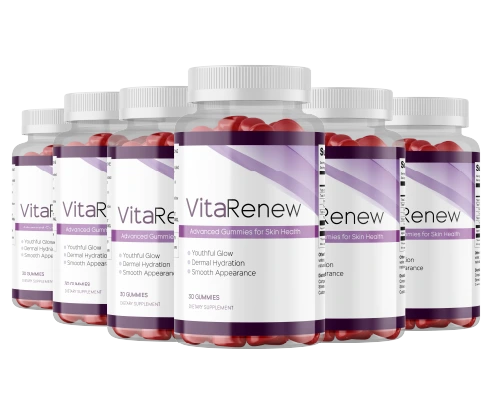
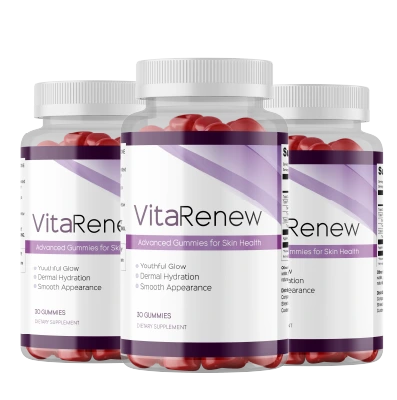
A number of women in their mid-forties through sixties are using a daily gummy supplement called VitaRenew, formulated around these three cofactors for dermal support. The 2-bottle kit — representing approximately sixty days of use — is where many start: it is the minimum meaningful trial period given the dermis operates on a slow timeline, and it carries a 60-day money-back guarantee.
The internal approach
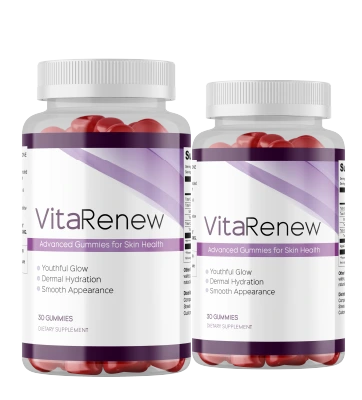
VitaRenew
Vitamin C, copper, and zinc in a daily gummy — the cofactors collagen synthesis and fiber cross-linking depend on. FDA-registered, GMP-certified facility.
Two months to see whether the internal approach makes a difference. 60-day guarantee if it doesn’t.
60-day money-back guarantee · One-time purchase, no subscription"I started because I understood the mechanism, not because of an ad. Once I learned what UV does to the dermis and what cofactors it depletes, it seemed logical. Four months in, the skin on my forearms looks measurably different. Not a dramatic before-and-after — a real, gradual difference."
"I'd been using collagen powder for two years with minimal results. What I eventually learned is that raw collagen peptides don't substitute for the cofactors the body needs to organize them. Switching to VitaRenew was a different experience — slower to start, but after five months the skin on my chest has genuinely changed."
These statements reflect individual experiences. Results are not typical and will vary from person to person.
Setting realistic expectations for timeline
The dermis is not a fast-responding tissue. The surface layer of skin — the epidermis — turns over every few weeks and can show visible changes relatively quickly. The deeper structural layer, where the collagen and elastin matrix lives, operates on a much slower timeline. Meaningful structural changes, when they occur, typically take sixty to ninety days to begin to manifest visibly, and longer to accumulate to a point a person can clearly identify.
This is why trial periods shorter than sixty days are unlikely to produce interpretable data. It is also why dermatologists advise photographing the areas of concern at the beginning of any intervention — the eyes adapt to gradual change and stop registering it, while a photograph from three months earlier makes the change legible.
The sun does cause crepey skin — through a specific, well-characterized pathway involving MMP activation, structural collagen and elastin degradation, and depletion of the cofactors needed to rebuild. That pathway does not respond to topical products aimed at the surface layer. For the women asking this question in their forties and fifties, understanding the mechanism is the beginning of a more targeted approach. The 2-bottle starter kit is where that approach practically begins.
Start here
VitaRenew
The cofactor approach to dermal support — vitamin C, copper, zinc. No autoship, no subscription. 60-day money-back guarantee.
The 2-bottle starter is the right place to begin.
60-day money-back guarantee · One-time purchase, no subscription