Skin Health · Explainer
The Skin on Your Hands Is Thinning — Here's What You Can Actually Do About It
Veins showing through. Bruises that appear without an obvious cause. A pinch that stays creased for a second too long. This is skin thinning — and the biology behind it points to specific things that support it.

It starts with the backs of your hands.
Not the face — that's often the second place women notice the signs of skin aging. The hands are first. They're in sunlight most, they're subjected to more mechanical stress, and they carry almost no subcutaneous fat to cushion the structural changes happening underneath. Whatever is happening to your skin overall, the hands show it first and most clearly.
What you're seeing — the more prominent veins, the skin that looks almost papery in certain light, the way it pinches and doesn't spring back immediately — isn't a surface problem. It isn't about moisturizer. It's about what's happening in the layer of skin you can't see or touch: the dermis.
Understanding what's actually going on in that layer is the only useful starting point if you want to do something meaningful about it.
What's actually happening beneath the surface
The dermis — the layer of skin that sits beneath the epidermis you can see — is built primarily from collagen. Dense, cross-linked collagen fibres give skin its thickness, its mechanical strength, and its ability to resist tearing and bruising. Between those fibres, hyaluronic acid draws in water, and elastin provides the springiness that makes skin snap back after it's stretched or pressed.
From roughly the mid-twenties onward, collagen production begins a gradual downward slope. Fibroblasts — the cells responsible for building and maintaining the dermal structure — become less active. Estimates in the peer-reviewed literature put the rate at approximately one percent of dermal collagen lost per year. Across two decades, that becomes measurable thinning.
The hands are particularly affected for two reasons. First, they have very little subcutaneous fat — the cushioning layer beneath the dermis that gives a "padded" quality to skin in other areas. Second, the skin on the backs of the hands receives cumulative UV exposure throughout a lifetime, and UV exposure accelerates collagen breakdown through a separate mechanism, generating enzymes called matrix metalloproteinases that degrade existing collagen.
What looks like aging on the surface of your hands is a structural change happening below it. The visible layer isn't the problem; the scaffolding underneath it is.
The bruising that many women notice after 45 or 50 is a direct mechanical consequence. When the dermis was denser and thicker, it absorbed minor impacts — bumping against a drawer, pressing the hand against a hard surface — without transferring that force to the blood vessels beneath. As the dermis thins, that cushioning is reduced. Minor impacts now do what they couldn't before.
Why the forties are when most women first notice it
Two separate processes converge in the perimenopausal years. The first is the slow cumulative decline in collagen production that has been building for fifteen to twenty years. The second is a hormonal shift that accelerates it.
Estrogen plays a significant role in maintaining dermal thickness and collagen density. It supports fibroblast activity and slows the enzymatic degradation of existing collagen fibres. As estrogen levels begin to fall through perimenopause and menopause, both of these protective effects weaken. Studies using ultrasound measurements of skin thickness have documented measurable decreases in dermal depth in the years immediately surrounding menopause — sometimes as much as a thirty percent reduction in skin collagen in the first five years after menopause.
That's the convergence. A decline that was slow and almost imperceptible suddenly has an accelerant. The hands, with their thin dermis and high UV exposure history, register the combined effect visibly.
"It happened so fast" is the phrase women often use. It didn't happen fast — two curves arrived at the same point simultaneously.
Why most approaches to skin thinning don't address the actual mechanism
Most products marketed for aging skin address the surface: barrier hydration, texture, tone. These are real concerns, and surface-level approaches can improve how skin looks. But they do not address dermal thickness or the collagen content of the dermis, because they cannot reach that layer.
Collagen-containing creams and serums are also largely surface-level: collagen molecules are too large to penetrate the epidermis in meaningful amounts. They work as humectants, improving the appearance of the surface — which is valuable — but they do not deliver collagen to the dermis.
The more interesting question is about internal support: whether the body's own collagen production can be influenced from the inside out. This is where the research gets specific.
The cofactors that collagen synthesis actually depends on
Your body still makes collagen. Fibroblasts are still present and still functional. Collagen synthesis is a multi-step biochemical process, and that process depends on more than just amino acid supply — it requires specific enzymatic cofactors without which the production is incomplete or structurally compromised.
Three cofactors stand out in the peer-reviewed literature:
- Vitamin C. Two enzymes that are essential to collagen synthesis — prolyl hydroxylase and lysyl hydroxylase — are both strictly dependent on vitamin C. These enzymes add hydroxyl groups to the collagen molecule, a step that is required for the triple-helix structure that gives collagen its strength. Without adequate vitamin C, these enzymes cannot function properly, and the collagen produced is structurally unstable. This is not supplement marketing — it is why vitamin C deficiency (scurvy) causes connective tissue to break down, and it has been established biochemistry for decades.
- Copper. Once individual collagen molecules have been synthesized, they must be cross-linked into a functioning network. The enzyme that does this — lysyl oxidase — requires copper as a cofactor. Without adequate copper, collagen fibres are produced but never properly organized into the dense, cross-linked mesh that gives the dermis its structural integrity. Cross-linked collagen is mechanically strong; uncross-linked collagen is not.
- Zinc. Zinc supports the activity of multiple enzymes involved in skin repair and connective tissue maintenance. It acts as a cofactor in the matrix metalloproteinase enzymes that regulate collagen remodelling, and adequate zinc is associated with better wound healing and structural skin integrity.
This matters for a practical reason. In a normally nourished adult, amino acid supply is rarely the limiting step in collagen synthesis. What more often limits it is the enzymatic machinery — and the machinery depends on vitamin C, copper, and zinc. Providing the building material without the tools does not change what gets built.
Think of collagen synthesis as a factory. Adding raw materials without the tools that process them doesn't increase output. The tools — the enzymatic cofactors — are what most formulas leave out.
Referenced in this article
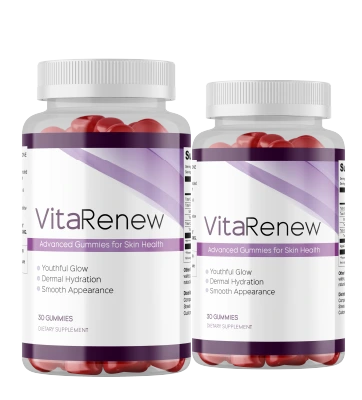
VitaRenew
Vitamin C, zinc and copper — the three cofactors collagen synthesis depends on — in one daily gummy. Supports skin, hair and nails. 60-day money-back guarantee.
A 60-day supply: enough time to give the dermis something real to work with.
60-day money-back guarantee · One-time purchase, no subscriptionWhat a practical checklist looks like
What to look for if you're evaluating support for skin thickness
- Vitamin C at a meaningful dose. Not a trace amount on a label for cosmetic appeal. The enzymes that stabilize collagen molecules require an actual supply.
- Copper — specifically. It is absent from the majority of "collagen support" formulas because it's considered unglamorous. But without it, the cross-linking step that gives collagen its structural strength is incomplete.
- Zinc alongside copper. The two minerals operate on different steps of the same process. They are best evaluated together.
- Antioxidant support. Vitamins E and selenium help protect existing collagen from oxidative degradation — the same breakdown accelerated by UV exposure over decades.
- Realistic timeline framing. Dermal remodelling is measured in months. Any product claiming visible improvement in a week is not describing collagen synthesis.
- At least a 60-day guarantee. The minimum meaningful window to evaluate any change in skin structure is eight to twelve weeks.
- Manufacturing in an FDA-registered, GMP-certified facility. Third-party quality control is verifiable and matters for supplement integrity.
Where VitaRenew addresses that list
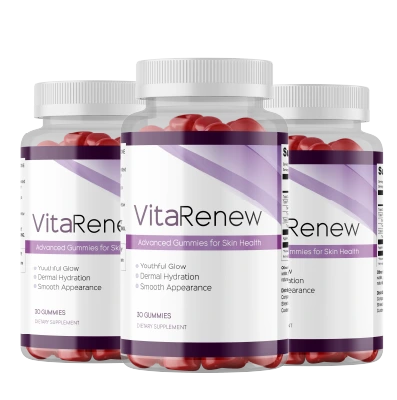
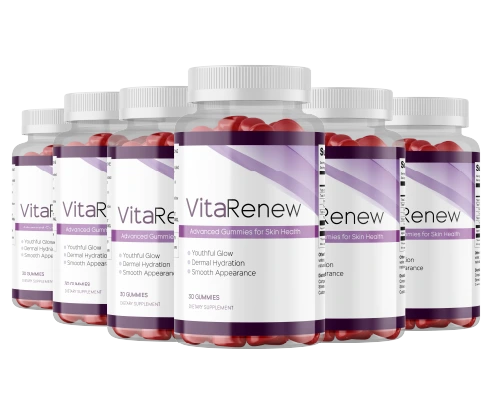
Of the formulas we reviewed for this piece, VitaRenew is the one that matches the checklist most directly. It's a daily gummy built specifically around the cofactor approach — vitamin C, zinc, and copper together, along with vitamin E, selenium, and beta-carotene for antioxidant support. It's manufactured in an FDA-registered, GMP-certified facility and sold with a sixty-day money-back guarantee.
It supports skin, hair, and nails. It is a supplement — it does not diagnose, treat, or cure any condition. The sixty-day guarantee reflects the realistic timeline for any meaningful change at the dermal level.
The entry point is the two-bottle supply — 60 days, $79 per bottle. That is the minimum meaningful trial. Given that payout is the same regardless of which size you choose, the two-bottle option is the sensible starting point: it gives enough time to notice anything real without a large upfront commitment.
What users report
"The bruising was what drove me to try something. I'd bump my hand against almost anything and end up with a mark that lasted two weeks. About two and a half months in, I do seem to be bruising less easily. It's not dramatic, but it's a real difference I keep noticing."
"I started paying attention to the backs of my hands last year. They'd gotten to the point where every vein and tendon was visible — almost transparent-looking. After three months I think there's slightly more substance to the skin. Hard to measure, but it looks less hollowed-out to me."
These reflect individual experiences. Results are not typical and vary based on age, diet, genetics, hormonal status, sun history, and other factors.
What's realistic to expect — and over what timeline
The dermis remodels slowly. Unlike the epidermis — the outer skin layer, which turns over in four to six weeks — dermal changes are measured in months. Studies that have examined skin-directed supplementation use eight-to-twelve-week outcomes as the primary measurement window because that is where the first statistically observable changes appear in controlled conditions.
Photograph the backs of your hands on day one, in consistent lighting, and compare at ninety days. Expect subtlety, not drama. The goal isn't a reversal of what's happened over decades — it's supporting the machinery that continues to build and maintain the dermis going forward.
Individual variation is significant. How much collagen you've already lost, how much cumulative UV exposure your hands have had, what your hormonal status is, how much vitamin C and copper you typically get from food — all of these affect what any supplement can do for a specific person. No supplement controls all of those variables.
When to see a dermatologist instead. The skin thinning described in this article is gradual and symmetrical — a slow biological change uniform across the hand. If you notice a spot that changes in color, shape, or texture rapidly, or a bruise that appears without any impact at all, those are questions for a physician. Gradual, diffuse, and bilateral is normal aging. Sudden and localized warrants professional evaluation.
The short version
Skin thinning on the hands is a structural change happening in the dermis — the inner layer — where collagen fibres have been thinning and losing their cross-linked density since the mid-twenties. The perimenopausal drop in estrogen accelerates that process. The visible result: veins and tendons more apparent, easier bruising, less springiness to the skin.
The body still produces collagen. What limits how much it can produce isn't usually amino acid supply — it's the enzymatic cofactors that vitamin C, copper, and zinc provide. That's the specific gap that most approaches to aging skin address least directly, and it's where the clearest mechanism exists for nutritional support.
Sixty days is the minimum meaningful trial. The two-bottle supply is the most practical entry point.
Product referenced above
VitaRenew
Vitamin C, zinc and copper — the cofactors collagen production depends on — in one daily gummy. FDA-registered facility. 60-day money-back guarantee.
Start with 60 days. Give the dermis what the factory needs.
60-day money-back guarantee · Supports skin, hair and nailsBackground reading
- Shuster S, Black MM, McVitie E. "The influence of age and sex on skin thickness, skin collagen and density." British Journal of Dermatology, 1975.
- Pullar JM, Carr AC, Vissers MCM. "The Roles of Vitamin C in Skin Health." Nutrients, 2017.
- Rucker RB et al. "Copper, lysyl oxidase, and extracellular matrix protein cross-linking." American Journal of Clinical Nutrition, 1998.
- Thornton MJ. "Estrogens and aging skin." Dermato-Endocrinology, 2013.
- Rittié L, Fisher GJ. "UV-light-induced signal cascades and skin aging." Ageing Research Reviews, 2002.
- Castelo-Branco C et al. "Relationship between skin collagen and bone changes during aging." Maturitas, 1994.