Skin Health · Science Explained
Is Crepey Skin a Sign of Dehydration? The Real Cause
You drink your water and reach for the moisturizer — and the texture still won't budge. Short answer: crepey skin isn't a hydration problem. The longer answer changes what you actually do about it.

You drink your water. You slather on lotion. And your arms still look like crepe paper.
If hydration were the root issue, that routine should work. It doesn't — at least not in any lasting way. You might notice the skin looks a little smoother for an hour after moisturizing, then by evening it looks exactly the same. That gap between what hydration promises and what it delivers is not a coincidence. It's information.
The intuitive logic goes: dry skin looks rough and dull, water plumps things up, therefore crepey skin equals dehydration. It's a reasonable chain, but it breaks down at the last link. Crepey skin and dehydrated skin are two different conditions that can coexist — and treating one won't reliably address the other.
Understanding the distinction doesn't just satisfy the question. It points to what actually matters.
What dehydrated skin looks and feels like
The outermost layer of the skin — the stratum corneum — is a moisture barrier. When it's compromised or when you're genuinely dehydrated, this layer loses water. The result: skin that looks dull or tired, feels tight, may flake slightly, and sometimes reacts with sensitivity.
This is the layer that skincare products can reach. A good moisturizer works here — it reinforces the barrier, traps water against the surface, and makes skin look smoother and more even for hours at a time. Drinking more water supports this too, particularly if you've been running below your personal baseline.
So far, so good. But here's where the chain breaks.
Crepey skin — that thin, tissue-paper texture on the inner arms, chest, neck, and backs of hands — doesn't respond meaningfully to these approaches. It persists through adequate hydration, through expensive serums, through a consistent skincare routine. In fluorescent light, in morning windows, it's still there.
That non-response is diagnostic. It tells you the issue isn't sitting where those products can reach.
The layer that crepey skin is actually pointing to
Beneath the barrier layer of the skin sits the dermis, a much thicker, structurally complex layer where the mechanical properties of skin actually live. Two proteins dominate here:
- Collagen provides firmness, thickness, and structural volume. Press your finger against your forearm and the skin holds its shape — or used to. That resistance comes from collagen density in the dermis.
- Elastin provides the snap-back quality. Pinch the skin and release it; the speed at which it returns is a measure of elastin function. Skin that settles slowly into folds, that creases and stays, is showing reduced elastin activity.
Crepey skin is the surface appearance of changes in this deeper structural layer — not the surface. The thin, papery texture results when collagen density falls and elastin loses its spring. The outer barrier layer may be perfectly hydrated, and the crepey texture is still present, because the texture isn't coming from the outer layer at all.
The moisturizer reaches the stratum corneum. The collagen and elastin are in the dermis. These are not the same layer — and that single fact explains most of why topical approaches have a ceiling.
This is why people who drink plenty of water and use good skincare products still develop crepey skin in their forties and fifties. The inputs they're adding are going to a different address than the problem.
Why it tends to appear after 40
Collagen synthesis declines gradually from the mid-twenties — commonly cited at roughly one percent per year. That pace is slow enough that it goes unnoticed for a long time. The scaffolding thins, but there's enough margin that nothing obvious changes in the mirror.
What makes the forties feel like a turning point is that a second process arrives on top of the first. Estrogen actively maintains dermal collagen density and skin thickness throughout the reproductive years. As estrogen levels fall through the perimenopausal transition, the pace of collagen loss accelerates markedly. Research into skin changes around menopause has found that a significant proportion of dermal collagen can be lost in the years immediately surrounding it.
The result is two declining curves meeting: the slow background slope of age-related collagen loss, and a sharper drop driven by hormonal change. That intersection is why it can feel like it happened overnight when it actually didn't. It had been building quietly for years before it crossed the visual threshold.
Sun exposure, smoking, and some medications can accelerate the process — but they're accelerants, not the cause. Women who avoided every risk factor still develop crepey skin after 40. It is not a consequence of anything you failed to do.
What the structural layer actually needs
Here is something worth understanding clearly: the body does not stop producing collagen when you hit your mid-forties. The fibroblast cells that produce it are still present in the dermis. Collagen synthesis is still running. What changes is how efficiently and how completely the process runs — and that depends on whether certain nutritional inputs are available.
Two of those inputs are worth knowing by name:
- Vitamin C is an essential cofactor for the enzymes that stabilize newly formed collagen into its final, structurally useful triple-helix shape. The enzymes involved — prolyl hydroxylase and lysyl hydroxylase — require vitamin C to function. Without adequate vitamin C, collagen is produced in a structurally weak, unstable form. This is not a supplement marketing claim; it is the mechanism behind scurvy's destruction of connective tissue, documented in biochemistry for decades.
- Copper activates lysyl oxidase, the enzyme that cross-links individual collagen and elastin fibres into the dense, tightly woven network that gives skin its firmness and snap-back. Think of it this way: you can have all the fibres you need, but if they're not cross-linked into structure, they behave like a pile of threads rather than a woven fabric.
Zinc belongs in this conversation as well — it is involved in skin cell turnover and the continuous maintenance processes that keep the dermis functioning over time.
These aren't raw building materials for collagen. They're the tools the assembly line needs to run. Adequate protein supply is rarely the bottleneck for most well-nourished adults. The limiting factor tends to be the enzymatic steps — and those depend on the nutrients above.
Referenced in this article
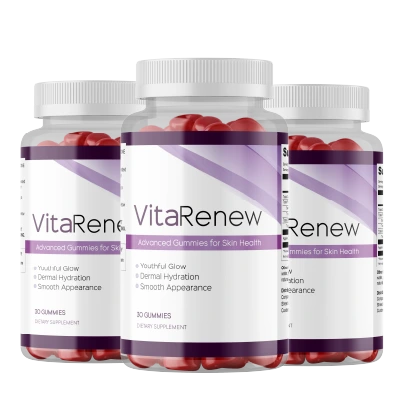
VitaRenew
Vitamin C, zinc and copper — the cofactors your skin's structural maintenance depends on — in one daily gummy.
For the days when you'd rather your arms not tell the story first.
60-day money-back guarantee · One-time purchase, no subscriptionWhat to look for when evaluating a supplement
If you have tried skin-focused supplements without a meaningful result, the most common reason is this: the product was built around collagen peptides — raw amino acids — rather than the cofactors the synthesis process needs. Several controlled trials of oral collagen peptides have reported modest improvements in skin elasticity and hydration measures. The research is real. But in a well-nourished adult, amino acid supply is usually not the limiting step.
A practical checklist
- Meaningful vitamin C quantity — not a trace quantity added for the label, but a dose that could actually support enzymatic activity.
- Zinc and copper together. They operate at different steps of the same process. Copper is routinely left out of skin formulas despite being the one that builds the cross-linked structure.
- A guarantee long enough to actually evaluate. Dermal remodelling runs on a timescale of months. A 30-day return window tells you the manufacturer isn't confident the product works; 60 days at minimum is the right threshold.
- Clean manufacturing. FDA-registered facility, GMP-certified. Third-party testing is a positive signal.
- Realistic marketing. If anything promises visible results in seven days, what it's actually telling you is something about the seller — not the product.
A note on timeline
The outer skin layer turns over every four to six weeks, so tone and surface texture can shift in that window. The dermis is slower — collagen remodelling is measured in months. This is why most controlled studies of skin supplements use eight- to twelve-week evaluation windows. Take a photograph on day one, in consistent light. Give any intervention three full months before drawing a conclusion. Expect change to be gradual, not dramatic, and to vary based on genetics, sun history, diet, and sleep — variables no supplement can override.
What people report
"I'd been taking a collagen powder for eight months and noticed very little. Then I switched to something that focused on the cofactors — vitamin C, zinc, copper. It took about ten weeks before I started noticing anything, but the texture on my arms does feel different. Less papery in certain light."
"The thing that convinced me was the 60-day guarantee. I figured I had nothing to lose. I'm on my third bottle now. Not a transformation, but the change has been real and steady. My doctor said my skin looks healthier at my last visit, and I hadn't told her I was trying anything new."
These are individual accounts. Results are not typical and vary considerably based on individual factors. No supplement is intended to diagnose, treat, cure, or prevent any condition.
Product referenced above
VitaRenew
The cofactor approach in one daily gummy — vitamin C, zinc and copper. Made in an FDA-registered, GMP-certified facility. 60-day money-back guarantee.
Support the structural layer, not just the surface.
60-day money-back guarantee · Supports skin, hair and nailsBackground reading
- Pullar JM, Carr AC, Vissers MCM. "The Roles of Vitamin C in Skin Health." Nutrients, 2017.
- Rucker RB et al. "Copper, lysyl oxidase, and extracellular matrix protein cross-linking." American Journal of Clinical Nutrition, 1998.
- Thornton MJ. "Estrogens and aging skin." Dermato-Endocrinology, 2013.
- Shuster S, Black MM, McVitie E. "The influence of age and sex on skin thickness, skin collagen and density." British Journal of Dermatology, 1975.
- Ogawa Y et al. "Zinc and skin disorders." Nutrients, 2018.