Skin Health · Explainer
Is Crepey Skin Permanent? What Really Happens After 40
Most people typing this question want a reassuring no — and also suspect the honest answer is more complicated. Here is what the biology actually says, and why the full picture is more useful than either extreme.

You pressed the skin on your forearm and it didn't spring back the way it used to. Or you noticed the fine, papery texture across your hands under direct light. And at some point you typed the question that everyone types and nobody asks their doctor: is this permanent?
It is the right question. And the answer involves a distinction that most skin articles blur together: permanence is not the same as inevitability going forward. These are two different things, and understanding the difference changes what you do next.
The short answer — and why it matters
The structural change that causes crepey skin does not reverse on its own. That part is accurate. Left alone, with no changes to what the body has available to maintain the dermis, the trajectory continues in one direction.
But "permanent" suggests a door that is permanently closed, and that is the part that requires qualification. The dermis — the layer of skin where the structural change is happening — remains a biologically active tissue throughout our lives. The cells that maintain it are still there. The pathways that build and repair it are still functioning. What those pathways depend on, and whether they have what they need, is the more useful question.
Where crepey skin actually comes from
Skin has layers. The one you can touch, moisturize, and treat topically is the outer layer — a barrier about as thick as plastic wrap, whose job is to hold water in and keep the outside world out.
The layer that matters for crepey texture sits beneath it: the dermis. This is a dense mesh of collagen fibres that give skin its thickness and firmness, elastin fibres that let it rebound after stretching, and hyaluronic acid molecules that bind water between them. When you press your skin and it springs back instantly, that is the dermis working.
Crepey skin is the surface appearance of a dermis that has thinned. Fewer fibres, less cross-linking between them, less recoil. The outer layer is still doing its job — but the structural support beneath it has diminished. This is why a richer moisturizer can temporarily make crepey skin look better (more water in the barrier plumps it and changes how light reflects) and then look exactly the same by evening. The surface was addressed. The source wasn't.
Why the forties tend to be the turning point
Collagen production declines gradually from the mid-twenties — approximately one percent per year by conventional estimates. That is slow enough that most people don't notice the effect for a long time.
What changes in the forties is that a second process arrives on top of the first. Estrogen plays an active role in maintaining collagen density and skin thickness; several mechanisms have been identified. As estrogen levels decline through the perimenopausal years, the rate of dermal collagen loss accelerates. Research on skin changes around menopause has documented significant collagen loss in the years immediately surrounding it.
So the effect that feels sudden wasn't sudden. Two gradual processes converged: the slow age-related decline and the sharper hormone-related drop. That intersection is what makes it feel like it happened quickly when it had been building for years.
Sun exposure, smoking, and some medications can accelerate this. But they are accelerants, not causes. Women who did everything right still encounter crepey skin in their forties. This is not a consequence of neglect.
What the body still knows how to do
Here is the part most prognostic discussions leave out: your skin has not lost the ability to maintain itself. The cells responsible for producing collagen and elastin — fibroblasts — are still present in the dermis at forty, fifty, and beyond. The genes encoding collagen synthesis are intact. The enzymatic pathways exist.
Collagen synthesis is, at its core, a biochemical assembly line. And like any assembly line, it does not only need raw material — it needs specific tools to run. Two of those tools are worth understanding in detail.
Vitamin C. After a collagen molecule is assembled from amino acids, it must be stabilized into its functional triple-helix shape. The enzymes that do this — prolyl hydroxylase and lysyl hydroxylase — are strictly dependent on vitamin C as a cofactor. Without adequate vitamin C, collagen forms in a structurally weak, unstable shape. This is not a wellness-industry claim. It is the long-established biochemical explanation for why scurvy destroys connective tissue — the same mechanism documented in textbooks decades before anyone marketed skin supplements.
Copper. Newly assembled collagen and elastin fibres begin as loose, unbound threads. An enzyme called lysyl oxidase cross-links them into the tightly woven, springy network that gives the dermis its mechanical properties. Lysyl oxidase is copper-dependent. Without adequate copper, fibres are produced but never assembled into functional structure.
Zinc rounds out the picture: it supports normal skin integrity and the continuous maintenance processes the dermis runs throughout our lives.
More raw material going into a line that is short on tools does not change the output. The tools are the bottleneck — and they are the piece that most skin formulations leave out.
Why collagen supplements often fall short
If you have taken an oral collagen supplement for several months without noticing much, this mechanism is the most likely explanation. Some controlled trials of collagen peptides have reported modest improvements in skin elasticity and hydration — the research is not worthless. But in most reasonably well-nourished adults, amino acid supply is not the rate-limiting step in collagen synthesis.
If the limiting factor is enzymatic — vitamin C for stabilization, copper for cross-linking — then supplying more raw material to a line that cannot fully process what it already has does not change the output meaningfully. The rate-limiting step stays rate-limiting.
Referenced in this article
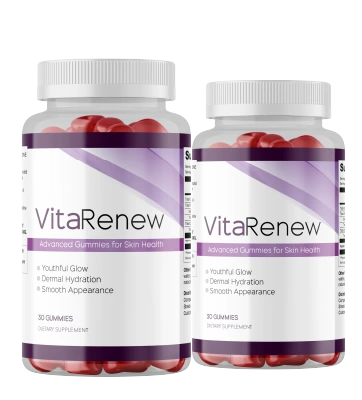
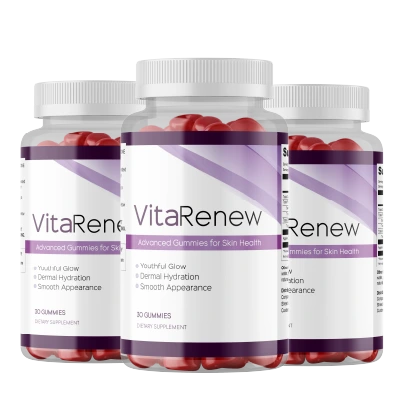
VitaRenew
The cofactors collagen synthesis depends on — vitamin C, zinc and copper — in one daily gummy. Designed for the step most products skip.
For the skin that's still doing the work, with the right support.
60-day money-back guarantee · One-time purchase, no subscriptionWhat realistic expectation looks like
This is the part worth calibrating before you start anything, because the mismatch between expectation and biology is the primary reason people quit before the process has had time to work.
The outer skin layer turns over roughly every four to six weeks. Texture and surface tone are the first things that can shift — this is the timescale that most topical products operate on, and why many of them produce visible effects quickly. The dermis is a different story. Collagen remodeling is measured in months, not weeks. Controlled studies of supplements targeting dermal structure typically use eight to twelve week evaluation windows, and that is not an artifact of study design — it reflects the pace of the underlying biology.
Take a photograph in consistent light, same time of day, on day one. Not because the change will be dramatic — it probably will not be — but because gradual change is invisible without a reference point. Three months is the minimum sensible window for evaluating anything targeting the dermis. Individual results vary based on genetics, existing dietary status, sun history, sleep, and factors no supplement can override.
What to look for
A practical checklist
- Vitamin C in a meaningful amount — not a trace added for the label, but a dose that would actually support enzymatic function.
- Zinc and copper together. They operate on different steps of the same pathway. Copper is the ingredient most skin products omit — it's not aspirational, and it doesn't market as well as collagen, but it matters for the cross-linking step.
- Antioxidant support (vitamin E, selenium) — oxidative stress degrades existing collagen fibres while you are trying to support new ones. Addressing only synthesis while ignoring degradation is incomplete.
- A realistic timeline in the marketing. Any product that promises visible results in seven days is telling you something useful about the seller, not the science.
- A guarantee long enough to actually evaluate the product — sixty days is the minimum. The dermis remodels on a timescale of months; a thirty-day guarantee is not long enough to let the biology answer the question.
- Third-party testing and transparent manufacturing standards. In a category where labeling is not uniformly enforced, third-party certification is the most available proxy for what is actually in the product.
What women who have tried this approach report
"I asked my doctor if crepey skin was permanent and she said basically yes, short of procedures. I wasn't ready to do procedures. I found an article about the cofactors — the vitamin C and copper angle — and decided to try the supplement approach with that logic. Four months in, the skin on my arms and hands is genuinely different. Less papery. My doctor asked what I'd changed."
"I want to be honest: I didn't have a dramatic transformation. What I have is skin that is noticeably less tissue-paper-thin than it was six months ago, and I stopped dreading sleeveless weather. The 60-day guarantee meant I could actually evaluate it without feeling like I was making a gamble."
These are individual accounts. Results vary and are not typical. No supplement can diagnose, treat, cure or prevent any disease or condition.
Product referenced above
VitaRenew
Vitamin C, zinc and copper in one daily gummy. Made in an FDA-registered, GMP-certified facility. 60-day money-back guarantee.
The cofactor approach — the piece most formulas leave out.
60-day money-back guarantee · Supports skin, hair and nailsBackground reading
- Pullar JM, Carr AC, Vissers MCM. "The Roles of Vitamin C in Skin Health." Nutrients, 2017.
- Rucker RB et al. "Copper, lysyl oxidase, and extracellular matrix protein cross-linking." American Journal of Clinical Nutrition, 1998.
- Thornton MJ. "Estrogens and aging skin." Dermato-Endocrinology, 2013.
- Proksch E et al. "Oral supplementation of specific collagen peptides has beneficial effects on human skin physiology: a double-blind, placebo-controlled study." Skin Pharmacology and Physiology, 2014.
- Ogawa Y et al. "Zinc and skin disorders." Nutrients, 2018.