Skin Health · Explainer
Loss of Skin Elasticity: The Three Causes Most Women Never Hear About
Collagen gets all the attention. But there are two other systems quietly failing alongside it — and missing either one explains why most responses to elasticity loss don't go far enough.

There's a test you can do in about three seconds. Press the back of your hand with two fingers, hold for a moment, then release. If you're in your twenties, the skin returns almost immediately. After forty, most women start to notice a lag — the skin settles back slowly, with a slight reluctance, like it's half-remembering where it used to sit.
That delayed return has a name: reduced skin elasticity. And the word "elasticity" already signals what's changing — the elastic component of the skin, the part that determines its snap and recoil. But elastin is only one part of the story, and it's the part the conversation around aging skin almost never reaches.
Most of what gets written about skin elasticity focuses narrowly on collagen — which is real and important, but incomplete. Understanding why skin loses its elasticity after forty requires looking at three interlocking systems, not one. Getting to all three is what makes the difference between a response that gets you halfway there and one that addresses what's actually failing.
The architecture of elastic skin
Skin isn't a single uniform material. It's a layered structure, and the layer that determines how skin feels and behaves is not the surface you can touch. That outer layer — the stratum corneum — is essentially a barrier: flattened, dead cells embedded in lipids, roughly as thick as kitchen wrap. Its job is to prevent water loss and keep the outside world out.
Underneath it sits the dermis. This is where the actual mechanical properties of skin live: a dense scaffold of collagen fibres giving skin its thickness and resistance, elastin fibres providing its snap and spring, and a matrix of hyaluronic acid and other glycosaminoglycans holding water between them. When people describe skin as feeling "firm," "bouncy," or "tight," they're describing the dermis performing well.
Loss of skin elasticity is what a dermis in structural decline looks like from the outside. Something has changed inside the scaffold — and usually, it's not one thing.
The three systems that determine skin elasticity are collagen volume, elastin integrity, and the enzymatic machinery that builds and maintains both. Most approaches touch the first. Almost none address the third — which is where the process most often breaks down.
Cause one: collagen loss
Collagen is the most abundant protein in the dermis. It provides the structural bulk — the mass and resistance that keeps skin thick and resistant to pressure. Collagen decline is well established: production falls from the mid-twenties onward at roughly one percent per year, which is slow enough to go unnoticed for a long time.
What makes the forties feel like a turning point isn't the rate of decline — that's been happening for nearly two decades — it's that a second layer of change arrives on top of it. Estrogen supports collagen density and skin thickness. As estrogen drops during the perimenopausal transition, collagen loss accelerates sharply. Research on skin changes around menopause has found that a substantial share of dermal collagen can be lost in the years immediately surrounding it.
The result is skin that's physically thinner and less resistant — which affects not just how it feels but how it responds to movement, expression, and the ordinary forces of daily life. When collagen thins, skin has less structural mass to snap back to.
Cause two: elastin — the part nobody talks about
Elastin is the protein that gives skin its actual recoil. It's what lets skin spring back after being stretched, pressed, or pinched. And here's what most conversations about aging skin leave out: unlike collagen, elastin fibres in adult skin are barely produced at all.
The elastin currently in your dermis was mostly laid down in childhood and adolescence. It is not regularly replaced. Your body does not meaningfully replenish it once you're an adult.
What changes after forty is not primarily elastin production (which was already minimal). What changes is the degradation of the elastin you already have:
- Oxidative damage accumulates. Elastin fibres are particularly sensitive to reactive oxygen species — the byproducts of normal metabolism that accumulate faster as antioxidant systems age. Over decades, this damage makes fibres more rigid and prone to fragmentation.
- UVA radiation degrades elastin directly. Unlike UVB (which causes burning), UVA penetrates through glass and cloud cover into the dermis, where it fragments elastin fibres. The cumulative effect, sometimes called photoaging, is a major contributor to the loss of elasticity in sun-exposed areas — the face, neck, chest, and forearms.
- Cross-links weaken over time. Newly made elastin fibres need to be cross-linked — bonded to one another — to form the resilient network that gives skin its spring. This process depends on specific enzymes and mineral cofactors. As those systems slow, existing fibres become less tightly bound.
This last point leads directly to the third cause — and the one that is almost never mentioned.
Cause three: the enzymatic cofactor gap
Here is the piece of the puzzle that changes how you think about all of this.
Your body does not passively lose collagen and elastin without replacement. The cells that make them — fibroblasts — are still present in adult skin, and they are still receiving signals to produce structural proteins. The process doesn't simply turn off. What happens instead is that the enzymatic machinery needed to complete the process becomes less effective — and in many cases, it's working with missing tools.
Two enzymes in particular are worth understanding, because they are the rate-limiting steps in collagen and elastin production:
- Prolyl hydroxylase and lysyl hydroxylase (for collagen). These enzymes give newly produced collagen its stable triple-helix shape — the structure that makes collagen strong. Both are strictly dependent on vitamin C as a cofactor. Without adequate vitamin C in the tissue, collagen is produced in a weak, unstable form that degrades quickly. This isn't a subtle effect: it's why scurvy destroys connective tissue, and it's in biochemistry textbooks that predate modern wellness marketing by decades.
- Lysyl oxidase (for both collagen and elastin). This enzyme cross-links newly made collagen and elastin fibres into the strong, springy network that gives skin its mechanical properties. Without cross-linking, you can produce all the individual fibre proteins you want — they'll never form a functional scaffold. Lysyl oxidase is a copper-dependent enzyme. Without copper, the fibres are made but never properly bound.
Zinc belongs in the same picture: it's involved in skin integrity and in the repair processes that run continuously in the dermis to address everyday micro-damage.
The analogy that holds: imagine a construction crew with all the timber and steel they need, but none of the fasteners or the tools to use them. The raw material is there. The building doesn't get built — and it certainly doesn't hold together under stress.
Why this explains what you've already tried
If you've taken collagen supplements for months without noticing a meaningful difference, the cofactor gap is the most likely explanation — and it's a more interesting one than "collagen doesn't work."
To be fair to the evidence: several controlled trials of oral collagen peptides have reported modest improvements in skin elasticity and hydration. The mechanism is still debated, but amino acids from collagen supplements may signal fibroblasts to increase their own collagen production. It isn't nothing. But in a reasonably well-fed adult, amino acid supply is rarely the bottleneck. If the limiting step is the enzymatic machinery — vitamin C for stabilization, copper for cross-linking — then increasing the raw material doesn't change the output much.
Similarly, topical creams can address the surface barrier — temporarily plumping the stratum corneum with water and occlusive ingredients, improving how light reflects off the skin. This produces a genuine but brief improvement. By evening it's back. Nothing in the dermis changed, because nothing in the dermis was ever reached.
What to look for, if you decide to try something
A practical label checklist
- Vitamin C in a meaningful amount — not a trace listed to decorate the label.
- Copper — the most commonly omitted cofactor in skin formulas, and arguably the most important for the cross-linking step.
- Zinc — works on different phases of the repair process; copper and zinc together cover more of the pathway than either alone.
- Antioxidant coverage — vitamin E and selenium are the pair most studied in combination with vitamin C for protecting existing dermis from oxidative fragmentation.
- Third-party testing and a named facility standard — GMP certification at minimum.
- A guarantee long enough to evaluate the product properly — sixty days at minimum, since dermal remodeling takes weeks, not days.
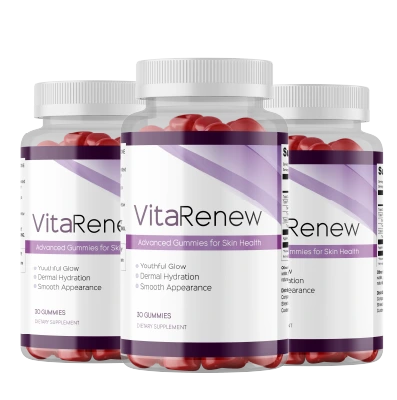
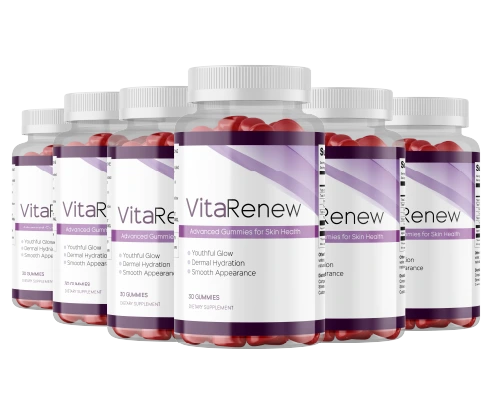
VitaRenew
Of the formulas we reviewed while writing this piece, VitaRenew is the one that most completely addresses the cofactor side of the equation. It's a daily gummy built around vitamin C, zinc, and copper — with vitamin E, selenium, and beta-carotene for antioxidant support. It's made in an FDA-registered, GMP-certified facility and sold with a sixty-day money-back guarantee.
It supports skin, hair, and nails. It is not a treatment for any condition. If you're looking for the "miracle cream" marketing, this is deliberately not that. What it is is a formula that matches what the research says the enzymatic repair process actually needs to run — and that's a different, quieter claim.
The briefest way to try it is the two-bottle supply — sixty days, the minimum time to genuinely evaluate whether your skin responds. If it doesn't, the guarantee covers it entirely.
Referenced in this article
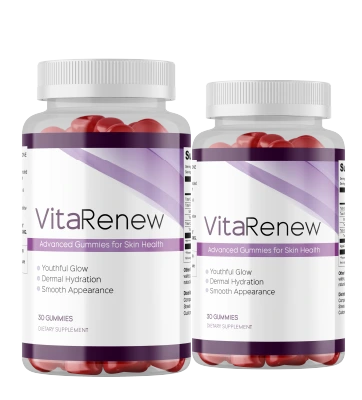
VitaRenew
Vitamin C, zinc, and copper — the cofactors the skin's repair process actually runs on — in one daily gummy.
Sixty days is enough time to find out if it works for your skin.
60-day money-back guarantee · One-time purchase, no subscriptionWhat women notice — and when
"I was skeptical — I'd tried collagen powders before and never noticed much. What changed for me was understanding the cofactor piece. Within the first couple of months I felt like my skin had a little more... presence. It's hard to describe, but the snap-back was different. My neck especially."
"The thing that convinced me was the science explanation, not the before-and-after photos. I started the two-bottle supply just to test it. At week six my daughter mentioned my skin looked different — brighter somehow. I'm now on my third order."
These statements reflect individual experiences. Results are not typical and will vary based on individual factors including age, sun history, baseline nutrition, and consistency of use.
A realistic timeline and the short version
The surface of skin — the stratum corneum — turns over roughly every four to six weeks. That's the timeframe for noticing changes in tone and texture. The dermis is slower: collagen remodeling is a matter of months, not days. Most controlled studies of skin-directed supplements measure outcomes at eight to twelve weeks for exactly that reason.
Give whatever you try a full sixty to ninety days before you evaluate it. Take a photo in the same light on day one. Expect gradual rather than dramatic — and remember that the most common cause of disappointment with supplements like this isn't the formula, it's the timeline.
One caveat worth stating plainly: if a patch of skin changes suddenly, thickens, discolors, or if any spot changes shape or texture in a way that isn't symmetrical and gradual, that's a dermatologist question — not a supplement question. The kind of elasticity loss described in this article is slow and bilateral. Anything that isn't should be examined professionally.
The short version: loss of skin elasticity after forty happens because three systems are changing simultaneously — collagen volume is falling, existing elastin is degrading, and the enzymatic machinery that cross-links both is working with missing cofactors. Addressing only the first and not the other two is why most approaches feel like they partially help and then stop. The cofactor piece is the one most worth investigating on a label.
Product referenced above
VitaRenew
Vitamin C, zinc, and copper in a daily gummy. Made in an FDA-registered, GMP-certified facility.
Start with sixty days. The guarantee means nothing is at stake except finding out.
60-day money-back guarantee · Supports skin, hair, and nailsBackground reading
- Pullar JM, Carr AC, Vissers MCM. "The Roles of Vitamin C in Skin Health." Nutrients, 2017.
- Rucker RB et al. "Copper, lysyl oxidase, and extracellular matrix protein cross-linking." American Journal of Clinical Nutrition, 1998.
- Shuster S, Black MM, McVitie E. "The influence of age and sex on skin thickness, skin collagen and density." British Journal of Dermatology, 1975.
- Thornton MJ. "Estrogens and aging skin." Dermato-Endocrinology, 2013.
- Ogawa Y et al. "Zinc and skin disorders." Nutrients, 2018.
- Kadler KE et al. "Collagen fibril formation." Biochemical Journal, 1996.