Skin Health · Explainer
Why Skin Gets Thinner With Age — What's Actually Happening Inside the Dermis
It isn't dryness, sun damage, or anything you did wrong. Your skin is genuinely getting thinner — and the reason is structural, not surface-level.

You probably didn't decide to pay attention to it. It was more that you couldn't not notice.
Maybe it was the way the skin on the back of your hand had become a thin film over the bones — veins and tendons now visible in a way they hadn't been before. Or a small collision with a cabinet door left a bruise the size of a plum that took two weeks to fade. Or you pressed your forearm against something and felt, beneath the skin, how little padding there seemed to be left underneath.
This is different from the fine-texture changes of crepey skin, though the two often arrive together. What you're describing is the skin itself getting physically thinner — losing the cushion and the structural volume it used to have. It's a real change, and the biology behind it is worth understanding, because it determines what can and can't actually help.
What "thinner skin" actually means
Skin is built in layers. The one you can see and touch — the epidermis — is the outermost layer, a few cell-lengths deep. Below it is the dermis, and that's where the architecture lives.
The dermis is made up of a dense mesh of collagen and elastin fibres, woven together in a way that gives skin its thickness, its springiness, and its resistance to tearing. Between the fibres, hyaluronic acid draws in water, keeping the whole structure hydrated and plump.
When we say skin "gets thinner with age," we are describing the dermis becoming less dense. Fewer collagen fibres, less cross-linking between them, less hyaluronic acid holding the space. The mesh loosens. The padding compresses. Skin that used to feel soft and resilient starts to feel like something with less underneath it — because there genuinely is less underneath it.
It isn't a surface change. Creams that sit on the epidermis are addressing the wrong floor of the building.
The visible signs of dermal thinning are mostly mechanical consequences of that loss. Veins and tendons become visible because there's less tissue over them. Bruising happens more easily because the dermis no longer cushions small impacts the way it once did. Skin tears at lighter contact because the structural fibres that used to give it tensile strength have thinned and loosened.
Why this happens — and why the forties in particular
Two processes overlap in the perimenopausal years, which is why the forties so often feel like the inflection point, even though the underlying change started earlier.
The first is the slow, decades-long decline in collagen production. The cells that make collagen — fibroblasts — gradually reduce their output from the mid-twenties onward. Estimates put it at roughly one percent of dermal collagen lost per year. At that rate, you wouldn't notice anything alarming for a long time. The numbers add up quietly.
The second is estrogen. Estrogen supports the density and thickness of the dermis. It encourages collagen synthesis, maintains skin hydration, and slows the breakdown of existing fibres. As estrogen levels fall through the perimenopausal transition, skin collagen loss accelerates — and skin thickness can decrease measurably in the years immediately surrounding menopause.
The two slopes — the gradual one and the steeper drop — overlap in the forties. That's the "it happened so fast" feeling. The change wasn't sudden; two downward curves simply arrived at the same time.
The part almost nobody explains
Here's where most articles stop. They describe the mechanism, recommend collagen supplements or expensive procedures, and leave. But there's a step between understanding the problem and evaluating any solution — and it's the step that explains why a lot of people try things and see nothing happen.
Your body hasn't lost the ability to make collagen. The fibroblasts are still there. The genes are intact. Collagen synthesis is a biochemical production line, and that line depends on more than raw material. It depends on the machinery that runs it.
Three cofactors are central to that machinery:
- Vitamin C. The enzymes that give a collagen molecule its stable triple-helix structure — prolyl hydroxylase and lysyl hydroxylase — are both strictly dependent on vitamin C as a cofactor. Without adequate vitamin C, collagen is synthesized in a structurally weak, unstable form. This is established biochemistry, not supplement marketing — it is the reason vitamin C deficiency destroys connective tissue, and it has been in textbooks for decades.
- Copper. Newly synthesized collagen and elastin fibres are, at first, separate threads. To become the resilient mesh that gives skin its structure and recoil, they must be cross-linked — bonded together by an enzyme called lysyl oxidase. Lysyl oxidase is copper-dependent. Without adequate copper, the fibres form but never properly bind into a functioning network.
- Zinc. Zinc is involved in multiple aspects of skin repair and structural integrity. It supports the normal function of skin cells and acts as a cofactor for enzymes involved in the ongoing maintenance of the dermal layer.
Most collagen supplements deliver amino acids — the raw material. That's a reasonable start. But in a well-fed adult, amino acid supply is rarely the limiting factor. The bottleneck is more often the enzymatic machinery: if vitamin C is insufficient, the collagen produced is structurally compromised; if copper is absent, the fibres never bond into a proper network.
Adding more building material to a factory running short on tools doesn't change what the factory produces.
What to look for — a practical checklist
Before you try anything for skin thickness
- Vitamin C in a meaningful amount. Not a trace included for label appeal. The enzyme systems that stabilize collagen depend on an actual supply of it.
- Copper — specifically. It's left out of most "skin health" formulas because it's unglamorous. Its absence leaves a gap in the cross-linking step.
- Zinc alongside copper. They work on different steps of the same process and are best evaluated as a pair.
- Antioxidant support. Vitamin E and selenium help protect existing collagen from oxidative degradation while the body tries to rebuild.
- No extravagant timeline claims. Dermal remodelling takes months. Any product promising visible improvement in seven days is describing something other than collagen production.
- A guarantee of at least sixty days. That's the minimum meaningful evaluation window for skin-layer changes.
- An FDA-registered, GMP-certified manufacturing facility. Supplement quality control matters and is verifiable on the label.
Where VitaRenew fits that list
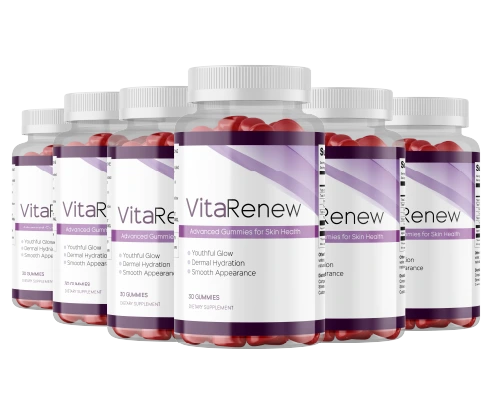
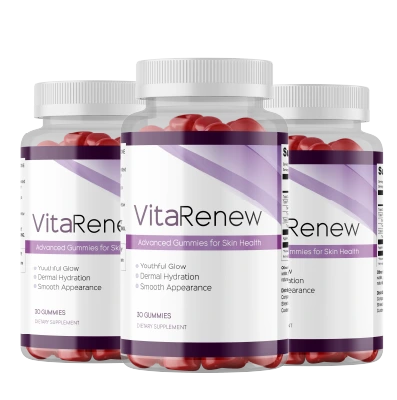
Of the formulas we reviewed while writing this, VitaRenew matches the checklist most completely. It's a daily gummy built specifically around the cofactor side of collagen support — vitamin C, zinc, and copper in one formula, along with vitamin E, selenium, and beta-carotene for antioxidant coverage. It's made in an FDA-registered, GMP-certified facility and sold with a sixty-day money-back guarantee.
It supports skin, hair, and nails. It is a supplement, not a treatment, and does not diagnose, treat, or cure any condition. The sixty-day guarantee exists because the meaningful timeline for any change in skin integrity is measured in months, not days.
Referenced in this article
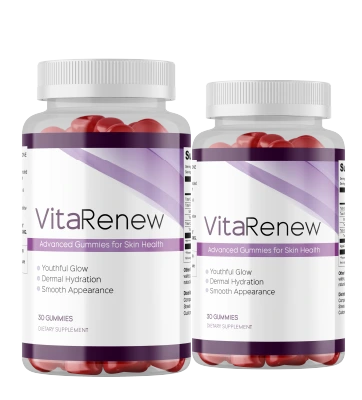
VitaRenew
The cofactors collagen synthesis actually depends on — vitamin C, zinc and copper — in one daily gummy.
For skin that holds up the way it used to.
60-day money-back guarantee · One-time purchase, no subscriptionWhat people report
"I've been bruising at the slightest bump for the past couple of years. After about two months on VitaRenew, I do feel like my skin has a bit more resilience. It's subtle — not dramatic — but I've kept going because something feels different."
"The skin on my hands was starting to look almost transparent — every vein showing through. Three months in, it looks a bit less pronounced to me. Hard to say exactly how much is the supplement, but I'll keep going."
These reflect individual experiences. Results are not typical and vary based on age, diet, genetics, and other factors.
A realistic timeline
The outer layers of skin turn over in four to six weeks — surface texture and tone may shift relatively quickly. The dermis is far slower. Collagen remodelling is measured in months. Most controlled studies examining skin-directed supplementation look at outcomes at eight to twelve weeks specifically because that's where measurable changes begin to appear.
Give anything you try a genuine three months before evaluating it. Photograph yourself in the same light on day one and again at ninety days. Expect gradual, not dramatic. Individual results are affected by baseline collagen levels, sun history, hormonal status, how much vitamin C and copper you were already getting from food, and factors no supplement controls.
A note on sudden changes. The skin thinning this article describes is gradual and uniform — the result of slow biological change over years. If a patch of skin changes suddenly in texture, colour, or thickness, or if a spot changes shape, those are questions for a dermatologist, not a supplement. Gradual and symmetrical is aging. Sudden and localized warrants a professional look.
The short version
Skin gets thinner with age because the dermis — the structural layer beneath the surface — loses collagen fibres and the density that holds them together. The change accelerates around menopause when estrogen, which supports collagen density, begins to fall. Your body still makes collagen; what often limits the output is the enzymatic machinery — specifically vitamin C, which is required to stabilize every collagen molecule produced, and copper, which cross-links the fibres into a working structure.
That's a less exciting answer than a miracle ingredient. It has the advantage of being true, and of being specific enough to be useful when you're reading a label.
Product referenced above
VitaRenew
Vitamin C, zinc and copper — the three cofactors most skin formulas leave incomplete — in one daily gummy. FDA-registered facility, 60-day guarantee.
For the skin that deserves better tools to work with.
60-day money-back guarantee · Supports skin, hair and nailsBackground reading
- Shuster S, Black MM, McVitie E. "The influence of age and sex on skin thickness, skin collagen and density." British Journal of Dermatology, 1975.
- Pullar JM, Carr AC, Vissers MCM. "The Roles of Vitamin C in Skin Health." Nutrients, 2017.
- Rucker RB et al. "Copper, lysyl oxidase, and extracellular matrix protein cross-linking." American Journal of Clinical Nutrition, 1998.
- Thornton MJ. "Estrogens and aging skin." Dermato-Endocrinology, 2013.
- Castelo-Branco C et al. "Relationship between skin collagen and bone changes during aging." Maturitas, 1994.