Why your skin suddenly lost its elasticity — the hormonal mechanism behind the overnight change


Most people expect skin changes to be gradual. A slow, year-by-year shift in texture and firmness — the kind of change you notice only when you compare photos a decade apart. For many women, that's exactly how it works. But a meaningful number describe something different: elasticity that seemed to drop quickly, in a window of months, not years. The skin on the arm or neck that behaved one way in spring and noticeably differently by fall.
This isn't a misperception. There's a well-characterized biological mechanism that explains rapid elasticity loss — and it's tied to a specific hormonal transition, not to aging in general. Understanding it changes what you can actually do about it.
What skin elasticity depends on at the structural level
Skin's ability to return to its position after being pressed or stretched depends on two proteins in the dermis — the thick, living layer beneath the visible surface. Collagen (primarily Types I and III) forms the scaffolding: the dense framework that gives skin its thickness and resistance to compression. Elastin provides the spring: the molecular coil that allows skin to deform and recover.
Both are synthesized by fibroblasts — specialized cells in the dermis whose output determines whether skin feels firm and resilient or loose and unresponsive. The decline of both proteins begins in the mid-20s, but at a rate slow enough that most people don't notice it for decades. Collagen production drops roughly 1% per year from the mid-20s onward. Elastin production essentially stops after adolescence; the elastin fibers you have at 18 are largely the same ones you'll carry through adulthood, aging in place as UV exposure and oxidative damage gradually degrade their structure.
At this pace, the changes are typically imperceptible from year to year. What accelerates the timeline is estrogen.
The estrogen-fibroblast connection
Estrogen is primarily understood as a reproductive hormone, but it also plays a documented regulatory role in fibroblast activity. Fibroblasts express estrogen receptors; when estrogen levels are adequate, they receive a signal that supports collagen synthesis. When estrogen declines, that signal weakens — and fibroblast output falls with it.
This relationship has been studied since the 1980s and replicated extensively. A frequently cited study in the British Journal of Dermatology found that postmenopausal women lose approximately 30% of their skin's collagen content in the first five years following menopause, with the greatest rate of loss in the first one to two years. A separate analysis found that collagen synthesis in perimenopausal women decreases at roughly 2% per year of postmenopausal age — a rate that's more than double the pre-menopausal baseline.
This is the mechanism behind the "it happened suddenly" experience. The annual 1% decline that went unnoticed for fifteen years becomes something closer to 5–6% per year in the perimenopause window — and the cumulative structural deficit that was below the threshold of visibility for years crosses that threshold quickly.
The threshold effect: why gradual loss suddenly becomes visible
Human perception of skin changes isn't linear — it's threshold-based. Below a certain level of structural loss, the changes in bounce-back and firmness are invisible to the eye and imperceptible to the touch. Above a threshold, they become obvious. The rate of loss during perimenopause is fast enough to push many women across that threshold in a short window, which is why the experience is described as "sudden" even though the underlying process has been running for years.
Where the threshold gets crossed first depends on anatomy: it tends to appear earliest in the places where skin is thinnest — around the eyes and mouth, along the jawline, in the neck, on the backs of the hands. These sites have less structural reserve. Once the scaffolding thins past a visible point there, the same process shows up progressively in areas with more collagen to lose.
What the pinch test measures
Dermatologists have used a simple functional assessment for decades: pinch the skin on the back of the hand, hold for two seconds, then release. In young skin, it snaps back immediately. As collagen and elastin thin, the recoil slows. In the perimenopause window, many women notice for the first time that the skin takes a beat longer — a fraction of a second that wasn't there before. This is the bounce-back quality that's declining, expressed directly.
The pinch test isn't diagnostic — it doesn't tell you how much collagen you've lost or what your estrogen levels are doing. But it's a reliable, immediate indicator of the structural change that perimenopause-driven collagen loss produces.
Why topical skincare hits its limits here
The anatomical reality of the dermis explains why even an excellent topical routine doesn't fully address this kind of change. The collagen and elastin that determine skin's structural firmness live below the epidermal layer — deeper than where most topical products exert their effects. Moisturizers and serums work on the surface; they support the barrier, reduce transepidermal water loss, and keep the visible skin hydrated and smooth. Retinoids have meaningful evidence for stimulating some collagen synthesis in the epidermis and upper dermis, particularly at prescription concentrations used consistently over months.
But the deeper dermal scaffolding — the layer being depleted by fibroblast slowdown — is not meaningfully reached by topical application. This is the structural limit, not a flaw in any particular product. Supporting the dermis from within requires a different route.
What the research on supplementation suggests
Over the past decade, a growing body of randomized controlled trial evidence has examined whether supplying hydrolyzed collagen peptides — collagen broken down into fragments small enough to be absorbed through the gut — can support dermal collagen levels from within. The proposed mechanism has two components: the peptides provide substrate (amino acids) for fibroblast collagen production, and they may also act as signaling molecules that prompt fibroblasts to increase synthesis.
Multiple placebo-controlled trials have found statistically significant improvements in skin elasticity, hydration, and dermal density with daily supplementation of 2.5g to 10g of hydrolyzed collagen over 8–12 weeks. A 2019 meta-analysis in the Journal of Drugs in Dermatology reviewing 19 randomized controlled trials concluded that supplementation "showed statistically significant improvement in skin hydration, elasticity, roughness, and density." Effect sizes are moderate and individual responses vary — but the research direction is consistent.
One consistent finding across studies: vitamin C is a required cofactor for the enzymatic step that hydroxylates proline residues, which is what gives collagen its triple-helix structure and stability. Providing collagen peptides without adequate vitamin C leaves the synthesis incomplete. The two belong in the same formula.
What we suggest looking into
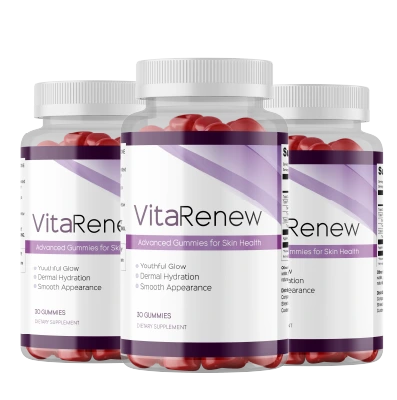
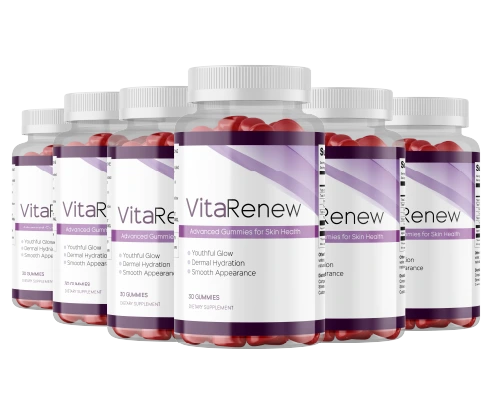
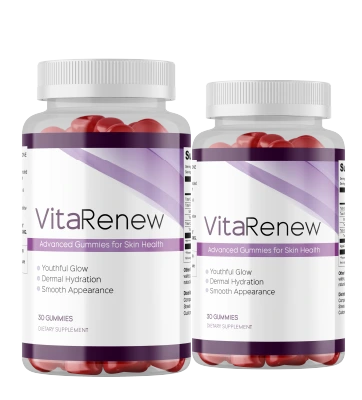
VitaRenew is a daily collagen gummy built around the specific research-validated approach to supporting skin structure from within:
- Type I & III collagen peptides — the primary structural types in skin's dermis, and the types studied in the randomized trials cited above for elasticity and firmness outcomes.
- Vitamin C built into the formula — the required cofactor for collagen synthesis, included so both arrive together when needed.
- Hyaluronic acid and silica — to support the hydration and connective tissue components of dermal volume alongside the collagen substrate.
- One gummy per day — compliance tends to be high with gummy formats relative to powders or capsules.
- Third-party tested — gluten-free, soy-free, dairy-free, non-GMO.
Honest framing: VitaRenew is a supplement, not a pharmaceutical. It won't undo accumulated structural loss, and it doesn't replace sun protection, hydration, and adequate sleep as foundational habits. But as a daily approach to supplying the fibroblast raw material that the perimenopause transition withdraws — specifically Type I and III collagen with its cofactors — the mechanism is sound. The 2-bottle supply provides a 60-day window to assess whether your skin responds, covered by a money-back guarantee.
VitaRenew
Type I & III collagen peptides with the cofactors your skin's structural repair system actually requires — in one daily gummy.
For the morning your skin holds itself the way it used to. 60-day money-back guarantee · One-time purchase, no subscriptionWhat users report
"I noticed the change in a short span — my jaw, my neck, the skin on my forearm. My dermatologist confirmed I was in perimenopause and explained the estrogen-collagen connection. I started VitaRenew as a low-risk complement to my existing routine. Around week ten the pinch test on the back of my hand was measurably faster. I've done it daily since."
"My skin literally felt different to the touch from one autumn to the next. VitaRenew was low-commitment enough to try. What I noticed first was texture — it felt more substantial. Then, a few weeks later, the firmness question."
These statements reflect individual experiences. Results are not typical and will vary from person to person.
The research-grounded bottom line
Skin elasticity can drop quickly — or appear to — because the perimenopause transition changes the rate at which structural proteins are lost from the dermis, compressing a gradual process into a shorter window. The mechanism is the estrogen-fibroblast relationship, the result is accelerated collagen decline, and the threshold of visible change gets crossed faster than most women expect. Topical products address the surface; the dermis requires support from within. Daily hydrolyzed collagen supplementation with vitamin C is the most research-backed nutritional approach to providing that support — which is what VitaRenew delivers.
If your skin's elasticity has shifted notably and recently, and you want to act on the underlying mechanism rather than only the surface, this is a well-reasoned, low-risk starting point. Any sudden skin changes that concern you medically are always worth discussing with your dermatologist.