Why the Skin on Your Hands Gets Thinner as You Age


Hold your hand up to a window on a bright day. If you are past forty, you may notice something striking: the skin on the back is almost translucent. You can see the tendons running toward the fingers, the veins branching underneath, the architecture of the hand itself visible through what used to be an opaque surface. If you press the skin together gently with two fingers and release, it does not immediately spring back.
This is not dryness — not in the primary sense. This is dermal atrophy: an actual reduction in the thickness and density of the skin's structural middle layer. It is one of the most honest physical expressions of collagen aging in the human body, and it is particularly visible on the hands because of a set of anatomical factors that converge there and nowhere else in quite the same combination.
The anatomy that makes hand skin different from the start
Skin is organized into layers. The outermost is the epidermis, which handles barrier function. Below it is the dermis — a dense matrix of collagen and elastin fibers, fibroblasts, and ground substance including hyaluronic acid. The dermis is what gives skin its thickness, firmness, and resilience. It is also the layer that changes most measurably with age.
On the back of the hand, the dermis starts thinner than in most other areas. There is also almost no hypodermis — the fat and connective tissue layer beneath the dermis — between the skin and the underlying tendons and bone. In areas like the cheek or upper arm, a subcutaneous fat layer compensates for early dermal thinning: as the dermis loses density, the volume beneath it can still provide some structural support. The hand has no such buffer. When the dermis thins, what is underneath is immediately visible.
Additionally, the back of the hand has fewer sebaceous glands than most body surfaces. These glands secrete sebum, a waxy substance that contributes to the skin's surface lipid film and helps limit transepidermal water loss. Lower sebaceous density means the skin of the hand loses water from its surface more readily — which compounds the structural problem with a persistent surface dryness on top of it.
How quickly skin actually thins — and what accelerates it
Collagen production in the dermis declines at approximately one percent per year beginning in the mid-twenties. Elastin production largely stops after adolescence. For most people, the cumulative effect of this gradual decline remains below the visible threshold for a long time — the structural reserve built up during youth absorbs the losses. But somewhere in the forties, for many women, a threshold is crossed where the losses become apparent. On the face, this typically shows up as fine lines, loss of volume in certain areas. On the hands, it shows up as translucency.
What sharpens the transition in many women is hormonal. Estrogen has a documented supporting role in skin collagen density: it promotes fibroblast activity, which is the cellular process responsible for synthesizing new collagen. As estrogen levels fall during perimenopause, the rate of dermal collagen loss accelerates. This new, faster rate is layered on top of whatever cumulative UV damage has already accumulated — and hands, being among the most consistently sun-exposed surfaces on the body while also among the least reliably SPF-protected, often carry a substantial UV burden by the time this acceleration begins.
Ultraviolet exposure degrades collagen and elastin through photooxidative pathways that are distinct from the biological aging process. The damage accumulates across decades. A woman who drives forty minutes each day for twenty years without UV protection on her hands has exposed the back of those hands to a meaningful cumulative dose — in direct sun, both hands, every day — without most of the protection she almost certainly applies to her face.
The result of structural thinning, hormonal acceleration, and cumulative UV damage converging on a body area that started with the smallest structural reserve: the skin that no longer feels like skin. It looks thin, paper-like. It does not pinch the same way it once did. Veins are more prominent. Tendons are visible beneath. The term crepey captures part of the texture; thin captures the volume loss underneath.
Why topical products reach a structural ceiling
The most common response to thin, aging hand skin is a richer hand cream — often one marketed specifically for aging hands. These products can produce genuine short-term improvements: the skin looks softer, better hydrated, the surface lines temporarily less pronounced. Within a few hours, the appearance reverts.
This pattern is not a product failure — it is a physics constraint. Skin evolved over millions of years to function as a barrier, and it is exceptionally effective at preventing molecular penetration from outside. The vast majority of topical ingredients, including hyaluronic acid and collagen peptides, are too large to penetrate through the epidermis into the dermis where the structural deficit actually exists. They work at and near the stratum corneum — the outermost surface layer. The dermis is below that, separated by the very barrier function that skin is built around.
This is not an argument against hand creams. They serve a real function in keeping the surface comfortable and in protecting against further transepidermal water loss. The limitation is simply that they cannot address the structural thinning that is the primary driver of what you observe.
The nutritional layer of collagen synthesis
Collagen synthesis is not a passive process. It is an active enzymatic chain that requires specific cofactors at multiple steps. Fibroblasts — the cells responsible for producing new collagen — remain active in adult skin. The question is not whether the machinery exists, but whether it has the inputs it needs to run efficiently.
Two cofactors have the most direct and well-documented relationship to collagen assembly:
- Vitamin C is a required cofactor for prolyl and lysyl hydroxylase, the enzymes that convert procollagen into structurally stable collagen by hydroxylating key amino acid residues. Without adequate vitamin C, this step is impaired — collagen is assembled in a weaker, less organized form. This relationship is foundational biochemistry, not extrapolation; it is the same mechanism responsible for the connective tissue fragility of scurvy.
- Copper is required by lysyl oxidase, the enzyme that cross-links newly synthesized collagen and elastin fibers into the organized, load-bearing network that provides structural integrity to the dermis. Without sufficient copper, fibers are produced but not properly cross-linked — the structural mesh that gives skin its thickness and resilience remains incomplete.
Zinc plays a supporting role in maintaining skin integrity and protecting existing structural proteins from oxidative damage. Biotin is involved in fatty acid synthesis relevant to skin barrier function. Certain plant-derived antioxidants help limit the ongoing photooxidative degradation that affects collagen in chronically UV-exposed areas. The case for addressing these inputs nutritionally, in areas of the body where topical approaches are structurally limited, is grounded in basic physiology.
What we suggest looking into
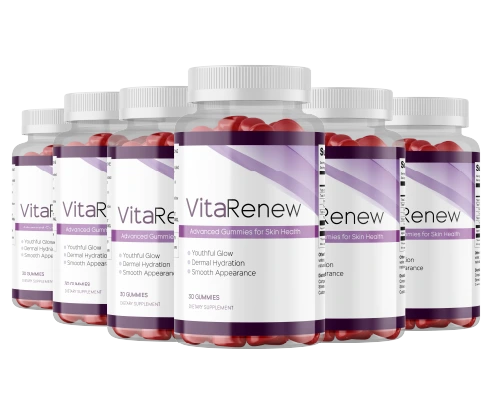
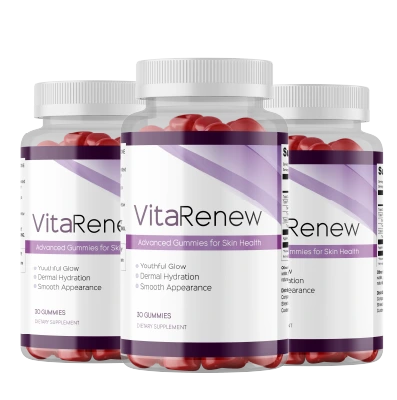
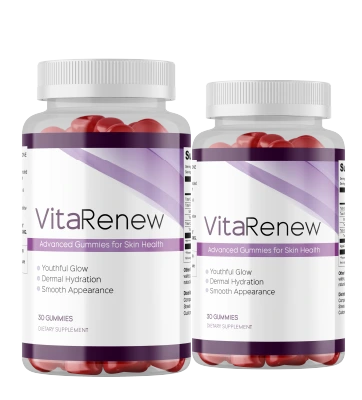
VitaRenew is a daily collagen-support gummy formulated for women 40 and over. Its approach is to address the enzymatic bottlenecks upstream in collagen synthesis — the specific cofactors that determine how well fibroblasts can produce and organize structural proteins — rather than delivering exogenous collagen, whose bioavailability as intact protein is limited once digested.
- Vitamin C & copper — cofactors for the two enzymes most directly responsible for collagen hydroxylation and cross-linking
- Zinc & antioxidant micronutrients — supporting skin integrity and protecting existing collagen from oxidative degradation
- Daily gummy format — designed to integrate into a morning routine without friction
VitaRenew is a supplement, not a medical treatment. Individual responses vary, and the science on nutritional supplementation for skin is appropriately probabilistic. For women experiencing the kind of structural hand skin thinning where topical products consistently fall short, it represents an approach targeted at the right layer — the same layer where the thinning is actually happening. Supply starts at a 60-day option; most customers who see results continue with a longer supply.
What women report noticing
"The thinning on my hands bothered me more than anything else — you could see every tendon. About six weeks in, the skin started looking less translucent and felt denser when I touched it. I didn't expect that from a supplement but I'll take it."
"My doctor mentioned dermal thinning when I asked about my hands. She said nothing topical would really reach that layer. I found VitaRenew a few weeks later and tried it — two months in, the texture on the back of my hand is genuinely different. More like skin should feel."
These statements reflect individual experiences. Results are not typical and will vary from person to person.
The case for working at the structural level
Thin skin on the hands as you age is a structural change — a real, measurable reduction in dermal density driven by declining collagen synthesis, hormonal shifts, and cumulative UV exposure acting on an area of the body that started with less structural margin than anywhere else. The surface of that skin can be softened and hydrated by topical products, and that matters. But the thinning itself, the translucency and volume loss, is in the dermis — and reaching the dermis requires a different approach. The enzymatic machinery that builds collagen remains active. Giving it the specific cofactors it requires to do that job efficiently is the most mechanistically direct approach available without a prescription. That is the logic behind VitaRenew, and it is the one that makes structural sense to us.