Skin Health · Explainer
Vitamin D Deficiency and Crepey Skin: Why Fixing Your Levels May Not Change Your Skin Texture
You got the test. You were low. You corrected it. And six months later the skin on your arms and chest looks exactly the same. Here's the honest explanation — and what the dermis actually depends on to maintain its structure.

The story usually goes something like this.
You mention the crepey texture on your arms to your doctor — or you bring it up yourself, having read that vitamin D affects skin. A blood test confirms you're deficient, which feels almost like good news: a clear answer, a clear solution. You start supplementing, bring your levels up into the normal range, and wait.
Months later, you look at your forearms in morning light and nothing has changed. The same thin, papery quality. The same fine lines that fold when you pinch the skin. You did the right thing, and it didn't move the needle.
That experience is not a coincidence, and it isn't your imagination. It's a predictable outcome of a very common misunderstanding about what vitamin D actually does for skin — and what it doesn't do.
What vitamin D actually does in the skin
Vitamin D is a genuine player in skin biology. The skin contains vitamin D receptors, and research has connected adequate vitamin D status to several aspects of skin function: barrier integrity, immune regulation, and the normal behaviour of keratinocytes — the cells that form the skin's outer surface.
Some research has also found that vitamin D receptors are present in fibroblasts, the cells in the deeper dermis that produce collagen. This is what generates the "vitamin D deficiency causes crepey skin" thread in the first place: if the D receptor influences fibroblast behaviour, and fibroblasts make collagen, maybe fixing a deficiency helps the structural layer too.
The problem is the gap between "vitamin D affects fibroblasts" and "correcting low vitamin D restores the dermal structure that causes crepey skin." That gap is wide, and the evidence for crossing it cleanly is thin.
Vitamin D participates in skin biology. It is not the primary driver of the structural change that produces a crepey texture — and understanding why opens up a more productive path.
What actually drives crepey skin after 40
Crepey skin is a change in the dermis — the layer of skin below the surface you can touch. The dermis is built from a dense mesh of collagen fibres, elastin fibres, and molecules that hold water between them. At 35 this mesh is tight, thick, and elastic. By the mid-forties it has thinned, lost cross-links, and begun to lose its ability to spring back.
The force behind this change is twofold. First: collagen production declines gradually from the mid-twenties onward — a slow, silent loss of roughly one percent a year that accumulates unnoticed. Second, and more abrupt: estrogen supports both collagen density and the thickness of the dermis. As estrogen levels fall through the perimenopausal years, dermal collagen loss accelerates significantly. The gradual slope and the steeper hormonal drop overlap in the forties. That convergence is the "it happened so fast" feeling.
Neither of these changes is primarily caused by vitamin D. Correcting a vitamin D deficiency can remove a contributing factor at the margins. It cannot rebuild a scaffold whose main architecture has thinned for reasons that are structural and hormonal.
The assembly line problem
Here is where the story gets more useful.
Your body has not forgotten how to build collagen. The fibroblasts are still present and functional. Collagen synthesis is a biochemical assembly line, and what limits that line — in a reasonably nourished adult — is rarely raw material. It's the enzymatic machinery that processes raw material into stable, cross-linked fibres.
Two pieces of that machinery have the strongest evidence base, and both tend to be missing from most discussions of skin and supplements.
Vitamin C: the stabilizer
A collagen molecule is useful because of its shape: three protein chains wound into a tight triple helix. That shape is what gives collagen its tensile strength. The winding is performed by two enzymes — prolyl hydroxylase and lysyl hydroxylase — and both are strictly dependent on vitamin C as a cofactor. Without it, the body still produces collagen; it produces a weak, unstable version that can't hold the helix properly.
This is basic biochemistry, not marketing — it's the same mechanism that causes connective tissue to deteriorate in scurvy. Marginal vitamin C status produces marginal collagen stability. That, over years, contributes to the thinning of the dermal scaffold.
Copper: the binder
Newly made collagen and elastin fibres start as separate threads. On their own they provide very little structural strength — they need to be cross-linked, chemically bonded to each other, to form the resilient network that gives skin its resistance and recoil. Cross-linking is performed by an enzyme called lysyl oxidase, which requires copper to function.
Without adequate copper, the fibres get produced and never get properly tied together. The bricks get made; the mortar never arrives. The result is looser tissue than the raw production number would suggest.
Look at the label of any skin supplement you've tried. Vitamin C is almost certainly there — it's widely known. Copper almost certainly isn't. That single omission explains a great deal about why many women supplement faithfully and see modest results.
The bottleneck for most women over 40 is not vitamin D. It's whether the enzymatic tools — vitamin C for stabilization, copper for cross-linking — are present in the amounts the collagen assembly line needs.
Referenced in this article
VitaRenew
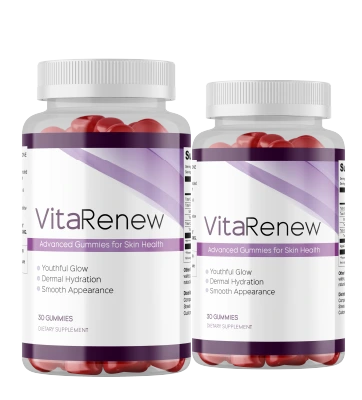
The cofactors your skin's collagen process actually runs on: vitamin C, zinc, and copper in one daily gummy.
For the woman who did everything right and still wants to understand what was missing.
60-day money-back guarantee · One-time purchase, no subscriptionWhat a well-built skin formula actually includes
Given the above, the question becomes practical: what should be on the label of anything you try?
The short list that matters
- Vitamin C in a meaningful dose — not a token milligram added for the front panel. The prolyl and lysyl hydroxylase enzymes need it in quantity.
- Copper — this is the single most common omission from skin formulas. Without it, cross-linking doesn't happen and the fibres never bind properly.
- Zinc — for normal skin integrity and the ongoing repair processes that run continuously in the dermis.
- Antioxidant support (vitamin E, selenium, or beta-carotene) — oxidative stress degrades existing fibres while the body is trying to build new ones. Both processes need to be supported at once.
- Manufacturing standards you can verify — FDA-registered facility, GMP-certified, third-party tested.
- A realistic timeline in the claims — the dermis remodels on months, not days. Any brand promising a visible result in a week is marketing, not biology.
No. 1: VitaRenew
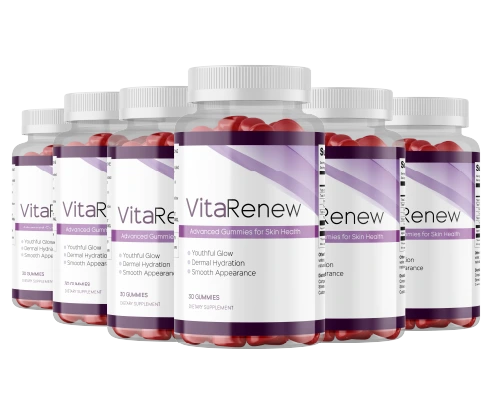
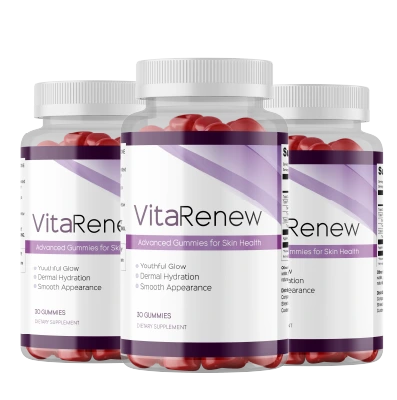
Of the formulas we reviewed for this piece, VitaRenew fits the checklist above more cleanly than anything else we found. It's built specifically around the cofactor side of collagen synthesis — vitamin C, zinc, and copper, with vitamin E, selenium, and beta-carotene for antioxidant support. It comes as a daily gummy, one-time purchase, no subscription, made in an FDA-registered, GMP-certified facility, and sold with a sixty-day guarantee.
It supports skin, hair, and nails. It is not a treatment, a drug, or a cure for anything. The sixty-day window exists because that's roughly when the first honest signal — if there is one — begins to emerge.
What women who've tried it report
These are personal accounts, not clinical measurements. Individual results vary based on genetics, sun history, diet, and how far the dermal changes have progressed.
"I spent almost a year getting my vitamin D into range and genuinely saw no change in my arms. A friend sent me something she'd read about copper and collagen cross-linking — which I'd never heard of — and I started looking. I found VitaRenew and tried it for three months. The skin on my upper arms is noticeably smoother. Not transformed, but different enough that I stopped wearing three-quarter sleeves every day."
"My doctor literally told me that vitamin D wouldn't fix the texture issue, but I kept hoping. Tried VitaRenew after I read the explanation about enzymatic cofactors. By month three the crepey feeling on my chest had softened. My nails stopped peeling, which I also hadn't expected. I'm still using it."
These statements reflect individual experiences. Results are not typical and may vary based on age, diet, lifestyle, and other factors.
How to set a fair timeline
The outer layer of skin — the epidermis — turns over every four to six weeks. Surface texture and hydration are the first things that can shift. The dermis is structural and much slower: collagen remodelling runs on months. Most controlled studies of skin-directed supplements measure outcomes at eight to twelve weeks, and that's the benchmark worth borrowing.
Give anything you try a full three months before you judge it. Take a photograph on day one in consistent, neutral light — no filter, same arm position. Expect gradual rather than dramatic. That's not a disclaimer; it's what the biology predicts.
One important note. If a patch of skin changes shape suddenly, thickens, or a spot develops irregular edges, that's a dermatologist's question, not a supplement's. Crepey skin from normal aging is gradual and symmetrical. Anything that isn't should be evaluated by someone with a medical licence. If you're pregnant, nursing, on medication, or managing a health condition, speak with your healthcare provider before starting any supplement.
The takeaway
Correcting a vitamin D deficiency is worth doing for many reasons — bone density, immune function, mood. It may nudge skin biology in a modest, positive direction. But the structural change that produces a crepey texture is driven by declining collagen production and the loss of hormonal support for the dermis — not primarily by vitamin D status.
What the collagen assembly line needs, in most women over 40, is the enzymatic machinery that converts raw protein into stable, cross-linked fibres: vitamin C to stabilize the triple helix, copper to bind the fibres together, zinc to support ongoing repair. Finding all three on the same label, at meaningful doses, is rarer than it should be.
Product referenced above
VitaRenew
Vitamin C, zinc and copper in a daily gummy — the cofactors collagen synthesis actually depends on. Made in an FDA-registered, GMP-certified facility.
Not a miracle. A formula built around what the collagen assembly line is actually missing.
60-day money-back guarantee · Supports skin, hair and nailsBackground reading
- Bikle DD. "Vitamin D and the skin: Physiology and pathophysiology." Reviews in Endocrine and Metabolic Disorders, 2012.
- Pullar JM, Carr AC, Vissers MCM. "The Roles of Vitamin C in Skin Health." Nutrients, 2017.
- Rucker RB et al. "Copper, lysyl oxidase, and extracellular matrix protein cross-linking." American Journal of Clinical Nutrition, 1998.
- Thornton MJ. "Estrogens and aging skin." Dermato-Endocrinology, 2013.
- Ogawa Y et al. "Zinc and skin disorders." Nutrients, 2018.