Skin Health · Deep Dive
What Causes Crepey Skin on Your Chest — The Internal Reason Most Women Miss
Your face got the moisturizer, the sunscreen, the serum. Your chest got the sun. For decades. The answer to why chest skin crepes isn't a mystery — it's anatomy and biochemistry, and it points to a solution most topical products can't reach.

She was sitting at her kitchen table, phone in hand, the summer photo still open. Her friend had sent it from the pool last weekend — one of those candid shots from the side, taken mid-laugh. Her face looked fine. Her arms looked fine. But across her chest, in the V below her collarbone, the skin looked different. Thin. Crinkled. Like tissue paper pressed over bone.
She typed four words into the search bar: what causes crepey skin on chest.
If you've typed those same words, this is the answer the search results often skim past — not the creams to try or the treatments to book, but the actual structural explanation for why this happens, and why it happens there first.
The chest is a structurally disadvantaged zone
Skin isn't uniform across the body. The dermis — the middle layer where structural proteins live — varies significantly in thickness from one area to the next. Facial skin is among the thickest, backed by muscle and richly supplied with blood. The central chest, by contrast, has one of the thinnest dermal layers on the body, spread over a bony breastbone with minimal subcutaneous fat beneath the midline.
This matters because crepey texture originates in the dermis, not at the surface. It begins when the collagen-and-elastin scaffold that holds the skin's structure starts to loosen and thin. In a thicker area like the cheek, that change takes years to become visible. In the chest, where the starting margin is already thin, the same rate of change shows up faster and more dramatically.
Skin researchers have a term for this: the décolletage is a high-visibility, low-investment zone. High visibility because it's exposed by almost everything you wear. Low investment because it almost never receives the protective attention the face does.
Collagen production slows after 40 — but that's only part of the story
The timeline most women know: somewhere after forty, collagen production begins to decline measurably. Skin loses roughly 1% of its collagen per year after this point, and the pace accelerates in the first years following menopause. The result is that the dermis becomes thinner and less resilient — and the visible effect of that thinning is most pronounced where the skin was thinnest to begin with.
But the decline in production isn't the whole picture. The body doesn't stop making collagen at forty. The fibroblast cells that synthesize it remain active throughout life. What changes is the efficiency of that production — and efficiency is significantly determined by cofactors: micronutrients that the collagen synthesis process depends on to function at full capacity.
The problem isn't that the body stops making collagen. The problem is that the ingredients for making it well become harder to maintain at optimal levels.
Three cofactors are directly involved in how well new collagen is assembled and how durable it becomes once formed:
- Vitamin C. The enzyme systems that give collagen its characteristic triple-helix structure — the shape that makes it mechanically strong — are vitamin C dependent. Without adequate vitamin C, the body produces structurally weaker collagen that degrades faster than healthy tissue should. This is not a fringe claim; it's foundational biochemistry established over many decades of research.
- Copper. Individual collagen fibres are threads until an enzyme called lysyl oxidase cross-links them into a resilient, load-bearing network. Lysyl oxidase requires copper as a cofactor. Without it, fibres form but remain poorly bonded — structurally similar to unstitched seams. The tissue forms, but it doesn't hold.
- Zinc. Zinc participates in normal skin cell turnover, wound response signalling, and the repair processes running continuously in the dermis. It also supports elastin health — the protein responsible for the bounce-back quality that lets healthy skin return to its resting shape after being pressed or pulled.
This is why collagen peptide supplements sometimes deliver modest results: the raw material arrives, but if the cofactors aren't at adequate levels, the assembly process can't use it efficiently. The limiting step isn't always supply — sometimes it's the machinery.
Referenced in this article
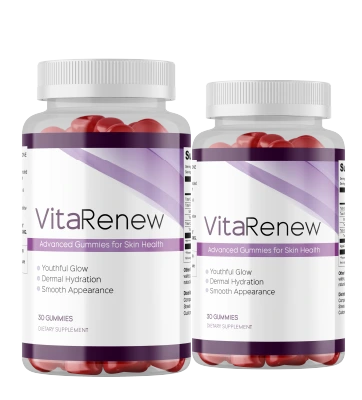
VitaRenew
Built around the cofactors collagen production depends on — vitamin C, copper, and zinc — in a daily gummy. Designed to support skin firmness from within, including in areas beyond the face. GMP-certified, FDA-registered facility.
For the woman who wants to address the cause, not just the surface.
60-day money-back guarantee · One-time purchase, no subscriptionDecades of sun exposure — accumulated silently
The second major driver of chest crepiness is ultraviolet damage, and it's the piece most women underestimate because the evidence accumulates invisibly for years before it shows.
The décolletage receives substantial sun exposure across a lifetime. It faces upward in outdoor chairs, at the beach, on the porch. It's exposed by every open-collar shirt, scoop neck, or V-neck worn across decades of summers. And while the face was almost certainly getting some sunscreen — at least some of the time, in recent years — the chest was not.
UV radiation degrades collagen and elastin in the dermis through a well-documented process called photoaging. It activates enzymes that break down existing structural fibres, and it disrupts the signalling that normally directs fibroblasts to repair that damage. The result is not just surface pigmentation change — it's actual structural degradation in the dermis that accumulates year over year.
By the time hormonal changes begin to affect collagen density — typically in perimenopause, when estrogen levels fall and the estrogen-collagen connection becomes significant — the chest is already working from a compromised baseline. Two declines arrive simultaneously. The face, which has had some protection and a thicker starting point, is behind by years.
Why topical products can't fully reach the cause
The instinctive response to crepey chest skin is moisturizer. Then a firming cream. Then a retinol. These approaches aren't useless — surface hydration genuinely affects how skin looks in the short term, and retinol has real evidence for supporting the epidermis (the outermost layer). But the structural change that produces crepey texture lives in the dermis, which sits below what topical products can reliably access.
The skin's barrier function — its primary evolutionary job — is to prevent things from crossing in or out. That same barrier keeps topical molecules from reaching the dermis consistently. This isn't a product-quality problem. It's a delivery-route problem. Reaching the dermis from the inside, through circulation, bypasses the barrier entirely.
This is the logic behind nutritional approaches to skin structure: the micronutrients that collagen synthesis depends on travel through the bloodstream and arrive at fibroblasts directly. No barrier to negotiate.
What women report after sustained use
"I'd given up on the chest area entirely. I started this mostly for my face and neck and honestly forgot about my chest. Around ten weeks in, my daughter mentioned the skin there looked smoother. I hadn't told her I was taking anything."
"The crepey texture on my chest was the one thing I never found an answer for. Three months in I won't say it's gone, but the feel of the skin is different — less papery when I press on it. That's more than anything else has done."
These statements reflect individual experiences. Results are not typical and will vary from person to person.
On timelines and realistic expectations
The dermis remodels slowly. The outermost skin layer turns over in four to six weeks — which is why texture changes can sometimes be felt in that window. But the structural collagen that determines firmness and smoothness has a longer cycle. Most peer-reviewed research measuring skin-directed nutritional interventions uses eight-to-twelve-week study periods, with the most significant findings appearing closer to the three-month mark.
Photograph the chest area in consistent light on day one. Be patient through the first month, where changes are often subtle. Going forward, adding sunscreen to the décolletage daily is genuinely worth the thirty seconds — it won't reverse what's already accumulated, but it will protect the structural investment you're making from within.
Product referenced above
VitaRenew
Vitamin C, copper, and zinc — the cofactors that support how skin builds and maintains its structural collagen — in a daily gummy.
Start with the 2-bottle pack and give it the full 60 days.
60-day money-back guarantee · Supports skin, hair and nails