Skin Health · Science Explainer
What Causes Skin to Sag? The Three Simultaneous Changes Happening After 40
Most explanations stop at collagen. Research now points to three parallel shifts that converge after 40 — and addressing just one of them leaves the other two unaddressed.

Ask someone what causes skin to sag and you will usually get one of two answers: collagen loss, or just aging. Both are technically true. Neither is the complete picture.
The reason the complete picture matters is practical: it determines what you actually look for if you want to support skin at this stage. If you address only one of three converging changes, you leave the other two unaddressed. And the three changes interact — each one makes the others worse.
This is what the dermatology literature shows when you look past the surface-level explanations.
Change 1: Collagen — not just loss, but a rate change
Collagen decline starts in the mid-twenties. Most sources note this — roughly one percent per year — which sounds gradual enough to be almost invisible. And for twenty years, it largely is. What changes the equation after 40, particularly in women, is a second mechanism: the hormonal shifts of perimenopause.
Estrogen plays a structural role in collagen synthesis. It stimulates collagen-producing fibroblasts and supports the cross-linking of new fibres into the load-bearing mesh that gives skin its mechanical strength. As estrogen levels begin to fall in the early to mid-forties, that support is withdrawn. Research published in the British Journal of Dermatology found that women may lose approximately thirty percent of dermal collagen in the first five years after menopause — a rate roughly ten times faster than the baseline annual decline.
The implication: it is not that collagen loss suddenly begins at 40. It is that a second driver accelerates a process that was already underway, compressing years of gradual change into a shorter window.
The collagen-building machinery doesn't stop working after 40. What changes is the rate at which the process is supported — and the specific cofactors the machinery needs to run properly.
Change 2: Elastin — the overlooked structural protein
Collagen gives skin its thickness and tensile strength. Elastin gives it the ability to return to shape after being stretched or pressed. Think of it this way: collagen is the canvas; elastin is the elastic in the frame.
Unlike collagen, which the body continues to produce throughout life, elastin fibres laid down in early adulthood are largely what you have. The body's capacity to produce new elastic fibres drops sharply after adolescence. What happens from the forties onward is that existing fibres — now several decades old — begin to degrade.
This degradation is driven primarily by oxidative stress: free radicals generated by UV exposure, environmental pollutants, and normal metabolic activity chemically damage elastic fibres, breaking their cross-links and reducing their recoil capacity. The fibres become fragmented and stiffer. Skin that used to spring back now holds the impression of being pressed. Not because the collagen scaffolding has changed — but because the elastic component of the structure has.
This is why two women of the same age with similar collagen levels can have very different skin behaviour. The elastin variable is separate — and it receives little attention in most supplement formulations.
Change 3: The hydration matrix — glycosaminoglycans and volume
The dermis is not just fibres. Between the collagen and elastin scaffolding sits a gel-like substance called the extracellular matrix — made up largely of glycosaminoglycans (GAGs), of which hyaluronic acid is the most well studied.
Hyaluronic acid can bind water at approximately one thousand times its own weight. In a healthy dermis, this creates a hydrated, plump tissue that gives skin its volume and the appearance of fullness beneath the surface.
After 40, hyaluronic acid and other GAGs decline in the dermis — both in total amount and in the average molecular weight of the molecules present. The effect is a loss of tissue water content and volume. The dermis becomes thinner and less supported from within. This is distinct from wrinkling — it is closer to deflation, the kind that makes a face look less supported from below rather than more creased on the surface.
The three changes interact: a collagen scaffold that is thinner and less cross-linked, combined with elastic fibres that have lost recoil capacity, combined with a hydration matrix that has less volume — the result is skin that cannot maintain its position. What looks like sagging from the outside is the convergence of all three changes from the inside.
Why surface applications reach a ceiling
Topical skincare has genuine value. Certain retinoids have solid evidence. Some peptides do something meaningful. But the dermis sits below the epidermis — the outermost barrier layer — and most molecules applied topically do not penetrate to the structural layer in meaningful concentrations. This is a physical constraint, not a marketing argument.
Dermatologists who understand the mechanism often look at nutritional inputs as a parallel track: not instead of topical care, but addressing the structural layer from the inside while topicals manage the surface.
Referenced in this article
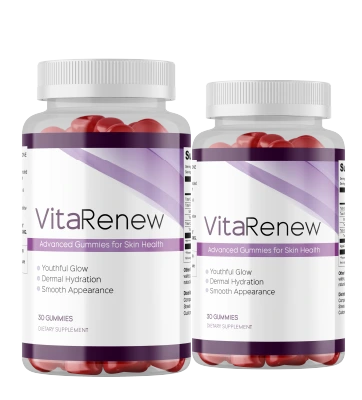
VitaRenew
Vitamin C, copper, zinc and antioxidants — the cofactors that support collagen cross-linking and help protect elastin from oxidative degradation — in one daily gummy.
The 2-bottle supply is where most people start. Sixty days is a fair evaluation window.
60-day money-back guarantee · One-time purchase, no subscriptionWhat the nutritional research points to
Each of the three changes has a corresponding nutritional angle. What the literature makes clear is that the bottleneck is often not the raw material — it is the cofactors the body's own repair enzymes require to function.
For collagen synthesis: vitamin C and copper. Collagen is assembled in a multi-step process inside fibroblasts, then cross-linked into durable fibres outside the cell. Both phases require specific cofactors. Two hydroxylase enzymes — prolyl hydroxylase and lysyl hydroxylase — give the collagen molecule its stable, triple-helix structure; both are vitamin C-dependent. Without adequate vitamin C, collagen produced is structurally weak and breaks down faster than it is rebuilt. Copper then activates lysyl oxidase, the enzyme responsible for cross-linking collagen fibres into the load-bearing mesh. Without adequate copper, new collagen is produced but the fibres remain poorly cross-linked — mechanically weaker than normal.
For elastin protection: antioxidants. Since the body cannot replace elastic fibres at adult rates, the strategy shifts to preservation. Antioxidant nutrients — vitamin E, selenium, beta-carotene — help neutralize the free radicals that cause oxidative fragmentation of elastic fibres. This does not regenerate what has already been lost, but it may support the rate at which remaining fibres degrade going forward.
For collagen regulation: zinc. Zinc supports the balance between collagen breakdown and synthesis. It is required by the matrix metalloproteinases — enzymes that clear old, damaged collagen to make way for new fibres — and plays a role in the vitamin A signalling pathway that influences fibroblast activity. Zinc deficiency is associated with impaired wound healing and skin repair.
What to look for on a skin supplement label
- Vitamin C at a meaningful dose. Not a trace amount added for label appeal — enough to support the two hydroxylase enzymes that require it.
- Both copper and zinc. They work at different steps: copper in cross-linking, zinc in regulation. Many formulas include only zinc.
- Antioxidant coverage. Vitamin E and selenium or beta-carotene to support elastin preservation.
- Verified manufacturing. FDA-registered, GMP-certified — verifiable, not just claimed.
- Honest timeline language. Dermal remodelling takes months. Any claim of visible change in days is telling you something important about how that brand communicates.
- A guarantee long enough to evaluate. Sixty days is the minimum for a meaningful trial at the dermal level.
What fits this profile
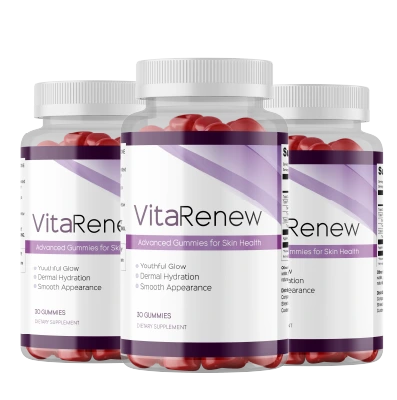
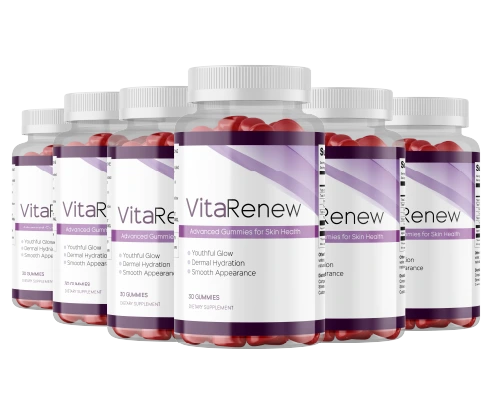
The formulation that most closely matches this checklist is VitaRenew — a daily gummy with vitamin C, zinc, copper, vitamin E, selenium, and beta-carotene. It is manufactured in an FDA-registered, GMP-certified facility and sold as a one-time purchase with no subscription. It carries a 60-day money-back guarantee.
The entry point is the 2-bottle supply at $79 per bottle. Two months is the minimum window for a fair evaluation of any supplement acting at the dermal level, given the timescales involved in structural remodelling. Shorter than that is not a sufficient test.
It is a supplement, not a treatment. It supports skin, hair and nails. It does not diagnose, treat, cure or prevent any condition. These statements have not been evaluated by the FDA.
What readers report
"I had tried collagen peptide powders for years. What I noticed with VitaRenew was different — after about nine weeks the texture under my jaw looked less loose in photographs. I wasn't specifically expecting that. I'm staying on the 3-bottle supply."
"I was skeptical about another skin supplement. But the ingredient list was actually different from others I had tried — copper was in there, which I'd never seen alongside zinc and vitamin C. After ten weeks my neck looked firmer in the morning and my skin felt less papery overall."
These statements reflect individual experiences. Results are not typical and will vary. Supplement use should complement, not replace, professional medical guidance.
Referenced in this article
VitaRenew
The cofactors that support skin firmness from the inside — vitamin C, copper, zinc, vitamin E and selenium — in one daily gummy.
Support firmer, smoother-looking skin — starting with the smallest pack.
60-day money-back guarantee · One-time purchase, no subscriptionBackground Reading
- Shuster S, Black MM, McVitie E. "The influence of age and sex on skin thickness, skin collagen and density." British Journal of Dermatology, 1975.
- Thornton MJ. "Estrogens and aging skin." Dermato-Endocrinology, 2013.
- Pullar JM, Carr AC, Vissers MCM. "The Roles of Vitamin C in Skin Health." Nutrients, 2017.
- Rucker RB et al. "Copper, lysyl oxidase, and extracellular matrix protein cross-linking." American Journal of Clinical Nutrition, 1998.
- Ogawa Y et al. "Zinc and skin disorders." Nutrients, 2018.
- Rittié L, Fisher GJ. "Natural and sun-induced aging of human skin." Cold Spring Harbor Perspectives in Medicine, 2015.
- Varani J et al. "Decreased collagen production in chronologically aged skin." American Journal of Pathology, 2006.