Skin Health · Explainer
What Is Crepey Skin a Sign Of? The Real Cause After 40
Most people treat it like a surface problem — dry skin, lost moisture, sunscreen they forgot to wear. The biology says otherwise. Here's what that thin, papery texture is actually telling you.

If you typed that question into a search bar, you probably did it because something changed — the skin on your arms, your neck, your chest — and you wanted an honest answer rather than another article about moisturizer.
Here it is: crepey skin is a sign of structural change inside the skin, not on the surface of it. It is not caused by dryness, and it is not caused by forgetting sunscreen last summer. Those things matter, but they don't explain the texture that arrives in the mid-forties and doesn't respond to the usual approaches.
Understanding what crepey skin actually indicates changes what you do about it — and more importantly, what you stop doing.
What it is a sign of, in plain terms
Skin has layers. The one you can touch and moisturize is the outer layer — the stratum corneum — a barrier about as thick as plastic wrap. Its job is to hold water in and keep the outside world out.
The layer that matters for crepey skin sits beneath it: the dermis. This is where the structural components live — a dense mesh of collagen fibres that gives skin its firmness and thickness, elastin fibres that allow it to snap back after being stretched, and hyaluronic acid binding water between them.
Crepey skin is a sign that this inner layer — the dermis — is thinning. Fewer collagen fibres, less cross-linking, less recoil. Skin that used to spring back now settles slowly. It folds where it didn't used to fold. Under certain light, particularly fluorescent or direct sunlight, it takes on that characteristic papery, crinkled texture — like fine tissue paper that has been folded many times.
Crepey texture is the surface appearance of a change that is happening one layer deeper. That single distinction explains almost everything about why topical products have a ceiling.
This is why a richer moisturizer will sometimes make crepey skin look better for a few hours — the barrier plumps with water, light reflects more evenly — and then look exactly the same by evening. Nothing structural changed. Nothing structural was ever reached.
Why it tends to appear after 40
Collagen production declines gradually from the mid-twenties onward — commonly cited estimates suggest roughly one percent per year. That's slow enough that most people don't notice it happening for a long time.
What makes the forties feel different is that a second change arrives on top of the first. Estrogen plays an active role in maintaining collagen density and skin thickness. As estrogen levels fall through the perimenopausal years, the rate of dermal collagen loss accelerates considerably. Research on skin changes around menopause has found that a substantial proportion of skin collagen can be lost in the years immediately surrounding it.
So what you are experiencing isn't one process — it's two curves meeting. The gradual slope of age-related collagen decline, and the sharper drop that accompanies the hormonal shift. That intersection is what makes it feel like it happened suddenly when it didn't.
Sun exposure, smoking, and some medications can accelerate the underlying process — but they are accelerants, not causes. Women who did everything right still get crepey skin in their forties and fifties. This is not a punishment for something you neglected.
The part most articles skip
Your body has not forgotten how to make collagen. The genes are intact. The cells responsible for making it — fibroblasts — are still present in the dermis. Collagen synthesis is a biochemical assembly line, and like any assembly line, it needs more than raw material to run. It needs the machinery.
Two pieces of that machinery are worth understanding:
- Vitamin C. The enzymes that stabilize a collagen molecule into its final triple-helix shape — prolyl hydroxylase and lysyl hydroxylase — are strictly dependent on vitamin C as a cofactor. Without adequate vitamin C, collagen is produced in a structurally weak, unstable form. This is not a marketing assertion — it's why scurvy destroys connective tissue, and it has appeared in biochemistry textbooks for decades.
- Copper. Newly formed collagen and elastin fibres begin as loose, unbound threads. An enzyme called lysyl oxidase cross-links them into the tightly woven, springy network that gives skin its resistance and snap-back. Lysyl oxidase is a copper-dependent enzyme. Without adequate copper, the fibres are produced but never properly assembled into structure.
Zinc belongs in the same conversation: it is involved in normal skin integrity and in the continuous maintenance processes that go on in the dermis throughout our lives.
You can have all the building material in the world. If the crew is short on tools, the structure doesn't get built — and certainly doesn't get bolted together properly.
Why collagen powders often disappoint
If you've taken a collagen supplement for several months without noticing much difference, this mechanism is the most likely explanation. It isn't that the research is worthless — several controlled trials of oral collagen peptides have reported modest improvements in skin elasticity and hydration, and the mechanism is still being studied. It isn't nothing.
But in a reasonably well-fed adult, amino acid supply is rarely the rate-limiting step. If what's limiting the process is the enzymatic machinery — vitamin C for stabilization, copper for cross-linking — then adding more raw material to a line that can't fully process what it already has will not change the output very much.
Referenced in this article
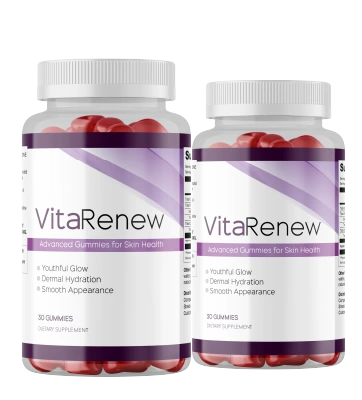
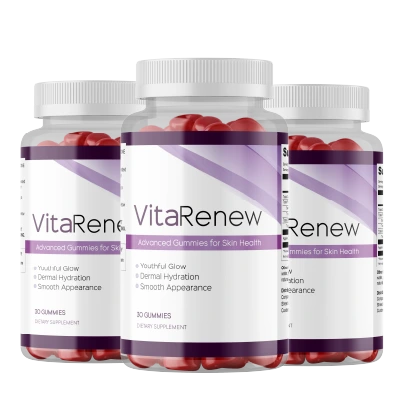
VitaRenew
The cofactors your skin's collagen synthesis actually depends on — vitamin C, zinc and copper, in one daily gummy.
For the days when you want the mirror to feel less like a question.
60-day money-back guarantee · One-time purchase, no subscriptionWhat to look for, if you decide to try something
There are reasonable products out there. These are the criteria worth applying:
A short checklist
- Vitamin C in a meaningful amount — not a trace added for the label.
- Zinc and copper together. They operate on different steps of the same process. Copper is left out of most skin formulas.
- Antioxidant support — vitamin E and selenium, typically — since oxidative stress degrades existing fibres while you're trying to support new ones.
- A realistic timeline in the marketing. If anything promises visible results in seven days, that tells you more about the seller than the product.
- A guarantee long enough to actually evaluate it — sixty days at minimum, since the dermis remodels on a timescale of months.
- Third-party testing and a manufacturer transparent about its facility standards.
What the timeline actually looks like
The outer skin layer turns over roughly every four to six weeks, so texture and tone are the first things that can shift. The dermis is considerably slower — collagen remodelling is measured in months, not days. Most controlled studies of skin-directed supplements use eight to twelve week windows for exactly this reason.
Take an honest photograph on day one, in the same light. Give anything you try a full three months before you evaluate it. Expect gradual, not sudden. Individual results vary based on genetics, existing diet, sun history, and sleep — none of which a supplement can override.
What people report
"I'd been using a collagen powder for almost a year and nothing. My sister suggested I look at what the collagen actually needs to work. Three months in, the skin on my arms has a different quality — less papery. I wouldn't have believed it if I hadn't photographed both."
"Not a miracle — I want to be honest. But the texture change on my chest and neck has been real and gradual. I'm on my third bottle and I'll keep going. The 60-day guarantee made it easy to try without feeling like I was gambling."
These are individual accounts. Results vary and are not typical. No supplement can diagnose, treat, cure, or prevent any condition.
Product referenced above
VitaRenew
Vitamin C, zinc and copper in a daily gummy. Made in an FDA-registered, GMP-certified facility. 60-day money-back guarantee.
The cofactor approach, in one daily gummy.
60-day money-back guarantee · Supports skin, hair and nailsBackground reading
- Pullar JM, Carr AC, Vissers MCM. "The Roles of Vitamin C in Skin Health." Nutrients, 2017.
- Rucker RB et al. "Copper, lysyl oxidase, and extracellular matrix protein cross-linking." American Journal of Clinical Nutrition, 1998.
- Thornton MJ. "Estrogens and aging skin." Dermato-Endocrinology, 2013.
- Shuster S, Black MM, McVitie E. "The influence of age and sex on skin thickness, skin collagen and density." British Journal of Dermatology, 1975.
- Ogawa Y et al. "Zinc and skin disorders." Nutrients, 2018.