What Is Crepey Skin? The Quiet Change Women Miss After 40


Many women in their forties or early fifties notice a change in their skin that isn't quite a wrinkle — and doesn't respond to the things that help wrinkles. The texture becomes fine and papery, almost like tissue paper that has been squeezed and released. It tends to appear in broader patches rather than individual lines: across the back of the hands, the inner arms, the chest, the neck. Pressing the skin lightly between two fingers, it bunches into small, dense folds that don't spring back immediately.
This texture has a name: crepey skin. The word comes from crêpe paper — the lightweight, crinkled paper with a distinctive rippled surface. Once you know the term, you recognize it immediately. But a surprising number of women who are living with it have never heard the word, and as a result they keep reaching for remedies aimed at the wrong problem.
Crepey skin versus wrinkles: a useful distinction
The two are related but structurally different, and the distinction matters for understanding what might help.
Wrinkles are discrete, defined lines — formed by the repeated creasing of skin over a muscle movement (frown lines, crow's feet), or by gravitational pulling at specific fold points (nasolabial folds). They are local and directional.
Crepey skin is diffuse. It covers larger surface areas, and it isn't associated with a single muscle movement. Its defining characteristic is a loss of surface tension and thickness: the skin has become thin enough and loose enough that it hangs, sags very slightly, and crinkles when compressed. Under low-angle light — the kind you get from a window in the afternoon — it shows a fine, all-over texture like crumpled paper.
How to tell if your skin is crepey
- The pinch test: Gently gather a small amount of skin on the back of your hand or inner forearm. Crepey skin forms many small, dense folds that are slow to flatten.
- The light test: Stand near a window with light coming from the side. Fine, all-over rippling on the chest, upper arms, or inner arms suggests crepey texture.
- Area pattern: Crepey skin tends to appear on larger, flatter areas — hands, arms, chest, neck, inner thighs — not just at expression points.
- Moisturizer response: Wrinkles may soften temporarily with hydration. Crepey texture typically returns to its resting state within hours because the issue is structural, not hydration-related.
What is actually happening in the skin
To understand crepey skin, it helps to think about skin as a two-layer system. The outer layer — the epidermis — is what you apply products to. Below it is the dermis, a dense, fiber-rich tissue that gives skin most of its mechanical properties: thickness, firmness, and the ability to snap back after being stretched or compressed.
The dermis is composed primarily of three components working together:
- Collagen fibers — tightly packed protein cables that provide tensile strength and thickness
- Elastin fibers — springy proteins woven through the collagen network that allow the skin to recoil
- Hyaluronic acid — a molecule that binds water and maintains the cushioned volume between fibers
In young skin, this architecture is dense, hydrated, and well-organized. Crepey skin is what a thinning, partially depleted version of this architecture looks like from the outside.
Why the change accelerates in the forties and fifties
Collagen production begins a slow, gradual decline from the mid-twenties — often cited at roughly one percent per year in dermatology literature. For two decades, this loss is invisible because there is enough structural reserve to absorb it. Then, around perimenopause, a second process arrives on top of the first.
Estrogen supports both collagen density and skin thickness. As estrogen declines through the perimenopausal transition, the rate of dermal collagen loss accelerates substantially — and the two decline curves overlap. That is why the change often feels sudden even though it has been building for twenty years.
A third factor compounds the effect: ultraviolet radiation. Decades of cumulative sun exposure progressively crosslinks and fragments existing collagen and elastin fibers, degrading the structural integrity of the dermal network. Skin that has had significant lifetime UV exposure will show crepey texture earlier and more visibly.
The result is a dermis that is measurably thinner, less hydrated, and structurally less organized than it was at thirty — and it is this structural thinning, not surface dryness, that creates the crepey appearance above it.
Why surface products have a ceiling
The most common first response to crepey skin is to apply richer moisturizers, serums, or topical collagen products. These can produce noticeable short-term improvements in surface texture because they temporarily increase hydration in the epidermis and the very top of the dermis. But the ceiling on this approach is set by basic skin physiology: the outer layers of skin exist partly to keep the outside world out, and large molecules — including most active ingredients — cannot penetrate past the stratum corneum into the deeper dermis where the structural change is occurring.
This is why the improvement from topicals tends to wear off within hours. You are addressing the symptom, not the layer where the problem lives.
What we suggest looking into
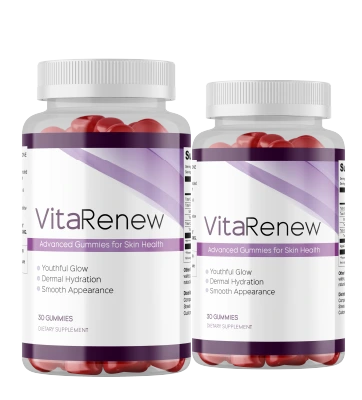
VitaRenew is a daily collagen-support gummy formulated for women 40 and over. Rather than attempting to deliver collagen topically — which faces the same penetration limits — it provides the micronutrients that the body's own collagen-synthesis pathways depend on:
- Vitamin C — required cofactor for the hydroxylase enzymes that stabilize newly assembled collagen molecules into their triple-helix structure
- Copper — essential for lysyl oxidase, the enzyme that cross-links collagen and elastin fibers into the organized, resilient network found in young skin
- Zinc & supporting nutrients — for skin integrity and protection from oxidative processes in the dermis
- Daily gummy format — easy to maintain consistently, which matters for a process that operates over weeks and months
It is a supplement, not a medical treatment. It supports the internal nutritional environment that collagen synthesis depends on — a structurally coherent approach for women who want to go beyond what creams can reach.
What women report
"I genuinely didn't have a word for what I was seeing on my arms until I came across this article. Once I understood it was structural, not dry, I stopped wasting money on creams. Six weeks after starting VitaRenew I could see a real difference in the texture."
"My dermatologist mentioned collagen cofactors and I started researching from there. My neck looks noticeably better — not perfect, but genuinely firmer. I'll take it."
These statements reflect individual experiences. Results are not typical and will vary from person to person.
The short answer — and what to do with it
Crepey skin is the visible result of a thinning, structurally depleted dermis — driven by declining collagen and elastin production, hormonal shifts, and cumulative UV damage. It appears in broader patches than wrinkles, is characterized by a fine, papery surface texture, and is not effectively addressed by topical hydration alone because its cause lies below the reach of products applied to the surface. Supporting the nutritional environment that the skin's own collagen-synthesis machinery depends on is a more structurally grounded approach. VitaRenew was designed around that logic.