Skin Health · Myth vs. Science
What Really Causes Crepey Skin — And Why Most of the Answers You've Heard Are Only Half Right
Three explanations circulate endlessly online. All of them are partially true. None of them are the full story — and that gap is exactly why so many women spend years treating the wrong thing.

Type "what causes crepey skin" into any search engine and you'll get roughly the same three answers, shuffled into different orders: sun damage, dehydration, and the natural loss of collagen with age.
These aren't wrong, exactly. But they're not quite right, either — or more precisely, they're right at the symptom level and silent at the mechanism level. Understanding the difference turns out to matter a great deal for deciding what you actually do about it.
We went through the underlying biology and found three specific places where the popular explanations stop short of the full picture.
Crepey skin isn't one thing going wrong. It's a chain of connected events — and the chain has a weak link most people never hear about.
Myth 1: "It's mostly sun damage"
The popular version
UV rays break down collagen and elastin in the dermis. If you spent time in the sun without protection, that's your answer. Wear sunscreen from now on.
What the biology adds
UV damage is real and it does degrade dermal proteins. But here's what this explanation leaves out: women who never go outside without SPF 50, who wore hats since their twenties, who actively avoided sun for decades — they still get crepey skin. On their arms. On their chest. Exactly where everyone else does.
That's because photoaging is one input into a process that runs regardless. The structural collapse in the dermis is happening even in the absence of UV, driven by hormonal changes and the slowdown of the body's own repair machinery. Sun accelerates the timeline. It is not the timeline.
Myth 2: "Your skin is just dry — drink more water"
The popular version
Crepey skin looks dry and papery, so it must be a hydration problem. Drink more water, use a richer moisturizer, apply hyaluronic acid.
What the biology adds
This one is the most persistently misleading because it works — temporarily. Apply any rich moisturizer to crepey skin and it genuinely looks better for a few hours. The outer layer plumps slightly, reflects light more evenly, and feels smoother to the touch.
By evening it's back.
What's changing when you moisturize is the stratum corneum — the outermost layer of the skin, essentially a barrier of already-dead cells and lipids about as thick as kitchen wrap. What's causing the crepey texture is what's happening in the layer below it: the dermis, where collagen fibres give skin its resistance and elastin fibres let it recoil. Moisturizer, by definition, doesn't reach there. The temporary improvement is real. The structural problem remains completely untouched.
Myth 3: "Collagen powder will fix it"
The popular version
Your body is losing collagen. Supplement with collagen peptides to give it the raw material it needs to rebuild.
What the biology adds
This is the most interesting one, because the logic sounds completely right and yet misses the most important step.
Your body has not forgotten how to make collagen. The genes are intact. The fibroblast cells that produce it are still present in the dermis. Collagen synthesis is a biochemical assembly line — and like any assembly line, it needs more than raw material. It needs the equipment to run.
Vitamin C, for example, is not optional in this process. It's a required cofactor for two specific enzymes — prolyl hydroxylase and lysyl hydroxylase — that give newly-built collagen molecules their stable triple-helix shape. Without adequate vitamin C, collagen is produced in a weak, unstable form. This is biochemistry textbook material; it's the same mechanism that explains why scurvy destroys connective tissue.
Copper is equally non-negotiable on the cross-linking side. An enzyme called lysyl oxidase takes newly made collagen and elastin fibres — which start as loose, unbound threads — and weaves them into the tightly cross-linked mesh that gives skin its resistance and recoil. Lysyl oxidase requires copper to function. Without it, fibres get produced but never properly bound.
What this means in practice: you can add all the collagen peptides you want, but if the enzymatic machinery that processes them is running short on its tools, the output doesn't change much. Raw material rarely turns out to be the bottleneck in a reasonably nourished adult.
What's actually happening in the dermis
The full picture looks like this.
From the mid-twenties, collagen production declines at roughly one percent per year. The loss is gradual enough that it goes unnoticed for a long time. Then, in the perimenopausal years, estrogen levels drop — and estrogen turns out to actively support skin thickness and collagen density. Research on skin changes around menopause has documented that a meaningful share of dermal collagen can be lost in the years immediately surrounding this transition.
Two curves meet. That's the "it happened overnight" feeling — the slow slope and the steeper drop overlapping in the same window. It didn't happen overnight. It just became visible overnight.
Underlying all of this is the question of the enzymatic toolkit. The body can still run the collagen repair process. The question is whether the cofactors those enzymes depend on — vitamin C for stabilization, copper for cross-linking, zinc for skin integrity and ongoing repair — are consistently present in amounts the process can actually use.
You can have all the raw material in the world. If the equipment is missing, the assembly line doesn't run. That's not a metaphor — it's the biochemistry.
Referenced in this article
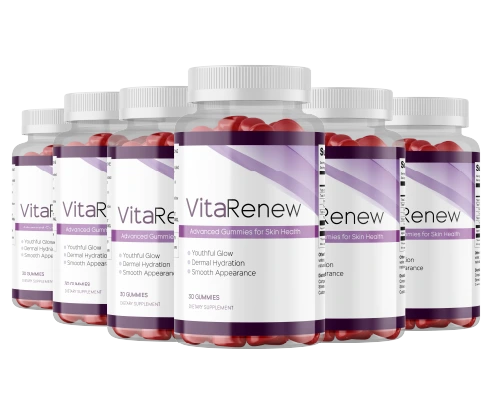
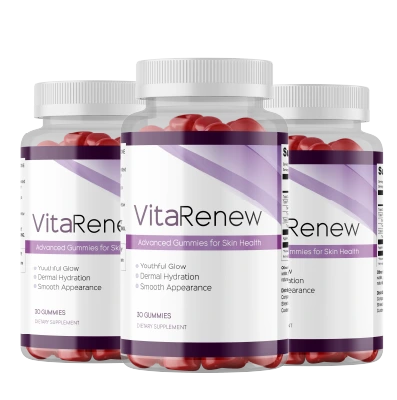
VitaRenew
A daily gummy built around the cofactors your skin's collagen process actually runs on — vitamin C, zinc and copper, with antioxidant support.
For the woman who's tried the creams and wants to understand what's actually going on.
60-day money-back guarantee · One-time purchase, no subscriptionWhat to look for, and what to ignore
If you decide to try something, the biology above suggests a fairly specific filter.
Products that lead with collagen peptides as the main story are addressing one part of the pipeline and skipping the part that tends to be rate-limiting. That's not nothing — there's modest evidence that collagen peptides support skin hydration and elasticity — but it's probably not why your skin changed in your forties.
What's harder to find on shelves is a formula that takes the cofactor side seriously: meaningful levels of vitamin C (not a trace for label compliance), copper specifically called out (most skin formulas omit it entirely because it's the less familiar piece), zinc, and antioxidant support to reduce the oxidative load on the fibres you're trying to preserve.
A few other things worth holding any product to: third-party testing, a manufacturer willing to name their facility standards, marketing that doesn't promise visible change in seven days, and a guarantee long enough to actually evaluate results — sixty days at minimum, since dermal collagen remodelling takes months, not weeks.
What people report
"I'd tried expensive creams for years and they'd help for a few hours, then nothing. About ten weeks in with VitaRenew I noticed the skin on my forearms seemed to be holding its shape a little better — like it had a bit more resilience. I'm not going to oversell it, but it's a change I actually notice."
"What I appreciated was reading the actual ingredient list before buying. Vitamin C, copper, zinc — I recognized those as the things I'd read about. It doesn't make wild promises, which is exactly why I trusted it enough to try."
These statements reflect individual experiences. Results are not typical and may vary based on age, genetics, diet and other factors.
A realistic note on timelines
Collagen remodelling in the dermis is a slow process. The outer layer of skin turns over in four to six weeks; the deeper structural changes that actually move the needle take longer. Most controlled studies of skin-directed supplements run their measurements at eight to twelve weeks for exactly this reason.
Expect gradual rather than dramatic. Photograph yourself honestly, in consistent lighting, on day one. Give whatever you try a full three months before forming a conclusion. Anything marketed with faster timelines than that is telling you something useful about the seller.
A word worth saying clearly: If a patch of skin changes suddenly, thickens, discolours, or a spot changes shape, that is a question for a dermatologist — not a supplement. Crepey skin from ageing is gradual and symmetrical. Anything that doesn't fit that description should be examined by a qualified professional.
Product referenced above
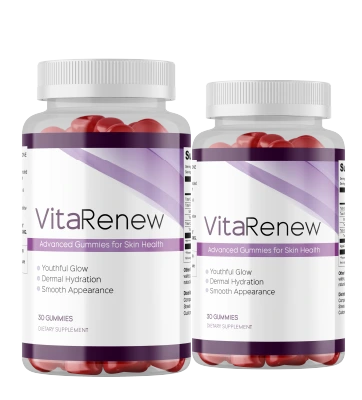
VitaRenew
Vitamin C, zinc and copper in a daily gummy. Made in an FDA-registered, GMP-certified facility. Sixty-day guarantee.
For when you want to address the process, not just the appearance.
60-day money-back guarantee · Supports skin, hair and nailsBackground reading
- Pullar JM, Carr AC, Vissers MCM. "The Roles of Vitamin C in Skin Health." Nutrients, 2017.
- Rucker RB et al. "Copper, lysyl oxidase, and extracellular matrix protein cross-linking." American Journal of Clinical Nutrition, 1998.
- Thornton MJ. "Estrogens and aging skin." Dermato-Endocrinology, 2013.
- Ogawa Y et al. "Zinc and skin disorders." Nutrients, 2018.
- Shuster S, Black MM, McVitie E. "The influence of age and sex on skin thickness, skin collagen and density." British Journal of Dermatology, 1975.