Skin Health · Explainer
What Vitamin Deficiency Causes Crepey Skin? The Answer Is More Useful Than the Question.
Asking which vitamin to take is reasonable. But the honest science points somewhere slightly different — and once you understand where, the path forward gets a lot clearer.

You noticed it on your forearms, or maybe in a photo, or maybe the moment you reached for something overhead and the skin above your elbow moved in a way it hadn't the year before. Thin. Soft. Folded like crepe paper left in the sun.
So you went to Google — as one does — and asked the question that felt most logical: what vitamin deficiency causes crepey skin?
It's a smart question. The assumption underneath it is also smart: the body changed, something internal drove that change, maybe something internal can help slow it. That reasoning is sound. What we want to do here is give you the complete answer, which is more nuanced than a single vitamin — and, once understood, much more useful.
The short answer: it's rarely just one deficiency
Vitamin C is the most frequently cited, and it's there for good reason — we'll get to it. Vitamin D gets mentioned because nearly everyone in the Northern hemisphere is low. Protein is sometimes invoked. Beta-carotene appears on skin supplement labels with some regularity.
But here is the thing that most articles gloss over: crepey skin isn't primarily a nutritional deficiency state. It's a structural change in the dermis — the layer of skin that lives below the one you can touch and clean and moisturize. And understanding that structural change explains both why single-vitamin approaches tend to disappoint and what actually supports the skin from the inside.
The dermis is built from a dense mesh of collagen fibres, elastin fibres, and water-attracting molecules. Crepey skin is what happens when that mesh thins, loses its cross-links, and stops springing back the way it did at thirty-five.
What actually happens in the dermis after 40
Collagen production begins declining gradually in the mid-twenties — roughly one percent a year by commonly cited estimates. At that rate, you don't notice it. What makes the forties feel abrupt is that a second shift arrives on top of the first.
Estrogen supports collagen density and the thickness of the dermis. As estrogen levels fall through the perimenopausal years, collagen loss accelerates meaningfully. The gradual slope and the steeper drop overlap. That's the "it happened overnight" sensation — it didn't, but two processes converged.
The result is a thinner, looser scaffold. Skin that used to recoil now settles slowly. Fine creases appear in places where skin is naturally thin: the upper arms, the chest, the neck, the hands. Apply a rich moisturizer and the surface layer temporarily plumps — the barrier holds more water and reflects light more evenly. By evening the appearance is back, because nothing in the dermis changed.
Where vitamins actually enter the picture
Here is where the vitamin question becomes genuinely interesting — and why "just take vitamin C" isn't the full story even though vitamin C matters enormously.
Your body has not forgotten how to build collagen. The fibroblasts — the cells that manufacture it — are still there. Collagen synthesis is a chemical assembly line, and what limits most assembly lines isn't raw material. It's the machines that process that material. Two of those machines are worth knowing by name.
Vitamin C: the machine that makes collagen stable
A collagen molecule is only useful because of its shape: three protein strands wound into a tight triple helix. That shape is what gives it tensile strength — the ability to resist pulling forces without snapping. The winding is performed by two enzymes, prolyl hydroxylase and lysyl hydroxylase, and both are strictly dependent on vitamin C to function.
This is not a wellness-industry claim. It's the biochemical explanation for why scurvy — a severe vitamin C deficiency — causes connective tissue to fall apart, wounds to reopen, and gums to bleed. Without adequate vitamin C, the body still produces collagen; it produces an unstable version that doesn't hold its structure.
You don't need scurvy-level deficiency for this to matter. The enzymes work along a gradient. Marginal vitamin C status means marginally less stable collagen output — which, over years, contributes to the thinning of the dermal scaffold.
Copper: the machine that binds the fibres together
This is the one almost no one talks about, and it may be the more critical gap in most skin supplementation approaches.
Freshly synthesized collagen and elastin fibres start out as separate, unconnected threads. On their own they provide very little structural strength. What turns them into a resilient, springy network is cross-linking — chemical bonds that tie fibre to fibre, converting a loose pile of rope into a woven net.
Cross-linking is performed by an enzyme called lysyl oxidase, and lysyl oxidase requires copper to function. Without copper, the fibres get produced and never get properly bound. The assembly line builds the bricks and never has mortar.
Look at the label of the last skin supplement you bought. Vitamin C is probably there — it's a familiar name. Copper almost certainly isn't. That gap explains a great deal about why many women supplement for months and see modest results.
Zinc, briefly
Zinc supports normal skin integrity and the repair processes that run continuously in the dermis. It isn't the headline in the crepey skin conversation, but it belongs on any sensible list of what the dermis actually uses.
So the answer to "what vitamin deficiency causes crepey skin" is: it's less about which vitamin is missing, and more about whether the process that uses vitamins has all the tools it needs. Vitamin C, copper, and zinc working together — not any single one of them alone.
What to look for, if you decide to try something
The above is the framework. The practical question that follows is: what does this translate to on a label?
What a well-built skin formula should include
- Vitamin C in a meaningful dose — not a token amount added for the front panel.
- Copper — if it's absent, cross-linking isn't being supported. This is the single most common omission from skin supplements.
- Zinc — for ordinary skin repair and integrity.
- Antioxidant support (vitamin E, selenium, or beta-carotene) — oxidative stress degrades existing fibres while the body is trying to build new ones.
- Third-party manufacturing standards — FDA-registered facility, GMP-certified, independently tested.
- A realistic timeline in the marketing — dermal collagen remodelling runs on months, not days. Any formula promising visible change in a week is telling you more about its marketing than its science.
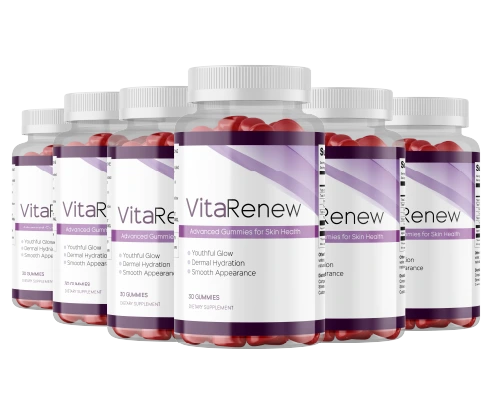
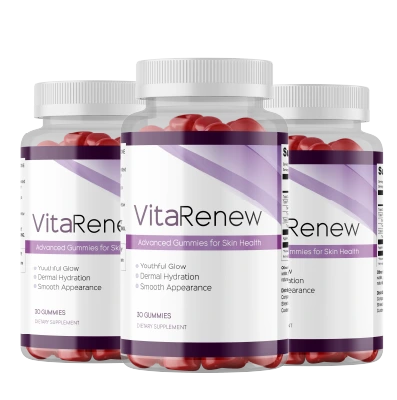
No. 1: VitaRenew
Of the formulas we reviewed while preparing this piece, VitaRenew is the one that maps most cleanly to the list above. It's built around the cofactor side of collagen synthesis — vitamin C, zinc, and copper, with vitamin E, selenium, and beta-carotene for antioxidant support — rather than adding more raw material to a process that already has enough of it.
It's a daily gummy, one-time purchase with no subscription, made in an FDA-registered, GMP-certified facility, and sold with a sixty-day money-back guarantee. It supports skin, hair, and nails. It is not a treatment for any condition.
Referenced in this article
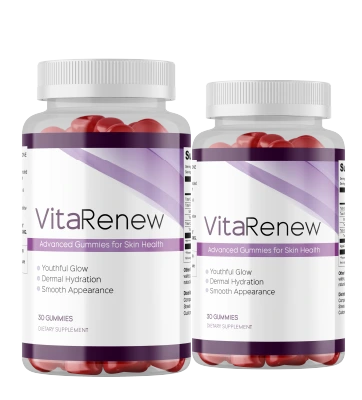
VitaRenew
Vitamin C, zinc and copper — the three cofactors collagen synthesis depends on — in one daily gummy.
For the woman who already tried the collagen powder and wants to understand what was missing.
60-day money-back guarantee · One-time purchase, no subscriptionWhat the women who've tried it report
Individual results vary. Genetics, sun exposure, sleep quality, and dietary baseline all affect outcomes. These are personal accounts, not clinical measurements.
"I'd been taking a collagen powder for eight months and honestly saw very little. Started VitaRenew in February, and by April the skin on my arms looked noticeably smoother. Not dramatic, but real. My nails also stopped breaking off constantly, which I hadn't even expected."
"What I appreciated most was that nobody oversold it to me. I was expecting some miracle marketing claim. Instead I got a clear explanation of what it does. The skin on my chest, which I'd started wearing scarves to cover, looks better. My husband noticed without me saying anything."
These statements reflect individual experiences. Results are not typical and may vary based on age, diet, lifestyle, and other factors.
How long before you can judge fairly
This is important to set correctly before you start, because impatience is the most common reason women give up before reaching an honest evaluation point.
The outer layer of skin turns over roughly every four to six weeks, so surface texture and hydration move first. The dermis is structural and slower — collagen remodelling is measured in months. Most controlled studies of skin-directed supplements run their measurement periods at eight to twelve weeks, which is a reasonable benchmark to borrow.
Give anything you try a full three months. Take a photograph in consistent light on day one — without a filter, with the same arm position. Expect gradual change, not sudden transformation. That's not a caveat; that's what the biology predicts.
One practical caution. If a patch of skin changes suddenly, thickens, or a spot changes shape — that's a dermatologist's question, not a supplement's. Crepey skin from aging is gradual and symmetrical. Anything that isn't should be evaluated by someone with a medical licence. And if you're pregnant, nursing, on medication, or managing any health condition, speak with your pharmacist or healthcare provider before starting any new supplement.
The practical upshot
Crepey skin is not primarily a sign of vitamin deficiency in the way a bruise might signal vitamin C depletion. It's a structural change in the dermis driven by declining collagen and elastin production, accelerated by the hormonal shifts of perimenopause.
Vitamins and minerals do play a role — just not as simple replacements for a missing nutrient. They play the role of enzymatic cofactors: tools the collagen assembly line depends on to do its job properly. Vitamin C stabilizes the triple helix. Copper cross-links the fibres. Zinc supports the continuous repair that keeps the dermis maintained.
Knowing that changes what you look for on a label. And looking for the right things is the only version of this that has a reasonable chance of making a difference.
Product referenced above
VitaRenew
Vitamin C, zinc and copper in a daily gummy. Made in an FDA-registered, GMP-certified facility.
Not a miracle. A formula built around how the dermis actually works.
60-day money-back guarantee · Supports skin, hair and nailsBackground reading
- Pullar JM, Carr AC, Vissers MCM. "The Roles of Vitamin C in Skin Health." Nutrients, 2017.
- Rucker RB et al. "Copper, lysyl oxidase, and extracellular matrix protein cross-linking." American Journal of Clinical Nutrition, 1998.
- Thornton MJ. "Estrogens and aging skin." Dermato-Endocrinology, 2013.
- Ogawa Y et al. "Zinc and skin disorders." Nutrients, 2018.
- Shuster S, Black MM, McVitie E. "The influence of age and sex on skin thickness, skin collagen and density." British Journal of Dermatology, 1975.