Longevity & Science · Skin Biology
Why Does Crepey Skin Happen? The Real Cause After 40
Two biological processes are running simultaneously inside the dermis — and they don't both start at forty. Understanding how they converge explains why the change can feel sudden when years of slow progress finally tip.

Pinch the skin on the back of your hand and release. For most people in their thirties, it returns to flat almost immediately. By the mid-forties, that snap has slowed to a settle. By the fifties, the skin may hold a small ridge for a moment before relaxing back.
That delay is not about hydration, which is what the old clinical "skin turgor" test was measuring. It reflects changes happening in the dermis: a structural layer has thinned, and the fibres that give skin its recoil have loosened.
The pattern that produces crepey skin — that fine, papery texture distinct from deeper wrinkles — is the result of two causes compounding each other. Grasping both makes clear why it tends to appear when it does, and why it appears as this texture specifically.
The first mechanism: the slow baseline
The dermis sits beneath the surface layer of the skin and contains the structural architecture: dense collagen fibres providing thickness and resistance, elastin fibres enabling recoil, and hyaluronic acid holding water between them.
Collagen is produced continuously by cells called fibroblasts. From the mid-twenties onward, production declines by roughly one percent per year. Elastin, which is produced in high volumes during adolescence, is barely replaced after that — the fibres that exist degrade gradually over decades.
So from the mid-twenties, there is a slow, invisible thinning: less collagen being made, elastin fibres degrading without replacement. The losses are spread over so many years that nobody notices. Twenty years of one percent compounding is a substantial sum — it simply arrives one percent at a time.
The second mechanism: the accelerant
Estrogen has a direct relationship with skin structure. It supports collagen density, maintains skin thickness, and is involved in hyaluronic acid production — the molecule that holds water in the dermis and keeps its mesh of fibres functional and pliable.
As estrogen levels fall during perimenopause — typically through the forties and into the early fifties — dermal collagen loss accelerates sharply. Research into skin changes around menopause has found substantial collagen loss concentrated in the years immediately surrounding the transition, above and beyond the baseline rate already running.
Two curves converge: the slow baseline loss accumulating since the mid-twenties, and a sharper perimenopause-driven drop. When they meet, two decades of gradual change become visible in two years — which is why so many women describe it as happening overnight.
Why this texture specifically
Crepey skin is not the same as sagging or deep wrinkles, even though they share the same upstream cause. The fine, crinkled, crepe-paper texture happens because of a specific combination: skin that has thinned enough to lose structural depth, with reduced adherence between the dermis and the epidermis above it.
When the dermis thins, the epidermis has less support beneath it. When the surface layer is also dehydrated — as it commonly is in lower-estrogen states — it does not lie flat over a thin, loose substrate. It crinkles. The crepey texture is the visual result of a surface that has outgrown its scaffolding.
This is why the same underlying process produces different results in different locations. Skin over the cheekbones, supported by underlying fat pads, tends to sag before it develops crepey texture. The arms, hands, chest, and neck — thinner to begin with, with less underlying volume — show the crinkled pattern earlier.
Why topical solutions have a ceiling
Moisturizers genuinely work — up to a point. Apply a rich cream to a crepey forearm and it looks better for several hours. The barrier plumps with water and light reflects more evenly off the smoother surface. By evening, the effect has reversed. Nothing structural changed, because nothing structural was ever addressed: the dermis is roughly a millimeter thick, and most topical ingredients do not reach it.
Collagen supplements have better evidence than they sometimes receive. Several controlled trials of oral collagen peptides have reported modest improvements in skin elasticity and hydration. The mechanism remains debated, but amino acid supply is rarely the limiting step in a reasonably well-nourished adult. What tends to limit collagen synthesis more often is the enzymatic machinery that assembles it.
What the collagen assembly line actually needs
Your body has not forgotten how to make collagen. The fibroblasts are still present; the genes are intact. Collagen synthesis is a biochemical process with specific dependencies, and those dependencies are often what is missing:
- Vitamin C is required by prolyl hydroxylase and lysyl hydroxylase — the enzymes that stabilize a collagen molecule into its functional triple-helix structure. Without adequate vitamin C, collagen is made in an unstable form. This is the same mechanism that causes connective-tissue breakdown in scurvy, and it has been documented in biochemistry for decades.
- Copper activates lysyl oxidase, which cross-links newly synthesized collagen and elastin fibres into a strong, springy network. Without copper, the fibres are laid down but never properly bonded — structurally weaker from the start.
- Zinc supports normal skin integrity and the continuous repair processes in the dermis. It is also involved in antioxidant defence, which matters because oxidative stress degrades existing fibres while new ones are being built.
Vitamin E and selenium belong alongside these: both support antioxidant capacity, helping protect what is already present while synthesis works to add more.
What to look for on a label
- Vitamin C in a functional amount — not a trace included for the label alone
- Zinc and copper together — they work on different steps of the same process; copper in particular is left out of most formulas
- Antioxidant support — vitamin E and selenium protect existing fibres from degradation
- Third-party manufacturing standards — FDA-registered facility, GMP certification
- A guarantee long enough to evaluate it — sixty days at minimum; dermal changes take weeks to months
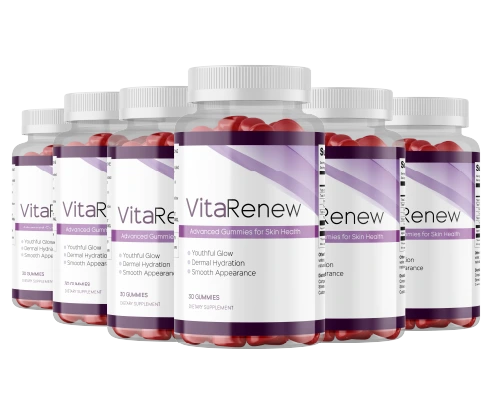
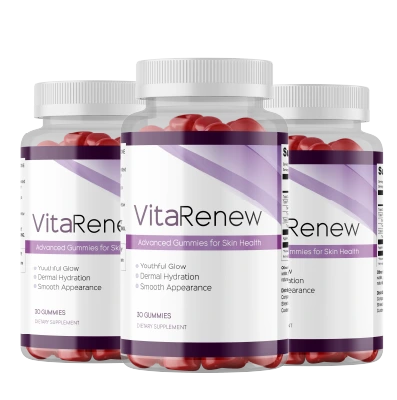
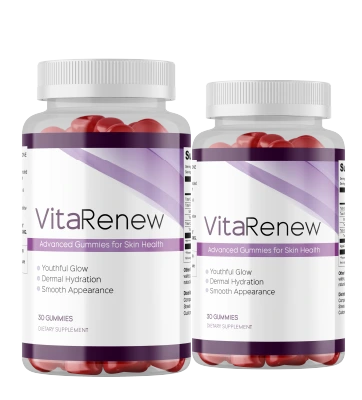
Of the formulas we reviewed, VitaRenew most cleanly matches this list. It is a daily gummy built around the cofactor side of the equation — vitamin C, zinc and copper, with vitamin E, selenium and beta-carotene for antioxidant support. It is made in an FDA-registered, GMP-certified facility and sold with a sixty-day money-back guarantee.
It is a supplement, not a treatment. It supports skin, hair and nails. It does not diagnose, treat, or cure any condition. Two months is a reasonable evaluation window — enough time for surface texture to begin shifting, and a start on the slower dermal timeline.
Referenced in this article
VitaRenew
The cofactors collagen synthesis runs on — vitamin C, zinc and copper — in a daily gummy. With vitamin E and selenium for antioxidant support.
For the morning you look in the mirror and recognize the person looking back.
60-day money-back guarantee · One-time purchase, no subscriptionWhat people report
"I've been taking collagen powder for years and never saw much change. My dermatologist mentioned the cofactor issue and I switched to VitaRenew. Three months in, the skin on my forearms has noticeably better texture."
"Started at 49 when I first noticed the crepey texture on my chest. I take a photo in the same light every few weeks. By month two the surface was smoother and the fine crinkles had reduced."
These statements reflect individual experiences. Results are not typical and vary based on genetics, lifestyle, sun history, and other factors.
A realistic timeline
The outer layer of skin turns over every four to six weeks, so surface texture and tone are the first things that can shift. The dermis is slower — collagen remodelling is measured in months. Most controlled studies of skin-directed supplements run eight to twelve weeks for exactly this reason.
A two-month supply gives enough time to evaluate the direction of change before deciding whether to continue. Take a photograph in consistent lighting on day one, and expect gradual rather than dramatic progress.
Product referenced above
VitaRenew
Vitamin C, zinc, copper, vitamin E and selenium in a daily gummy. FDA-registered facility. Ships from the US.
For the photograph you don't feel like deleting.
Start with a 60-day supply · No subscriptionBackground reading
- Pullar JM, Carr AC, Vissers MCM. "The Roles of Vitamin C in Skin Health." Nutrients, 2017.
- Thornton MJ. "Estrogens and aging skin." Dermato-Endocrinology, 2013.
- Rucker RB et al. "Copper, lysyl oxidase, and extracellular matrix protein cross-linking." American Journal of Clinical Nutrition, 1998.
- Shuster S, Black MM, McVitie E. "The influence of age and sex on skin thickness, skin collagen and density." British Journal of Dermatology, 1975.
- Proksch E et al. "Oral supplementation of specific collagen peptides has beneficial effects on human skin physiology." Skin Pharmacology and Physiology, 2014.