Why your skin is losing elasticity after 40 — and what the research points to


There's a simple test dermatologists have used for decades to get a rough sense of skin hydration and elasticity: pinch the skin on the back of your hand, hold for two seconds, then let go. In healthy, young skin, it snaps back almost instantly. After 40, for most women, it takes a little longer — a fraction of a second more than it used to. Not a dramatic pause, but a noticeable one.
This isn't an illusion and it isn't the result of using the wrong products. It's the visible consequence of changes that have been accumulating quietly in the deeper layers of skin for the past decade or two — changes that are well-documented in the research on skin biology.
What elasticity actually is — and where it lives
When we talk about skin "bouncing back," we're talking about the work of two structural proteins: collagen and elastin. They're both manufactured in the dermis — the thick, living layer beneath the surface — by cells called fibroblasts. And they do very different jobs.
Collagen (particularly Type I and Type III) acts like the scaffolding or the frame of a mattress: it gives skin its thickness, density, and resistance to pressure. Elastin does what its name suggests — it allows skin to stretch and then return to its original position. Think of collagen as the structure and elastin as the spring.
Together, they determine whether skin looks full and firm or thin and loose. And both begin to decline on a predictable timeline.
The timeline researchers understand
Studies published in the Journal of Investigative Dermatology and elsewhere estimate that from our mid-20s onward, the body produces roughly 1% less collagen per year. That sounds manageable — and for a while it is. But the effects compound. By the time most women reach their early 40s, they've lost somewhere between 15 and 20 percent of the collagen they had at 25.
For elastin, the picture is even more concerning: unlike collagen, elastin production essentially stops after adolescence. The elastin fibers you have at 18 are largely the ones you'll have for life. What changes is their quality. UV exposure, oxidative stress, and normal aging cause elastin fibers to fragment and cross-link in ways that reduce their flexibility — turning what was once a supple spring into something stiffer and more prone to breaking.
Around menopause, the decline accelerates further. Estrogen plays a direct role in signaling fibroblast activity — the skin's own collagen and elastin production. When estrogen drops, the rate of structural protein breakdown increases and synthesis slows. Studies tracking women's skin during perimenopause document measurable reductions in skin thickness and elasticity over relatively short windows of time.
Why the change feels sudden — even though it isn't
The most common thing women say when they notice the change is that it seemed to happen "overnight." That's a perception, not a timeline — but the perception is understandable. The loss is gradual and below the threshold of daily notice, until cumulative changes in the scaffolding finally show up visibly at the surface. It tends to become visible first in the places where skin is thinnest: around the eyes, along the jaw, in the neck, and on the backs of the hands. Then one afternoon you catch yourself in a particular light — or you do the pinch test — and realize the skin doesn't quite behave the way it used to.
What topical products can and can't do
This is worth being direct about. Moisturizers, serums, and creams do real things: they hydrate the surface, reduce transepidermal water loss, and make skin feel softer and look smoother. Some active ingredients — retinoids in particular — have meaningful evidence for stimulating collagen production when used consistently over months.
But topical products work on the surface layers. The collagen and elastin that determine skin's structural firmness live in the dermis, deeper than most topical ingredients penetrate significantly. This is why the best moisturizer in the world can leave your skin feeling soft and still not restore the bounce-back quality you're missing. The structure itself is what's thinning.
What the research on collagen supplementation suggests
Over the past decade, there's been substantial interest in whether supplying the body with hydrolyzed collagen peptides — collagen broken into small, highly absorbable fragments — can support the skin's structural layer from within. The hypothesis is that these peptides, once absorbed, act as both building blocks and as signals that prompt fibroblasts to increase their own collagen synthesis.
Multiple randomized controlled trials have found that daily supplementation with hydrolyzed collagen (typically 2.5g to 10g per day for 8–12 weeks) is associated with improvements in skin elasticity and hydration compared to placebo. The effect sizes are modest rather than dramatic, and individual results vary — but the direction of the evidence is consistent enough that collagen supplementation has moved from fringe interest to mainstream discussion in dermatology circles.
What the research consistently emphasizes is that vitamin C is an essential cofactor: without it, the body cannot assemble the hydroxylated amino acids that give collagen its triple-helix structure. Supplying collagen peptides without adequate vitamin C is like having the lumber for a house without the nails.
What we suggest looking into
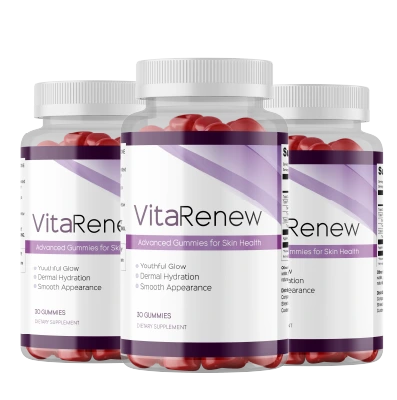
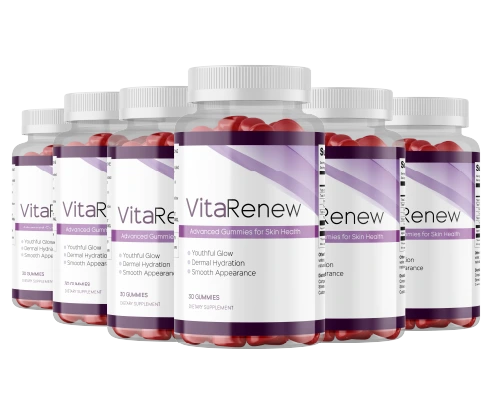
One product that reflects this research directly is VitaRenew — a daily collagen gummy built specifically around supporting skin structure from within:
- Type I & III collagen peptides — the two types most studied for their role in skin firmness and elasticity.
- Vitamin C included — the cofactor without which collagen synthesis cannot proceed, built into the same formula.
- Hyaluronic acid and silica — to support skin hydration and the broader connective tissue matrix.
- In gummy form — one gummy per day; no powder to mix, no pills to remember alongside breakfast.
- Third-party tested — manufactured without gluten, soy, dairy, or GMOs.
It's worth being clear: VitaRenew is a supplement, not a medication. It won't undo structural changes that have accumulated over years, and it isn't a substitute for the standard advice around sun protection, sleep, and hydration. But as a daily approach to supporting the body's collagen-making process — providing the specific raw materials the skin's repair system actually uses — the logic is sound, and the risk is low. Most users in the company's own tracking report increased skin hydration within 2–4 weeks, with texture and firmness changes appearing between 4 and 12 weeks of consistent use.
A two-bottle supply (60 days) is the lowest-commitment way to see whether your skin responds, and it's covered by the 60-day money-back guarantee if it doesn't.
Referenced in this article
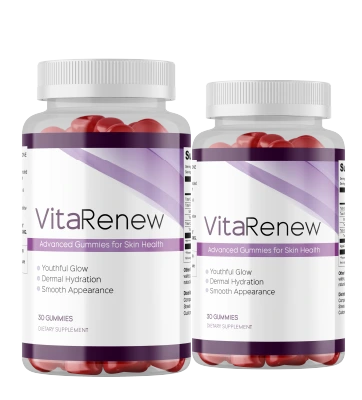
VitaRenew
Type I & III collagen peptides paired with the cofactors your skin's repair process actually requires — in one daily gummy.
For the morning your skin holds itself the way it used to.
60-day money-back guarantee · One-time purchase, no subscriptionWhat users report
"I'd tried everything in a jar and nothing got at the actual firmness. Three months in and the pinch test on my hand springs back faster — I've done it a dozen times because I didn't quite believe it."
"The first thing I noticed was my nails stopped peeling, then my skin started feeling more supported — less like it was sitting loose on my face. I'd been skeptical about gummies but I'm a convert."
These statements reflect individual experiences. Results are not typical and will vary from person to person.
The scientific bottom line
Skin loses elasticity after 40 because the two proteins that give it structure — collagen and elastin — naturally decline with age, and the decline accelerates in the years around menopause. Topical products help the surface; they don't meaningfully address the structural layer beneath. The most research-backed nutritional approach to supporting that structural layer from within is daily supplementation with hydrolyzed collagen peptides paired with vitamin C — which is what VitaRenew delivers.
If you're noticing changes in skin firmness and want to do something about the underlying cause rather than just the surface, this is a low-risk, evidence-aligned place to begin. And as always, any sudden or unusual skin changes are worth discussing with your dermatologist.