Menopause & Skin · Explainer
Why Menopause Makes Skin Crepey After 40 — Explained
The texture change isn't caused by dryness, sun damage, or weight loss. It starts in a structural layer of skin that most articles never mention — and its primary driver is hormonal.

Most women who search this question have already spent time layering on richer creams and waiting for a result that didn't arrive. The change they're noticing — skin that has gone thinner, slightly crumpled, with a fine crosshatch of lines that looks like tissue paper — has a name: crepey skin. And the reason moisturizer alone rarely resolves it comes down to where the change actually begins.
It begins in the dermis. Not the surface. The layer beneath it.
What estrogen actually does in skin — and why most women are never told
The conversation about menopause tends to orbit familiar symptoms: hot flashes, sleep disruption, mood shifts. Skin rarely gets a full explanation. But the dermis — the structural foundation beneath the surface you can touch — contains estrogen receptors. The cells responsible for building and maintaining the skin's collagen network, called fibroblasts, are directly responsive to estrogen.
When estrogen is present at the levels typical of reproductive years, fibroblasts stay active. They lay down fresh collagen fibers, remodel aging ones, and sustain the dense mesh that gives skin its thickness and that characteristic snap-back when pinched. Estrogen, in this sense, is a maintenance signal for the dermis.
When estrogen levels decline — gradually through perimenopause, then more sharply at menopause — fibroblast activity slows in step with it. New collagen production drops. The existing collagen and elastin framework continues breaking down at its usual pace. The balance tips toward net loss, and the structural consequences of that loss become visible at the surface.
Why women describe it as happening "overnight"
Here is the detail that catches most women off guard: dermal collagen loss is not new at forty. It begins in the mid-twenties, at a rate slow enough — roughly one percent per year — that the skin stays within the threshold of what feels normal for a very long time. The change is gradual and largely invisible for fifteen years.
What changes during the perimenopausal window is the arrival of a second accelerating factor stacked on top of the first. Research has found that the years immediately following menopause can bring a sharper period of dermal thinning — as fibroblast activity slows and the hormonal maintenance signal diminishes. The two slopes converge, and a change that felt imperceptible for over a decade suddenly seems to accelerate within eighteen months.
This is why crepey texture so often appears in step with other menopausal transitions, and why it carries that disorienting sense of suddenness even though the underlying process has been building for years.
Why the chest, arms, and hands go first
The skin on the upper arms, inner elbows, chest, and backs of the hands is structurally different from facial skin. It is thinner to begin with. It sits over looser connective tissue with less subcutaneous fat beneath to cushion structural changes. It has typically accumulated more cumulative sun exposure — which accelerates collagen breakdown through a separate mechanism.
When the dermis begins to lose density and the elastin network becomes less resilient, these areas have the least reserve to absorb the shift. The skin loosens slightly, the surface develops that characteristic papery texture, and it no longer springs back the way it once did. The face often follows later — partly because it carries more subcutaneous fat, and partly because it tends to receive more deliberate topical care.
Crepey skin is a structural event. It begins in a layer that moisturizers were never designed to reach.
What the dermis is actually made of — and what it loses
Understanding crepey skin means understanding what the dermis contains, and what changes when it thins:
- Collagen fibers give skin its thickness and mechanical integrity. Types I and III are the dominant forms in the dermis. Their loss is the primary driver of the thinner, softer quality that crepey skin produces.
- Elastin fibers give skin its recoil — the ability to stretch and return. As elastin degrades and isn't replaced at the same rate, the skin loses that elastic quality. It stretches but recovers slowly or incompletely.
- Glycosaminoglycans — including hyaluronic acid — fill the space between fibers and hold water within the tissue. Their decline contributes to the flat, deflated quality that crepey areas take on even when the surface appears adequately moisturized.
All three components are produced by fibroblasts. All three are sensitive to the hormonal environment. And none of them are accessible to products designed to work only at the surface.
The part most coverage leaves out: what collagen synthesis actually runs on
Here is where the explanation tends to end in most articles — at the observation that hormonal change slows collagen production. What is less often discussed is that the body's capacity to produce collagen doesn't disappear at menopause. It slows. And slowing can be partially offset by making sure the process has what it needs to run.
Collagen synthesis is an enzymatic assembly line, and that line depends on specific micronutrients acting as cofactors:
- Vitamin C is essential for two enzymes — prolyl hydroxylase and lysyl hydroxylase — that give each collagen molecule its stable triple-helix shape. Without sufficient vitamin C, the collagen produced is structurally weaker. This is established biochemistry, documented extensively in the research literature.
- Copper activates an enzyme called lysyl oxidase, which cross-links newly formed collagen and elastin fibers into interconnected, load-bearing networks. Without copper, fibers are synthesized but remain poorly bound — like threads laid out but never stitched.
- Zinc supports the continuous skin cell renewal process and plays a role in the repair mechanisms that operate throughout the dermis.
The practical implication is worth stating clearly: if the raw material exists but the cofactors are insufficient, the assembly line runs slowly regardless of input. Addressing all three in combination may better support ongoing skin structure than focusing on any single nutrient in isolation.
Referenced in this article
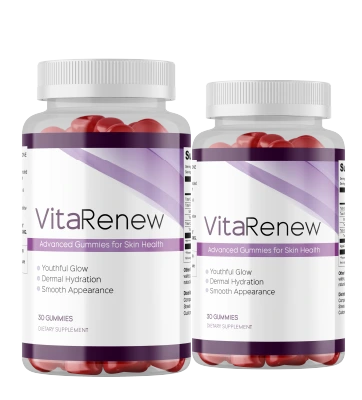
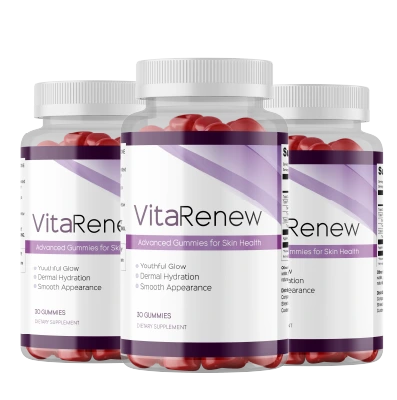
VitaRenew
Formulated around the cofactors collagen synthesis depends on — vitamin C, copper, and zinc — in a daily gummy. Made in an FDA-registered, GMP-certified facility. 60-day money-back guarantee.
For the skin you'd like to feel comfortable in again.
60-day money-back guarantee · One-time purchase, no subscriptionWhat "supporting" skin during this transition actually looks like
None of this is a claim that anything can undo what menopause does to the dermis. The hormonal shift is real, and its structural effects are real. What research on skin-directed supplementation explores is whether ensuring the body has adequate cofactors for collagen synthesis — during a period when the process is already under pressure — may support the skin's structural maintenance.
Studies on vitamin C and skin outcomes generally measure results at eight to twelve weeks for a reason: collagen remodeling is a slow process. The surface layer of skin turns over every three to six weeks, so some changes in texture and tone can appear relatively quickly. The deeper structural changes take longer to accumulate and are correspondingly slower to reflect.
A realistic timeline: commit to a consistent approach, photograph the areas you're paying attention to in the same light, and allow three full months before drawing any conclusions. Genetics, sun history, diet, sleep, and hydration all influence outcome. No approach produces identical results for everyone.
What women in their forties and fifties report
"I started around the same time I was going through perimenopause — the skin on my arms and chest had changed so noticeably. By week ten, I could see a difference. Not dramatic, but the texture felt less papery. I stopped avoiding short sleeves."
"I was skeptical of supplements generally, but this was more about the cofactor idea than any big promise. The gummy is easy. A few months in, my skin feels different — firmer somehow, less tissue-like on my upper arms."
These statements reflect individual experiences. Results are not typical and will vary from person to person.
Product referenced above
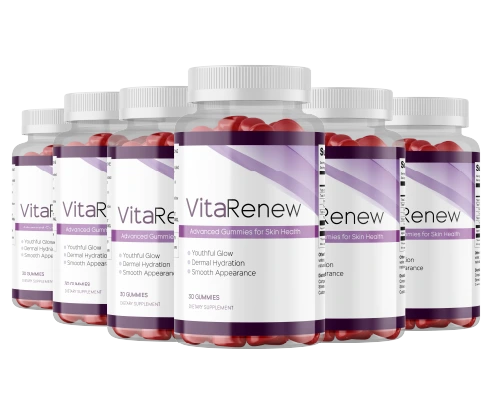
VitaRenew
Vitamin C, zinc, and copper in a daily gummy. Supports skin, hair, and nails from within.
For the photograph you don't think twice before sharing.
60-day money-back guarantee · Supports skin, hair and nails