Skin Health · Research Explainer
Why Neck Skin Sags After 50 — The Structural Explanation
The neck reveals age faster than the face. Understanding why — from the biology of cervical skin to the cofactors that support its structure from within — changes what you look for on a supplement label.

Most conversations about aging skin focus on the face. But for many women over 50, it is the neck — specifically, the area from the jawline down to the collarbone — that becomes the more pressing concern. The skin there can loosen, crease horizontally, and lose the smooth vertical line between chin and chest more quickly than the face does, and often before a woman has noticed comparable changes above the jaw.
The reasons for this are structural, and they are different from the general mechanisms of facial aging. Understanding them matters for anyone evaluating what can realistically help — and what cannot.
Why the neck ages differently than the face
Cervical skin — the skin covering the neck — is anatomically distinct from facial skin in three important ways.
First, it is thinner. The dermis of the neck typically measures one to two millimetres in depth, compared to three to five millimetres in areas like the forehead and cheeks. A thinner dermis means a thinner scaffold: less collagen, less elastin, and less hyaluronic acid matrix holding the structure together. When age-related degradation occurs at the same rate as the face, the effect is proportionally more visible in a thinner starting material.
Second, cervical skin has significantly fewer sebaceous (oil) glands than facial skin. Sebaceous secretion contributes to the lipid barrier that maintains moisture and, to some degree, surface suppleness. Without it, neck skin tends toward dryness, which amplifies the visual appearance of crepiness and fine horizontal lines.
Third, the neck experiences a mechanical stress pattern the face does not. Decades of looking down — at books, phones, work surfaces — load the horizontal crease zones of the neck with repeated folding. The dermal matrix in these zones undergoes mechanical strain that, over time, accelerates local degradation of the structural fibres.
The result is a site that starts thinner, dries out more readily, and is subjected to repetitive mechanical load — all before age-related collagen loss begins working on it.
What's happening in the tissue
The dermis is built around a mesh of collagen and elastin fibres. Collagen provides tensile strength — it is the material that resists stretching and maintains the skin's volume. Elastin provides recoil — it is the material that allows skin to return to shape after deformation. Between the fibres, proteoglycans and glycosaminoglycans, including hyaluronic acid, form a water-attracting matrix that keeps the mesh hydrated and gives it physical bulk.
Collagen synthesis declines from the mid-twenties at roughly one percent per year. By the late forties, a meaningful portion of the dermal scaffold that was present in a woman's twenties has been lost. Critically, the fibres that remain undergo cross-linking changes: they become less well-organised and more fragmented, losing both the parallel alignment that gives young collagen its strength and the elastin integration that gives it spring.
Estrogen amplifies this process. It supports the fibroblast activity responsible for producing collagen and elastin, regulates hyaluronic acid synthesis, and maintains dermal thickness. As estrogen falls during the perimenopausal transition, dermal collagen loss accelerates substantially. Published research in the dermatology literature indicates that a significant proportion of total dermal collagen can be lost during the years immediately surrounding menopause — a loss that then continues, but more slowly, afterward.
Neck skin starts with less scaffold than the face, loses it faster, and has fewer compensating mechanisms. That combination explains why the change becomes visible there first — not because anything unusual is happening, but because the starting point was lower.
What topical products can and cannot do
The skincare market offers a substantial range of products for neck-specific concerns: firming creams, tightening serums, retinoid formulations. Some of these have genuine evidence behind them. Retinoids — vitamin A derivatives — are the most studied: they are small enough to penetrate the stratum corneum barrier and have documented effects on surface texture and fibroblast signalling.
The structural ceiling appears when you trace how far applied molecules actually reach. The stratum corneum limits penetration of molecules above roughly 500 daltons in molecular weight. Collagen is orders of magnitude larger than that threshold, and applied forms remain at or near the surface. Even retinoids, the most penetrating topical agents with dermal evidence, operate primarily at the dermal-epidermal junction rather than deep in the dermis where the structural scaffold lives.
On the neck specifically, this ceiling is lower than on the face because the stratum corneum barrier function — though present — is supported by fewer sebaceous secretions. The skin may absorb topical agents slightly differently, but the depth limitation of the dermis itself remains.
This is not a reason to abandon topical care. It is a description of the layer it cannot reach, which is the same as describing where an internal approach begins.
The cofactor argument for internal support
The body does not lose the ability to synthesise collagen at 50. Fibroblasts remain present and can remain active. What research has clarified is that collagen synthesis is an enzymatic process with specific cofactor requirements — molecules the enzymes need in order to complete the work.
Three are particularly relevant:
- Vitamin C is required by prolyl hydroxylase and lysyl hydroxylase — the enzymes that add the hydroxyl groups that give the collagen triple helix its stable, cross-linked structure. Without adequate vitamin C, newly produced collagen is formed but structurally incomplete. This is not a marketing claim; it is the biochemical mechanism documented in the clinical nutrition literature for decades.
- Copper is the cofactor for lysyl oxidase, the enzyme that cross-links collagen and elastin fibres into the load-bearing network. Cross-linking is what converts loose protein threads into a functional scaffold. Without copper, fibres are produced but the final bonding step is incomplete. Copper is consistently underrepresented in commercial skin supplements relative to its role in the biochemistry.
- Zinc participates in wound repair signalling, in regulating the matrix metalloproteinases that govern collagen turnover, and in maintaining skin integrity. Its role is supportive rather than rate-limiting in healthy individuals, but it is consistently present in the dermal biology literature.
Antioxidant cofactors — particularly vitamin E and selenium — address a separate mechanism: oxidative degradation of existing fibres. The dermis is an aerobic tissue with ongoing metabolic activity, and oxidative stress accelerates fibre fragmentation at the same time the body is attempting to rebuild the scaffold. Supporting the antioxidant capacity of the tissue is therefore complementary to supporting synthesis.
Referenced in this article
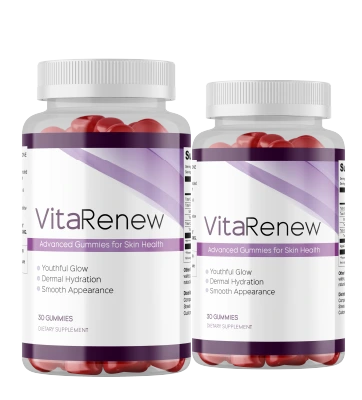
VitaRenew
Vitamin C, copper, zinc, vitamin E and selenium — the cofactor combination the collagen synthesis process depends on, in one daily gummy.
The 2-bottle supply is where most readers start — 60 days is the minimum for a fair evaluation of any internal skin support.
60-day money-back guarantee · One-time purchase, no subscriptionWhat to hold a supplement to in this category
If you are evaluating an internal product for skin support, particularly neck skin, these criteria are worth applying before you spend:
A working checklist
- Vitamin C at a dose that matters. Not a trace amount included for label positioning.
- Copper alongside zinc. They act at different enzymatic steps. A formula with zinc but no copper addresses one step and misses the cross-linking stage — which is where scaffold formation actually completes.
- Vitamin E and selenium. The antioxidant pair consistently cited in the dermal oxidative stress literature — not a single-source antioxidant.
- Verified manufacturing. FDA-registered facility, GMP certification. These are certifiable facts, not marketing language — the manufacturer should be able to provide documentation.
- A realistic timeline commitment. The dermis remodels slowly. Any supplement promising visible improvement in days is telling you something about the seller, not the biology.
- A guarantee long enough for honest evaluation. Given that meaningful dermal change takes 8 to 12 weeks, a 60-day guarantee is the minimum acceptable window.
VitaRenew
Of the formulations we reviewed against this list, VitaRenew maps most directly to the cofactor model. It is a daily gummy supplying vitamin C, zinc, copper, vitamin E, selenium, and beta-carotene — the combination that addresses both the enzymatic requirements of collagen synthesis and the antioxidant requirements of existing fibre protection, in a single product rather than a multi-supplement stack.
It is manufactured in an FDA-registered, GMP-certified facility and sold as a one-time purchase with no subscription and a 60-day money-back guarantee. The entry option — two bottles at $79 each — provides a 60-day evaluation window at a per-bottle price that matches the minimum time horizon any honest assessment of an internal skin supplement requires.
It is a supplement, not a treatment. It supports healthy skin, hair and nails — it does not diagnose, treat or cure any condition, and these statements have not been evaluated by the FDA.
On timelines and expectations
Neck skin responds to internal support on the same biological timeline as skin elsewhere — which is to say, slowly. Surface-layer changes, including moisture and texture, can shift within four to six weeks. The dermis, where the structural scaffold lives, remodels on a timescale of months. Clinical trials in this area standardly measure outcomes at 8 to 12 weeks, not 4.
Individual variation is significant and real. Starting point — how much collagen loss has already occurred, hormonal status, genetics, cumulative UV exposure — affects both the baseline and the rate of response. Two women using the same product for the same period can see different outcomes, and both can be within the normal range of variation for that supplement.
"I specifically started looking for something after I noticed how much my neck was aging compared to the rest of my face. After about three months on VitaRenew the horizontal lines are less pronounced and the skin feels less papery. My husband commented before I said anything."
— Carolyn M., 57, verified purchaser
"A dermatologist friend mentioned that most women ignore neck skin until it becomes the issue — and then it's frustratingly hard to address. She pointed me toward collagen cofactors rather than creams. VitaRenew had the copper and vitamin C combination she described. Nine months in, I'm maintaining what I started with rather than watching it continue to change."
— Nancy K., 63, verified purchaser
Individual results vary. These testimonials represent personal experiences and may not reflect typical outcomes.
A clinical note: if you notice a skin change that is rapid, asymmetric, thickening, or changing in colour — that warrants evaluation by a dermatologist, not a supplement. Age-related dermal thinning and sagging is gradual and bilateral. Anything that does not match that pattern should be professionally assessed before any other response.
The short version
Neck skin sags after 50 for a combination of reasons that are specific to that site: it starts thinner than facial skin, has fewer oil glands, and is subjected to decades of mechanical loading from looking down. Over that baseline, the same age-related collagen loss and estrogen-associated acceleration that affects all skin work on a structural foundation that was already thinner.
Topical products operate above the structural layer and have a real but bounded ceiling. The body retains the enzymatic capacity to rebuild dermal collagen, but that capacity depends on cofactors — vitamin C, copper, and zinc most directly — that are separate from protein intake and commonly absent or underdosed in commercial skin supplements.
That is what the research supports. What you choose to do with it is a personal decision.
Product referenced above
VitaRenew
The cofactor-first formula for skin, hair and nails. Made in an FDA-registered, GMP-certified facility. No subscription.
Start with the 2-bottle supply — a full 60-day window at the per-bottle price of an honest evaluation.
60-day money-back guarantee · No subscription · Ships from the USBackground Reading
- Pullar JM, Carr AC, Vissers MCM. "The Roles of Vitamin C in Skin Health." Nutrients, 2017.
- Rucker RB et al. "Copper, lysyl oxidase, and extracellular matrix protein cross-linking." American Journal of Clinical Nutrition, 1998.
- Uitto J. "The role of elastin and collagen in cutaneous aging: intrinsic aging versus photoexposure." Journal of Drugs in Dermatology, 2008.
- Thornton MJ. "Estrogens and aging skin." Dermato-Endocrinology, 2013.
- Varani J et al. "Decreased collagen production in chronologically aged skin." American Journal of Pathology, 2006.
- Cao C et al. "Mechanical properties of the human skin over the neck." Journal of Biomechanics, 2019.
- Ogawa Y et al. "Zinc and skin disorders." Nutrients, 2018.