Skin Health · Explainer
Why Skin Gets Crepey After 40 — And What's Actually Happening Underneath
It isn't dryness. It isn't neglect. And it isn't something a richer moisturizer was ever going to fix — because the change is happening in a layer creams don't reach.

Most women can name the exact moment they noticed it.
Not a wrinkle — wrinkles you see coming. This was different. You lifted your arm in a dressing room and the skin above your elbow moved in a way it hadn't before. Or you caught the light across your chest in a photograph and saw fine, papery lines that hadn't been there last summer. Thin. Loose. A little like tissue paper that had been folded and smoothed out again.
The word for it is crepey, and it tends to arrive somewhere in the forties, on the arms, the chest, the neck, and under the eyes — the places where skin is thinnest to begin with.
Two things are worth saying before we get into the biology.
The first is that you are not being vain for minding it. Skin is the organ other people read. Minding how it changes is not shallow — it's human, and it's the same instinct that makes you want to feel like yourself in your own photographs.
The second is that this is not a verdict on how well you took care of yourself. Women who never smoked, always wore sunscreen and never skipped a night of moisturizer get crepey skin too. It is not a punishment for something you neglected.
Crepey skin is a structural change, not a surface one. That single distinction explains almost everything about why the products most of us reach for first don't do very much.
What is actually changing
Skin has layers. The one you can touch — the stratum corneum — is essentially a barrier of flattened, already-dead cells and lipids. Its job is to hold water in and keep the world out. It is about as thick as a sheet of kitchen film.
Underneath sits the dermis, and that's where the architecture lives: a dense mesh of collagen fibres giving skin its thickness and resistance, elastin fibres letting it snap back, and hyaluronic acid holding water between them.
Crepey skin is what a thinning, loosening dermis looks like from the outside. The mesh has fewer fibres, and the fibres it still has are less tightly bound to one another. Skin that used to spring back now settles slowly, and folds where it didn't used to fold.
This is why the moisturizer test is so misleading. Apply a rich cream to a crepey forearm and it will genuinely look better for a few hours — the barrier plumps with water and light reflects off it more evenly. By evening it's back. Nothing structural changed, because nothing structural was ever addressed.
Why the forties in particular
Collagen production declines gradually from the mid-twenties onward; commonly cited estimates put it at roughly one percent a year, which is slow enough that nobody notices it happening.
What makes the forties feel abrupt is that a second change arrives on top of the first. Estrogen supports collagen density and skin thickness, and as estrogen levels fall through the perimenopausal years, dermal collagen loss accelerates. Research on skin changes around menopause has found that a substantial share of skin collagen can be lost in the years immediately surrounding it.
So the gradual slope and the steeper drop overlap. That is the "it happened overnight" feeling — it didn't, but two curves met.
The part almost nobody explains
Here is where most articles stop and start recommending things. It's worth going one step further, because this step is the one that determines whether anything you take will do anything at all.
Your body has not forgotten how to make collagen. The genes are intact, the cells that make it — fibroblasts — are still there. Collagen synthesis is simply a chemical assembly line, and like any assembly line it needs more than raw material. It needs the machinery to run.
Two of those machines are worth knowing by name, because they explain a great deal:
- Vitamin C. The enzymes prolyl hydroxylase and lysyl hydroxylase are what give a collagen molecule its stable triple-helix shape. Both are strictly dependent on vitamin C as a cofactor. Without adequate vitamin C, collagen is produced in a weak, unstable form. This is not a marketing claim — it's the reason scurvy destroys connective tissue, and it has been in biochemistry textbooks for decades.
- Copper. Newly made collagen and elastin fibres are, at first, loose threads. An enzyme called lysyl oxidase cross-links them into the strong, springy network that gives skin its resistance and recoil. Lysyl oxidase is a copper-dependent enzyme. Without copper, the fibres get made but never properly bound.
Zinc belongs in the same conversation: it's involved in normal skin integrity and in the ordinary repair processes that go on continuously in the dermis.
Put plainly: you can have all the building material in the world, but if the crew is missing its tools, the wall doesn't get built — and it certainly doesn't get bolted together.
Which brings up the collagen supplement question
If you've taken collagen powder for six months and seen nothing, this is the most likely explanation — and it's a more interesting one than "collagen doesn't work."
To be fair to the evidence: several controlled trials of oral collagen peptides have reported modest improvements in skin elasticity and hydration, and the mechanism is still debated. It isn't nothing. But amino acid supply is rarely the bottleneck in a reasonably fed adult. If the limiting step is the enzymatic machinery — vitamin C for stabilization, copper for cross-linking — then adding more raw material to a line that can't process what it already has won't change the output much.
That's not a reason to feel foolish for having tried it. It's a reason to look at what was missing alongside it.
What to look for, if you decide to try something
Whatever you end up choosing — and there are reasonable options — these are the criteria worth holding it to:
A short, unglamorous checklist
- Vitamin C in a meaningful amount. Not a trace for the label.
- Zinc and copper together. They work on different steps of the same process, and copper in particular is left out of most skin formulas.
- Antioxidant support — vitamin E and selenium are the usual pair — since oxidative stress degrades existing fibres while you're trying to build new ones.
- Third-party testing and a manufacturer willing to name its facility standards.
- A realistic timeline in the marketing. Anything promising visible change in seven days is telling you something about the seller, not the product.
- A guarantee long enough to actually evaluate it — sixty days at minimum.
No. 1: VitaRenew
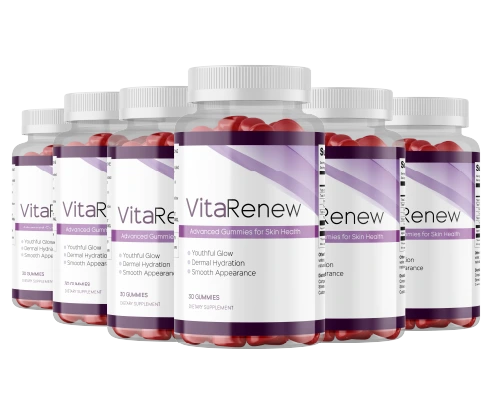
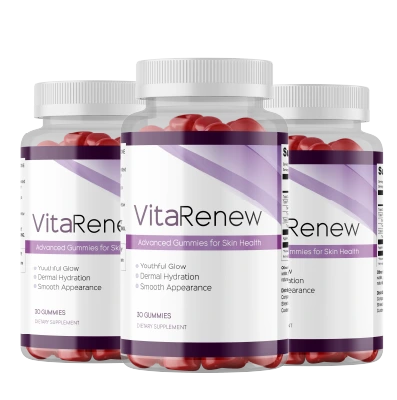
Of the formulas we looked at while writing this, VitaRenew is the one that most cleanly matches the list above. It's a daily gummy built around the cofactor side of the equation rather than the raw-material side: vitamin C, zinc and copper, with vitamin E, selenium and beta-carotene for antioxidant support. It is made in an FDA-registered, GMP-certified facility and sold with a sixty-day money-back guarantee.
It is a supplement, not a treatment. It supports skin, hair and nails — it does not diagnose, treat or cure anything, and any company telling you otherwise is one to walk away from.
Referenced in this article
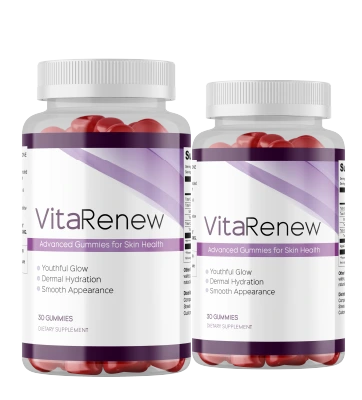
VitaRenew
The cofactors your skin's repair process actually runs on — vitamin C, zinc and copper, in one daily gummy.
For the morning you look in the mirror and recognise the person looking back.
60-day money-back guarantee · One-time purchase, no subscriptionWhat a realistic timeline looks like
This is where honest expectations matter more than enthusiasm.
The outer layer of skin turns over roughly every four to six weeks, so surface texture and tone are the first things that can shift. The dermis is slower — collagen remodelling is a matter of months, not days. Most controlled studies of skin-directed supplements measure their outcomes at eight to twelve weeks for exactly that reason.
So: give anything you try a full three months before you judge it, take an honest photograph in the same light on day one, and expect gradual rather than dramatic. Individual results vary — genetics, sun history, sleep, and how much you already get from your diet all move the needle.
Worth saying plainly: if a patch of skin changes suddenly, thickens, discolours, or a spot changes shape, that is a dermatologist's question and not a supplement's. Crepey skin from ageing is gradual and symmetrical. Anything that isn't should be looked at by someone with a licence.
The short version
Crepey skin is a change in the dermis — fewer collagen fibres, less cross-linking, less recoil. Creams work on a layer above it and have a real but temporary ceiling. Your body still knows how to rebuild that architecture; what tends to be missing is the cofactors the process runs on, particularly vitamin C and copper.
That's a less exciting story than a miracle ingredient from a remote island. It has the advantage of being true, and of pointing at something you can actually check on a label.
Product referenced above
VitaRenew
Vitamin C, zinc and copper in a daily gummy. Made in an FDA-registered, GMP-certified facility.
For the photograph you don't feel like deleting.
60-day money-back guarantee · Supports skin, hair and nailsBackground reading
- Pullar JM, Carr AC, Vissers MCM. "The Roles of Vitamin C in Skin Health." Nutrients, 2017.
- Rucker RB et al. "Copper, lysyl oxidase, and extracellular matrix protein cross-linking." American Journal of Clinical Nutrition, 1998.
- Shuster S, Black MM, McVitie E. "The influence of age and sex on skin thickness, skin collagen and density." British Journal of Dermatology, 1975.
- Thornton MJ. "Estrogens and aging skin." Dermato-Endocrinology, 2013.
- Ogawa Y et al. "Zinc and skin disorders." Nutrients, 2018.