Skin Health · Research Explainer
Why Skin Sags With Age — And What's Actually Happening in the Dermis
Gravity gets the blame. But the real mechanism starts inside the skin's structural layer — and understanding it changes what you look for on a supplement label.

Ask most people why skin sags with age and they will say gravity, sun damage, or simply the passage of time. All of those have a role. But the structural explanation — the one that determines whether anything can meaningfully support skin at this stage — is more specific than that.
It begins with the dermis.
The dermis is the layer of skin that sits below the surface you can touch. It is not particularly thick — three to five millimetres in most places — but it is dense with infrastructure: a mesh of collagen fibres running in multiple directions, elastin fibres woven through them, and a matrix of water-attracting molecules holding moisture between the threads. Together, these give skin its volume, its spring, and its ability to return to shape after being pressed or folded.
When the mesh degrades, skin stops returning. That is what sagging is: not skin falling from above, but skin losing the internal architecture that was holding its shape from the inside.
The two-curve problem
Collagen production declines gradually from the mid-twenties onward. Estimates vary, but published research typically puts the rate at roughly one percent per year. One percent sounds trivial until you appreciate that it is cumulative — by the time a woman reaches her late forties, a meaningful fraction of the dermal scaffolding present in her twenties is gone, and what remains has reorganised into a looser, less cross-linked matrix.
This slope alone would produce visible changes over time. What makes the forties feel like a step change is that a second curve descends on top of the first.
Estrogen plays a structural role in skin that is often underappreciated in non-clinical discussions. It supports fibroblast activity (fibroblasts are the cells that manufacture collagen and elastin), it regulates hyaluronic acid production, and it maintains dermal thickness. As estrogen levels fall during the perimenopausal transition, dermal collagen loss accelerates. Research published in the dermatology literature has found that a substantial proportion of dermal collagen can be lost in the years immediately surrounding menopause — a rate that then settles to a slower trajectory afterward.
The "it happened overnight" quality that many women describe reflects two independent decline curves overlapping. Nothing happened overnight. Two slopes intersected, and the combined effect became visible.
The dermis is not passive tissue. It is a living matrix with ongoing repair capacity — but that repair depends on inputs that most people are not tracking.
Why creams have a structural ceiling
Skincare for sagging has expanded into a significant commercial category, and some products — particularly those with retinoids and certain peptides — do have evidence supporting modest effects on surface texture and fine lines.
The structural ceiling appears when you trace where topically applied molecules actually go. The stratum corneum, the outermost layer of skin, functions as a highly effective barrier. Molecules with a molecular weight above approximately 500 daltons are largely excluded from meaningful dermal penetration under normal conditions. Collagen itself is a large protein — far above this threshold — and applied forms remain at or near the surface.
Retinoids are an exception; they are small enough to penetrate and have documented effects on fibroblast activity. But even they operate closer to the dermal-epidermal junction than deep in the dermis, and the evidence for their effect on sagging specifically — as opposed to surface fine lines — is more limited.
This is not an argument against topical care. It is a description of where its effects end, which is the same as describing where a different approach begins.
The cofactor question
Here is the piece of the collagen story that receives less attention than it deserves.
The body does not lose the ability to synthesise collagen at 40 or 50. Fibroblasts remain present and, under appropriate conditions, remain active. Collagen synthesis is a multi-step enzymatic process, and like any enzymatic process it depends on cofactors — molecules that the enzymes in question require in order to function correctly.
Two are particularly relevant to the stability and cross-linking of collagen and elastin:
- Vitamin C is required by the enzymes prolyl hydroxylase and lysyl hydroxylase, which add the hydroxyl groups that give the collagen triple helix its stable shape. Without adequate vitamin C, these enzymes cannot complete the stabilisation step — newly produced collagen is formed but is structurally weak. This is not a marketing claim; it is the mechanism behind scurvy, and it has appeared in biochemistry and clinical nutrition literature for decades.
- Copper is the cofactor required by lysyl oxidase, the enzyme responsible for cross-linking collagen and elastin fibres into the load-bearing network that gives skin its mechanical properties. Cross-linking is what turns loose protein threads into a functioning scaffold. Without copper, fibres are produced but the final bonding step cannot be completed.
Zinc participates in skin integrity, wound repair signalling, and the regulation of matrix metalloproteinases — enzymes involved in normal collagen turnover. Its role is less dramatic than vitamin C or copper but consistently present in the literature on dermal biology.
The practical implication is that supporting collagen production is not simply a matter of supplying amino acid precursors. The enzymatic machinery that assembles and cross-links collagen needs its own inputs, and those inputs are separate from protein intake.
What to look for, and what to hold it to
If you are evaluating a supplement in this category, these criteria are worth applying:
A working checklist
- Vitamin C at a meaningful level. Not a trace quantity for label positioning.
- Both zinc and copper. They act at different steps; copper in particular is absent from most formulas.
- Antioxidant co-factors — vitamin E and selenium are the research-supported pair — since oxidative stress degrades existing fibres at the same time the body is attempting to rebuild them.
- Verified manufacturing. FDA-registered facility, GMP certification. Not marketing language — certifiable fact.
- A realistic timeline. Dermal remodelling takes weeks to months. Any claim of visible improvement in days is a signal about the seller's honesty.
- A guarantee of at least 60 days. The timeline for genuine evaluation requires it.
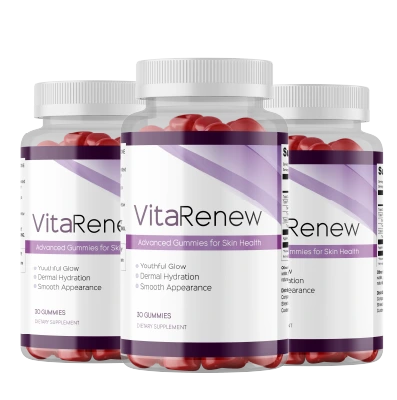
VitaRenew
Of the formulas we reviewed against this list, VitaRenew maps most directly to the cofactor model. It is a daily gummy that includes vitamin C, zinc, copper, vitamin E, selenium, and beta-carotene — the combination that addresses the enzymatic and antioxidant requirements in one formulation, rather than requiring a multi-product stack.
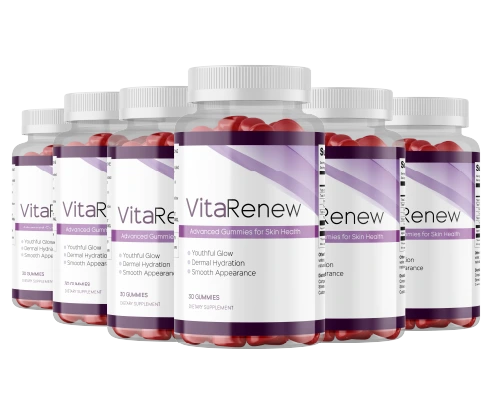
It is manufactured in an FDA-registered, GMP-certified facility and carries a 60-day money-back guarantee. It is sold as a one-time purchase with no subscription. The entry point — the 2-bottle option at $79 per bottle — is a reasonable starting window for evaluation, given that any meaningful dermal change requires at least eight weeks of consistent intake before assessment is meaningful.
It is a supplement, not a treatment. It supports skin, hair and nails — it does not diagnose, treat or cure any condition, and these statements have not been evaluated by the FDA.
Referenced in this article
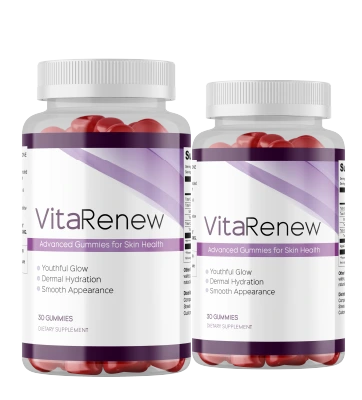
VitaRenew
Vitamin C, copper, zinc and antioxidant co-factors — the inputs the dermal repair process depends on, in one daily gummy.
The 2-bottle supply is where most readers start — 60 days is the minimum for a fair evaluation.
60-day money-back guarantee · One-time purchase, no subscriptionWhat the research says about realistic timelines
Skin's outer layers turn over on a cycle of roughly four to six weeks. Surface texture, tone, and moisture can shift within that window. The dermis is slower: collagen remodelling is a process of months, which is why the controlled trials in this area typically measure outcomes at 8 to 12 weeks rather than 4.
Individual variation is real and significant. Genetics, cumulative UV exposure, sleep quality, overall nutritional status, and — particularly for women in their forties and fifties — hormonal context all affect the starting point and the rate of change. Two women taking the same supplement for the same period of time can see meaningfully different outcomes, and both can be within the normal range for that product.
"I've taken a lot of supplements that promised something and delivered nothing obvious. After about ten weeks on VitaRenew I noticed my neck skin looked less crepey in photographs. Not dramatic. But consistent enough that I kept going."
— Sandra M., 54, verified purchaser
"My dermatologist mentioned collagen cofactors when I asked about skin supplements. I found VitaRenew had the copper and vitamin C she referenced. Six months in, the skin on my forearms feels different — less papery. My husband noticed before I said anything."
— Patricia L., 61, verified purchaser
Individual results vary. These testimonials represent personal experiences and may not reflect typical outcomes.
A clinical note: if you notice a skin change that is sudden, asymmetric, discoloured, or thickening — that is a question for a dermatologist, not a supplement. Age-related dermal thinning and sagging is gradual and symmetrical. Anything that does not fit that pattern should be professionally assessed.
The short version
Skin sags after 40 because the dermal scaffold — collagen and elastin fibres — thins and loses cross-linking over time. Two overlapping declines drive the acceleration in the forties: the long-running ~1% per year reduction in collagen synthesis, and the accelerated loss associated with declining estrogen. Topical products operate above this layer and have a real but structural ceiling.
The body retains the enzymatic capacity to rebuild dermal collagen, but that machinery depends on cofactors — vitamin C, copper, and zinc most directly — that are separate from amino acid supply and commonly underweighted in supplement formulations.
That is the case the research makes. What you choose to do with it is a personal decision.
Product referenced above
VitaRenew
The cofactor-first formula for skin, hair and nails. Made in an FDA-registered, GMP-certified facility.
Start with the 2-bottle supply — a full 60-day window to evaluate without committing to more.
60-day money-back guarantee · No subscription · Ships from the USBackground Reading
- Pullar JM, Carr AC, Vissers MCM. "The Roles of Vitamin C in Skin Health." Nutrients, 2017.
- Rucker RB et al. "Copper, lysyl oxidase, and extracellular matrix protein cross-linking." American Journal of Clinical Nutrition, 1998.
- Thornton MJ. "Estrogens and aging skin." Dermato-Endocrinology, 2013.
- Shuster S, Black MM, McVitie E. "The influence of age and sex on skin thickness, skin collagen and density." British Journal of Dermatology, 1975.
- Varani J et al. "Decreased collagen production in chronologically aged skin." American Journal of Pathology, 2006.
- Ogawa Y et al. "Zinc and skin disorders." Nutrients, 2018.