Longevity & Science · Skin Health
Will Crepey Skin Ever Go Away? What Really Happens After 40
The question contains two separate problems — and most articles answer only the pessimistic one. The full picture is more honest, and more useful, than either extreme.

You pressed the skin on the inside of your forearm — or across the back of your hand — and watched it settle slowly rather than spring back. The texture is there: fine, papery, a creasing that wasn't there ten years ago. And you typed the question that almost everyone asks and almost no one answers precisely: does it ever go away?
The honest answer depends on which part of the question you are asking. There are two distinct questions embedded in those five words, and conflating them produces either false reassurance or unnecessary resignation.
The two questions inside "will it go away"
The first is whether crepey skin resolves passively — whether the body, given time and no other intervention, will gradually undo the structural change that produced the texture. The answer to that question is no, and understanding why is more useful than the answer itself, because the same biology points directly at what actually matters.
The second question is whether the tissue where the change originated — the dermis — remains biologically capable of being supported. Whether the systems that built dermal structure are still functioning and responsive to input. That answer is more nuanced, and it is the one worth understanding in detail.
Why passive recovery does not happen
Crepey texture originates in the dermis — the dense layer of connective tissue beneath the outer surface of the skin. The dermis is a matrix of collagen fibres that provide thickness and mechanical firmness, elastin fibres that give skin its recoil, and water-binding molecules between them. When you press skin and it snaps back immediately, that is the dermis functioning normally. When it settles slowly or stays creased, the matrix has thinned.
Collagen production declines gradually from the mid-twenties — at roughly one percent per year by standard estimates. The cells responsible, fibroblasts, are still present in the dermis throughout our lives. What changes is the ratio between synthesis and degradation. Fibroblasts both build new collagen and respond to the continuous enzymatic degradation of old fibres; as the decades pass, the net balance shifts.
For most of the thirties this change is slow enough to go unnoticed. The change becomes apparent in the forties partly for a structural reason: estrogen plays an active and well-documented role in maintaining collagen density and dermal thickness. The hormonal transition of the perimenopausal years accelerates the collagen decline that was already underway. Two gradual processes converge at the same time — which is why the change so often feels sudden when it had actually been accumulating for years.
Passive recovery does not occur because the systems that produce collagen are not activated by the absence of collagen. Fibroblasts respond to mechanical signals, to tissue tension, and to the biochemical inputs required to run the synthesis pathway. Time alone does not supply those inputs. The system does not self-correct toward baseline.
The synthesis pathway — and its rate-limiting steps
Collagen synthesis is a multi-step biochemical process, and it has specific points where the pathway slows or stalls if particular inputs are unavailable. These are the levers that are actually accessible — and the ones that most skin formulations overlook in favor of the ingredient with better marketing.
Amino acids are the raw material from which collagen is assembled — predominantly glycine, proline, and hydroxyproline. For most adults in reasonably varied diets, amino acid supply is not the rate-limiting step. This is the most likely explanation for why oral collagen peptide trials produce variable results: in adequately nourished individuals, more raw material to a pathway that is stalled further downstream does not change the output.
Vitamin C is the cofactor for stabilization. After a collagen molecule is assembled from amino acids, it must be hydroxylated — converted into its functional triple-helix configuration. The enzymes that carry out this step, prolyl hydroxylase and lysyl hydroxylase, are strictly dependent on vitamin C as a cofactor. Without adequate vitamin C, assembled collagen is structurally unstable and degraded before it can be incorporated into the matrix. This is the well-established biochemistry of scurvy — the same connective tissue degradation mechanism documented in clinical medicine for over a century.
Copper is required for cross-linking. Newly synthesized collagen and elastin fibres exist initially as loose, soluble strands. An enzyme called lysyl oxidase assembles them into the tightly woven, mechanically load-bearing architecture that defines the dermis. Lysyl oxidase is strictly copper-dependent. Without adequate copper, fibres are produced but cannot be cross-linked into functional structure. The assembly line runs up to a point and stalls.
Zinc supports dermal maintenance across multiple pathways — fibroblast regulation, tissue repair signaling, and the continuous low-level processes that maintain the matrix throughout our lives.
The rate-limiting step in collagen synthesis is often not the raw material. It is the enzymatic cofactors. Providing more protein to a pathway stalled at the stabilization or cross-linking step does not change the output.
Referenced in this article
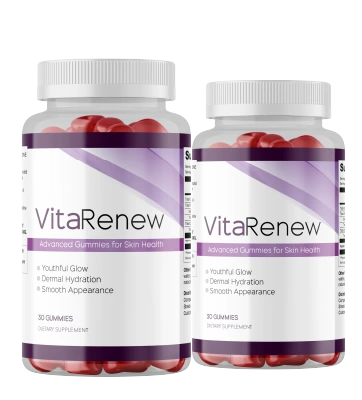
VitaRenew
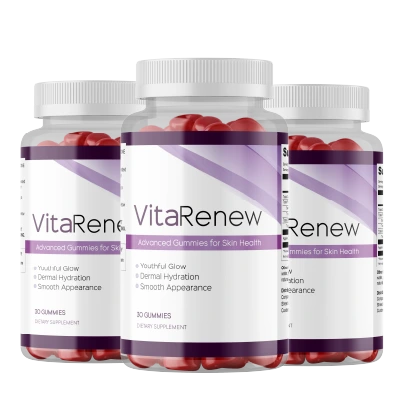
Vitamin C, zinc and copper — the three enzymatic cofactors collagen synthesis depends on — in a single daily gummy. Formulated around the step most products skip.
For the dermis that is still doing the work, with the inputs it actually needs.
60-day money-back guarantee · One-time purchase, no subscriptionWhat changes when the cofactors are present
The dermis is not static or inert. Fibroblasts remain active throughout adult life — continuously laying down new collagen, responding to tissue tension, running the low-level maintenance of the extracellular matrix. The question is not whether the system is running. It is whether it has what it needs to run the pathway to completion.
Research on vitamin C's role in collagen hydroxylation and copper's role in lysyl oxidase activity does not describe aspirational ingredients. These are the documented biochemical requirements of the pathway itself — requirements that have been characterized in connective tissue biology for decades. Ensuring those requirements are met may support the pathway running more efficiently.
The framing that the science supports: crepey skin does not resolve passively. The dermis is, however, a biologically active tissue still running collagen synthesis pathways throughout our lives. Providing those pathways with what they require to function may support dermal firmness over time. This is not a dramatic before-and-after claim. It is the mechanistic hypothesis that the biochemistry supports — one with a realistic timeline measured in months rather than weeks.
What women who have focused on this approach report
"My dermatologist told me the honest truth: there is no topical product that reaches the dermis in a meaningful way. So I started looking at what the dermis actually needs biochemically. I spent about four months on a supplement built around the vitamin C, copper and zinc cofactors. By month three the skin on my hands and inner arms was noticeably less tissue-paper in quality. Not a transformation — but a real change in a direction I had not seen from any cream."
"I want to be clear that I do not have a transformation story. What I have is skin that is less translucent and less papery than it was eight months ago, and I am less reluctant to wear sleeveless tops. I started because I understood the cofactor logic and wanted to test it properly. The 60-day guarantee meant I could actually evaluate it on a real timeline — not just hope something was working."
Individual experiences. Results vary and are not typical. No supplement can diagnose, treat, cure or prevent any disease or condition.
A practical note on timeline
The epidermis — the outermost skin layer — turns over approximately every four to six weeks. Improvements in surface texture and tone appear on this timescale, which is why products that work at the barrier level can produce noticeable changes in a month.
The dermis remodels more slowly. Collagen fibres and the matrix they form are not replaced on a monthly cycle. Published research evaluating nutritional approaches to dermal structure uses minimum evaluation windows of eight to twelve weeks — not because the researchers are being conservative, but because that is the pace of the biology. Three months is the practical floor for evaluating anything targeting the dermis. Six months provides a more complete picture.
Photograph in consistent light on day one. Changes in dermal quality are gradual enough to be invisible without a reference point. Individual response varies with baseline nutritional status, genetics, sun history, and factors outside the reach of any supplement.
Product referenced above
VitaRenew
Vitamin C, zinc and copper in a daily gummy. Made in an FDA-registered, GMP-certified facility. 60-day money-back guarantee.
The cofactor approach — the piece most formulas overlook.
60-day money-back guarantee · Supports skin, hair and nailsBackground reading
- Pullar JM, Carr AC, Vissers MCM. "The Roles of Vitamin C in Skin Health." Nutrients, 2017.
- Rucker RB et al. "Copper, lysyl oxidase, and extracellular matrix protein cross-linking." American Journal of Clinical Nutrition, 1998.
- Thornton MJ. "Estrogens and aging skin." Dermato-Endocrinology, 2013.
- Proksch E et al. "Oral supplementation of specific collagen peptides has beneficial effects on human skin physiology." Skin Pharmacology and Physiology, 2014.
- Ogawa Y et al. "Zinc and skin disorders." Nutrients, 2018.